

Written by students who passed Immediately available after payment Read online or as PDF Wrong document? Swap it for free 4.6 TrustPilot
logo-home
Document preview thumbnail
Preview 3 out of 19 pages
Exam (elaborations)

PCC Paving Inspection Exam 2026/2027 | 140+ Questions & Answers – Concrete Paving, Joints, Dowels, Curing & Quality Control | Louisiana DOTD

Document preview thumbnail
Preview 3 out of 19 pages

This comprehensive PCC Paving Inspection LADOTD 2026/2027 exam study guide contains approximately 140+ questions and answers across 19 pages, providing detailed preparation for personnel studying Portland Cement Concrete (PCC) pavement inspection and construction requirements associated with the Louisiana Department of Transportation and Development (LADOTD). The material covers concrete placement, finishing and texturing, slip-form and fixed-form paving, vibration and consolidation, joints, dowel and tie bars, curing, concrete temperature limits, batching and delivery, traffic control, quality control, compressive strength, pavement thickness and inspection responsibilities. The opening section focuses extensively on PCC surface finishing and pavement texture. Students review allowable surface variation near slab edges, carpet-drag and metal-tine texturing, mechanical and handheld floating, longitudinal tube floats, bull floats, straightedge operations, strike-off bars and machine versus hand finishing. The document specifies practical inspection details such as setting the longitudinal tube float at a 45-degree angle to the pavement centerline, using straightedges to identify surface irregularities and applying water only as an approved fog spray when permitted during finishing. A major section addresses concrete placement, consolidation and field quality control. Questions cover internal and handheld vibrators, over-vibration, dowel assemblies, base preparation, batch certification forms, slump and air testing, jobsite water additions, agitating versus non-agitating delivery equipment and concrete placement time limits. The guide also reviews the responsibilities of the contractor's certified technician for mix-design development and quality control, as well as scale and meter calibration and requirements associated with the master proportioning table. The document provides particularly detailed coverage of PCC pavement joints. Students review transverse and longitudinal joints, Type CJ construction joints, Type EJ expansion joints, transverse butt joints, longitudinal construction joints, contraction joints, keyways and sleeper slabs. It explains that joints are used to manage cracking and movement in concrete pavement and examines when specific joint types are required. Questions also cover joint spacing, sawing, expansion sleeves, joint fillers, backing material, sealant depth and the use of compression seals. Dowel bars and tie bars receive extensive attention because of their importance to pavement performance. The guide distinguishes their functions: dowels provide load transfer across pavement joints, while tie bars help hold adjacent slabs together. Students review placement at approximately one-half the pavement thickness, dowel basket assemblies, smooth dowels for specified construction joints, epoxy-related requirements for butt joints and the consequences of improper dowel positioning. Joint sealing is likewise covered in depth, including silicone and polyurethane sealants, compression seals, lubricant adhesives, joint cleaning and prevention of water and incompressible-material infiltration. Another important section covers curing, weather limitations and pavement protection. The questions address white-pigmented curing compound, minimum curing periods, protection against rain using polyethylene sheeting, hot-weather evaporation and shrinkage cracking, concrete temperature restrictions and strength requirements before mechanical equipment can operate on completed pavement. Students also review form-removal timing and curing-compound coverage rates, making this portion particularly relevant to field inspection and acceptance decisions. The final pages integrate LADOTD specifications, concrete mixture requirements and acceptance criteria. Topics include PCC plant certification, scale accuracy, form dimensions and staking, grade stakes, slip-form paver components, vibration frequencies, Type B pavement slump, compressive-strength requirements, thickness-related payment adjustments and initial concrete set. Page 18, for example, tests pavement acceptance concepts involving lot-average compressive strength, percentage payment for thickness deviations, concrete temperature and minimum strength before equipment operation. Traffic-control responsibilities are also included. The document states that traffic-control management plans are generally expected to comply with the Manual on Uniform Traffic Control Devices (MUTCD) unless otherwise specified and tests requirements involving written traffic-control changes and traffic-control diaries. These concepts are supported by the Federal Highway Administration's MUTCD, which establishes national standards for traffic-control devices used on streets, highways and other public roadways. FHWA Manual on Uniform Traffic Control Devices For authoritative technical study, students should compare numerical answers in this review with the current Louisiana DOTD Standard Specifications, project plans, special provisions and applicable testing procedures. Construction specifications can change between editions, and project-specific requirements may supersede general provisions. The official Louisiana Department of Transportation and Development should therefore be treated as the primary source for current Louisiana highway construction requirements. Relevant Students: This document is particularly relevant for Louisiana DOTD PCC paving inspection candidates, LADOTD inspectors, transportation engineering technicians, highway construction inspectors, concrete paving inspectors, contractor quality-control technicians, construction engineering students and personnel preparing for PCC pavement inspection certification or assessment. It is especially useful for learners who need detailed review of concrete placement, paving equipment, joint construction, dowels, tie bars, curing, concrete testing, quality control and pavement acceptance. APA References: Federal Highway Administration. (2023). Manual on Uniform Traffic Control Devices for Streets and Highways (11th ed.). U.S. Department of Transportation. FHWA MUTCD Louisiana Department of Transportation and Development. (n.d.). Louisiana Department of Transportation and Development. State of Louisiana. Louisiana DOTD Keywords: PCC Paving Inspection Exam, PCC Paving Inspection LADOTD, LADOTD PCC exam, LADOTD paving inspection, Louisiana DOTD paving inspection, PCC inspection questions and answers, PCC paving study guide, PCC paving exam 2026, PCC paving exam 2027, Portland cement concrete pavement, concrete pavement inspection, concrete paving inspector, highway construction inspection, concrete finishing, concrete texturing, carpet drag, metal tine texture, slip form paving, fixed form paving, concrete straightedge, concrete vibration, concrete consolidation, concrete slump test, concrete air test, PCC quality control, concrete batch certification, concrete curing, curing compound, concrete temperature limits, pavement joints, transverse construction joint, transverse expansion joint, longitudinal construction joint, contraction joints, pavement joint sealing, dowel bars, dowel basket assemblies, tie bars, pavement load transfer, keyway concrete, compression seals, joint sealant, concrete compressive strength, pavement thickness inspection, traffic control plan, MUTCD, LADOTD specifications, Louisiana highway construction, PCC inspector certification

Content preview

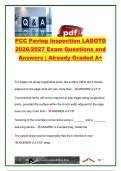
PCC Paving Inspection LADOTD
2026/2027 Exam Questions and
Answers | Already Graded A+


For edges not along longitudinal joints, the surface within the 6 inches

adjacent to the edge shall not vary more than - ANSWER ✔✔1/4"


Conventional forms will not be required at slab edges along longitudinal

joints, provided the surface within the 6 inch width adjacent to the edge

does not vary more than - ANSWER ✔✔1/8"


Texturing of the concrete is to be done using a _______ and a ________

texturing device - ANSWER ✔✔carpet drag; metal tine


The carpet drag must be reasonably free from indentions over -

ANSWER ✔✔1/16" deep

,In slip form paving, the drag is usually attached to the - ANSWER

✔✔longitudinal float machine


Two approved methods of floating are - ANSWER ✔✔mechanical

and hand held

The longitudinal tube float is set at a __ angle to the centerline of the

slab. - ANSWER ✔✔45 degree


Following the mechanical, longitudinal tube float, the _____________

float may be used to smooth and fill open textured pavement areas. -

ANSWER ✔✔hand held


The vibratory, longitudinal bull float is only used - ANSWER ✔✔over

joints

T/F Excess water and loose material should be removed from the

surface with a 10 foot, metal, static straightedge. - ANSWER ✔✔True


T/F The handle of a straightedge must be approximately 5 foot longer

than 1/2 the width of the pavement slab. - ANSWER ✔✔False


T/F When working the straightedge, the blade is first worked at a 45

degree angle to the centerline and then with the blade parallel to the

centerline. - ANSWER ✔✔True

, T/F The straightedge operations should advance along the concrete slab

in successive stages of 5 feet. - ANSWER ✔✔True


T/F When performing straightedge operations, water may be thrown on

the surface to make the work easier. - ANSWER ✔✔False


If the application of water to the concrete surface is permitted during

finishing operations, it shall be applied as - ANSWER ✔✔fog spray


Screeds yield the _____ grade of the concrete slab - ANSWER

✔✔initial


_________ finishing will be required on all highway pavements or

_____, regardless of width. - ANSWER ✔✔Machine; ramps


Under what conditions will hand finishing be permitted? - ANSWER

✔✔1. If mechanical equipment breaks down. 2. Pavement not a principal

highway and width does not exceed 16 ft. 3. Area has regular

dimensions.


T/F A strike off bar is used to level the concrete. - ANSWER ✔✔True


T/F Prior to concrete placement and the paver in place, th DOTD

Inspector should use a string line to make sure the strike off is true to

line. - ANSWER ✔✔True


COPYRIGHT©PROFFKERRYMARTIN 2025/2026. YEAR PUBLISHED 2026. COMPANY REGISTRATION NUMBER: 619652435. TERMS OF USE.
PRIVACY STATEMENT. ALL RIGHTS RESERVED


Document information

Uploaded on
August 7, 2026
Number of pages
19
Written in
2026/2027
Type
Exam (elaborations)
Contains
Questions & answers
$18.99

Wrong document? Swap it for free Within 14 days of purchase and before downloading, you can choose a different document. You can simply spend the amount again.
Written by students who passed
Immediately available after payment
Read online or as PDF

Seller avatar
Reputation scores are based on the amount of documents a seller has sold for a fee and the reviews they have received for those documents. There are three levels: Bronze, Silver and Gold. The better the reputation, the more your can rely on the quality of the sellers work.
PROFFKERRYMARTIN
3.3
(55)
Sold
286
Followers
9
Items
11175
Last sold
21 hours ago


Why students choose Stuvia

Created by fellow students, verified by reviews

Quality you can trust: written by students who passed their tests and reviewed by others who've used these notes.

Didn't get what you expected? Choose another document

No worries! You can instantly pick a different document that better fits what you're looking for.

Pay as you like, start learning right away

No subscription, no commitments. Pay the way you're used to via credit card and download your PDF document instantly.

Student with book image

“Bought, downloaded, and aced it. It really can be that simple.”

Alisha Student

Working on your references?

Create accurate citations in APA, MLA and Harvard with our free citation generator.

Working on your references?

Frequently asked questions
