

Written by students who passed Immediately available after payment Read online or as PDF Wrong document? Swap it for free 4.6 TrustPilot
logo-home
Document preview thumbnail
Preview 2 out of 11 pages
Exam (elaborations)

NEIEP 200 Final Review 2026/2027 | 70 Questions & Answers – Wire Rope, Governors, Safeties, Rails & Elevator Installation | NEIEP

Document preview thumbnail
Preview 2 out of 11 pages

This comprehensive NEIEP 200 Final Review 2026/2027 contains 70 exam questions with correct answers across 11 pages, designed for focused preparation in elevator construction, installation, safety and mechanical systems. The material covers wire rope construction and handling, counterweights, car and counterweight safeties, governors, terminal and final limit switches, buffers, guide rails, hoistway installation, rigging, reeving, elevator machines, cab modernization and jobsite safety. It combines technical definitions with calculations and practical installation scenarios, making it particularly useful for apprentices preparing for a NEIEP 200 final examination. A major portion of the review addresses elevator suspension ropes, rigging and hoisting practices. Questions cover regular lay and Lang lay rope, preformed rope, 6 × 19 Seale construction, improved plow steel, constructional and elastic stretch, rope wedge clamps, Crosby clips, rope seizings, resocketing and rope safety factors. Students also work through applied calculations involving counterweight loading, rope stretch, reeving ratios and equipment weights. One question, for example, requires determining the appropriate reeving arrangement for lifting a 14,500-pound machine with a 4,000-pound-capacity portable hoist, while another compares the speed and capacity effects of changing a machine from 1:1 to 2:1 roping. The elevator safety and motion-control section reviews car and counterweight safeties, Type C safeties, overspeed governors, electrical overspeed switches, terminal motion switches, directional limits and final limit switches. Students examine the mechanical relationship between the governor rope and car safety, governor tension sheaves, counterweight safety requirements and the circumstances in which oil buffers are required. The document also tests practical concepts such as runby, buffer clearance, traction loss and preventing an elevator car from being pulled into the overhead. Guide-rail and hoistway installation receive similarly detailed treatment. The questions cover T-rails, formed guide rails, rail brackets, spreaders, tongue-and-groove rail joints, staggered rail installation, DBB/DBG measurements, bayonet gauges, benchmarks, spud wrenches and hoistway plumbing. Students review how corridor lines and outside rails are used as reference points when laying out a bank of elevators and how final layout drawings determine equipment placement. These questions combine measurement knowledge with the practical procedures required during elevator installation. The guide also emphasizes tools, construction practices and occupational safety. It reviews scaffold-grade lumber, capstans, ladders, rollers, compound miter saws, circular saws, hacksaws, strap and spud wrenches, portable working platforms, safety glasses and ABC fire extinguishers. Other applied questions address carpet calculations, laminated elevator-cab glass, handling freight platforms and storing T-rails. Together, these topics reinforce the relationship between technical installation knowledge and safe work practices. Later questions examine geared and gearless machines, drive sheaves, machine RPM, U-grooves, double-wrapped secondary sheaves, machine bedplate tie-downs, load-weighing transducers, cab modernization and group controllers. The document therefore extends beyond basic installation into the operating principles of traction elevator equipment and modernization work. The final page consolidates these concepts with calculations involving roping ratios, load capacity, speed, counterweight blocking and rope stretch. The subject matter is consistent with the elevator-industry training associated with the National Elevator Industry Educational Program (NEIEP) and repeatedly references ASME elevator safety requirements within the questions. For authoritative technical verification, students should consult the applicable edition of ASME A17.1/CSA B44, Safety Code for Elevators and Escalators, because code requirements can vary by adopted edition and jurisdiction. ASME A17.1/CSA B44 Elevator and Escalator Safety Code Relevant Students: This document is particularly relevant for NEIEP 200 students, elevator constructor apprentices, International Union of Elevator Constructors (IUEC) apprentices, elevator installation trainees, elevator mechanics reviewing foundational material, and students preparing for a NEIEP 200 final assessment. It is especially valuable for learners who need exam-focused practice involving wire ropes, rigging, governors, safeties, guide rails, buffers, traction equipment and elevator installation calculations. APA Reference: American Society of Mechanical Engineers. (2022). ASME A17.1/CSA B44: Safety code for elevators and escalators. ASME. ASME A17.1/CSA B44 Keywords: NEIEP 200 Final Review, NEIEP 200 final exam, NEIEP 200 questions and answers, NEIEP 200 study guide, NEIEP 200 2026, NEIEP 200 2027, elevator apprenticeship exam, elevator constructor apprentice, elevator installation exam, elevator mechanic study guide, elevator wire rope, regular lay wire rope, Lang lay rope, preformed wire rope, rope stretch calculation, elevator counterweight, counterweight calculation, elevator safeties, Type C safety, elevator governor, overspeed governor, governor tension sheave, elevator buffers, oil buffers, terminal motion switch, final limit switch, elevator runby, guide rail installation, T rail installation, rail brackets, elevator hoistway, hoistway plumbing, elevator rigging, reeving calculation, Crosby clips, rope wedge clamps, elevator traction, geared elevator machine, gearless elevator machine, drive sheave, elevator cab modernization, group controller, load weighing transducers, ASME A17.1, elevator safety code, IUEC apprentice exam, elevator construction training, NEIEP exam preparation

Content preview

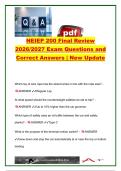
NEIEP 200 Final Review
2026/2027 Exam Questions and
Correct Answers | New Update


Which lay of wire rope has the strand wires in line with the rope axis? -

ANSWER ✔✔Regular Lay


At what speed should the counterweight safeties be set to trip? -

ANSWER ✔✔Up to 10% higher than the car governor


Which type of safety uses an oil buffer between the car and safety

planks? - ANSWER ✔✔Type C


What is the purpose of the terminal motion switch? - ANSWER

✔✔slow down and stop the car automatically at or near the top or bottom

landing

, If you have a 3500 lb. car rated at 4000 lbs. capacity, how much should

the counterweight assembly weigh for a normal 40% installation? -

ANSWER ✔✔5100 lbs.


When the pit directional limit switch is actuated, the normal circuits will

allow the car to run - ANSWER ✔✔Up


_______should not be disassembled in the field. - ANSWER ✔✔Oil

Buffers

The loss of traction between the hoist ropes and the machine driver

when the counterweight lands on its buffer avoids... - ANSWER

✔✔The elevator car being pulled into the over head.


Refer to Table 1. With a safety factor of 5, what is the breaking strength

for 1 1/8" nylon rope? - ANSWER ✔✔52,000 lbs.


Which of the following applies to rope usage? - ANSWER ✔✔Prevent

manila rope from unraveling by using whipping.

What does the designation 3/8" 6 X 30 improved plow steel mean? -

ANSWER ✔✔It is a high strength cable with 6 strands composed of

30 wires per strand?

Document information

Uploaded on
August 7, 2026
Number of pages
11
Written in
2026/2027
Type
Exam (elaborations)
Contains
Questions & answers
$18.99

Wrong document? Swap it for free Within 14 days of purchase and before downloading, you can choose a different document. You can simply spend the amount again.
Written by students who passed
Immediately available after payment
Read online or as PDF

Seller avatar
Reputation scores are based on the amount of documents a seller has sold for a fee and the reviews they have received for those documents. There are three levels: Bronze, Silver and Gold. The better the reputation, the more your can rely on the quality of the sellers work.
PROFFKERRYMARTIN
3.3
(55)
Sold
281
Followers
9
Items
11103
Last sold
15 hours ago


Why students choose Stuvia

Created by fellow students, verified by reviews

Quality you can trust: written by students who passed their tests and reviewed by others who've used these notes.

Didn't get what you expected? Choose another document

No worries! You can instantly pick a different document that better fits what you're looking for.

Pay as you like, start learning right away

No subscription, no commitments. Pay the way you're used to via credit card and download your PDF document instantly.

Student with book image

“Bought, downloaded, and aced it. It really can be that simple.”

Alisha Student

Working on your references?

Create accurate citations in APA, MLA and Harvard with our free citation generator.

Working on your references?

Frequently asked questions

