

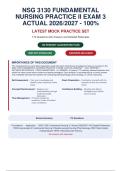
NSG 3130 FUNDAMENTAL
NURSING PRACTICE II EXAM 3
ACTUAL 2026/2027 - 100%
LATEST MOCK PRACTICE SET
170 Questions with Answers and Detailed Rationales
100 PERCENT GUARANTEED PASS
INSTANT DOWNLOAD ANSWERS INCLUDED
IMPORTANCE OF THIS DOCUMENT
This comprehensive examination preparation guide has been meticulously developed to help you succeed in the
NSG 3130 FUNDAMENTAL NURSING PRACTICE II EXAM 3 ACTUAL 2026/2027 - 100% VERIFIED |
DETAILED RATIONALES - PASS GUARANTEED - A+ GRADED. It contains 170 carefully selected questions that
reflect the most current exam content and testing strategies. Each question is accompanied by a correct answer
and a detailed rationale that explains the underlying pathophysiology, pharmacology, or clinical reasoning.
Self-Assessment – Test your knowledge and Exam Preparation – Familiarize yourself with the
identify areas requiring further question format and content
study areas
Concept Reinforcement – Deepen your Confidence Building – Develop test-taking
understanding through strategies and reduce
evidence-based exam anxiety
rationales
Time Management – Practice answering
questions under simulated
exam conditions
Review Summary 170 Questions
Foundations - Application - NSG 3130 Fundamental Nursing II 3 Actual 2026/2027 100 Detailed Rationales
PASS Guaranteed A Fundamental Nursing II Medical-surgical Nursing Pharmacology AND Patient Safety
Undergraduate YEAR 3 Baccalaureate Nursing
All answers with rationales
,Table of Contents
Section A - Blood Section B - Finding
Questions 1 to 43 Questions 44 to 86
Section C - Receiving Section D - Transfusion
Questions 87 to 129 Questions 130 to 170
,Section A - Blood
Q1.
In a patient receiving a continuous infusion of norepinephrine, the mean arterial pressure
(MAP) suddenly drops from 70 to 55 mm Hg. The nurse notes the infusion site is pale and
edematous. Which action should the nurse take FIRST?
A. Increase the norepinephrine infusion rate B. Stop the infusion and assess for
to restore MAP. extravasation.
C. Flush the IV line with normal saline to D. Administer a bolus of IV fluids to increase
ensure patency. preload.
Correct: B - Stop the infusion and assess for extravasation.
Rationale:The signs indicate extravasation of a vesicant; continuing the infusion would
worsen tissue damage. The priority is to stop the infusion and manage extravasation.
Increasing the rate or flushing could exacerbate injury. IV fluids may be needed later but not
before addressing the infiltration.
Q2.
Which of the following represents the most critical nursing action to prevent
ventilator-associated pneumonia (VAP) in an intubated patient?
A. Elevate the head of the bed to 30-45 B. Change the ventilator circuit every 24
degrees. hours.
C. Administer prophylactic antibiotics as D. Perform oral care with chlorhexidine
ordered. twice daily.
Correct: A - Elevate the head of the bed to 30-45 degrees.
Rationale:Head-of-bed elevation is a core evidence-based intervention to reduce aspiration
and VAP risk. Ventilator circuit changes are no longer recommended daily. Prophylactic
antibiotics are not standard and can promote resistance. Oral care is important but head
elevation is the most critical mechanical measure.
Q3.
A patient with heart failure is receiving furosemide 40 mg IV push. Which laboratory value
requires immediate nursing intervention?
A. Serum potassium 3.2 mEq/L B. Serum sodium 138 mEq/L
C. Serum creatinine 1.0 mg/dL D. Serum magnesium 1.8 mEq/L
Correct: A - Serum potassium 3.2 mEq/L
Page 3
, Section A - Blood
Rationale: Furosemide causes potassium loss; hypokalemia (K+ < 3.5) increases risk of
dysrhythmias, especially digoxin toxicity. Sodium is normal. Creatinine is normal. Magnesium
is low-normal but not the priority compared to potassium.
Q4.
A nurse is preparing to administer a medication that is a weak acid. Which statement best
describes the drug's absorption in the gastrointestinal tract?
A. It will be mostly ionized in the acidic B. It will be mostly non-ionized in the acidic
stomach and poorly absorbed. stomach and well absorbed.
C. It will be mostly non-ionized in the D. Absorption is independent of pH because
alkaline intestine and well absorbed. it is a weak acid.
Correct: B - It will be mostly non-ionized in the acidic stomach and well absorbed.
Rationale:Weak acids are non-ionized in acidic environments, allowing them to cross cell
membranes easily. In the stomach (pH ~1-2), the drug is largely non-ionized and absorbed. In
the intestine, it becomes ionized and less absorbable. pH-independent absorption is false.
Q5.
During a blood transfusion, a patient develops hypotension, dyspnea, and flank pain. The
nurse's priority action is to:
A. Slow the transfusion and notify the B. Stop the transfusion and maintain IV
provider. access with normal saline.
C. Administer diphenhydramine as ordered. D. Recheck vital signs and continue if
stable.
Correct: B - Stop the transfusion and maintain IV access with normal saline.
Rationale:These signs indicate a hemolytic transfusion reaction. The transfusion must be
stopped immediately to prevent further reaction. IV access is maintained with saline for
emergency drugs. Slowing is not appropriate; the reaction is acute. Diphenhydramine is for
allergic reactions, not hemolytic.
Q6.
Which of the following is the most reliable indicator of adequate tissue perfusion in a
patient with sepsis?
A. Mean arterial pressure (MAP) 65 mm Hg B. Urine output of 0.5 mL/kg/hr
C. Lactate level < 2 mmol/L D. Central venous oxygen saturation
(ScvO2) 70%
Correct: C - Lactate level < 2 mmol/L
Page 4
NURSING PRACTICE II EXAM 3
ACTUAL 2026/2027 - 100%
LATEST MOCK PRACTICE SET
170 Questions with Answers and Detailed Rationales
100 PERCENT GUARANTEED PASS
INSTANT DOWNLOAD ANSWERS INCLUDED
IMPORTANCE OF THIS DOCUMENT
This comprehensive examination preparation guide has been meticulously developed to help you succeed in the
NSG 3130 FUNDAMENTAL NURSING PRACTICE II EXAM 3 ACTUAL 2026/2027 - 100% VERIFIED |
DETAILED RATIONALES - PASS GUARANTEED - A+ GRADED. It contains 170 carefully selected questions that
reflect the most current exam content and testing strategies. Each question is accompanied by a correct answer
and a detailed rationale that explains the underlying pathophysiology, pharmacology, or clinical reasoning.
Self-Assessment – Test your knowledge and Exam Preparation – Familiarize yourself with the
identify areas requiring further question format and content
study areas
Concept Reinforcement – Deepen your Confidence Building – Develop test-taking
understanding through strategies and reduce
evidence-based exam anxiety
rationales
Time Management – Practice answering
questions under simulated
exam conditions
Review Summary 170 Questions
Foundations - Application - NSG 3130 Fundamental Nursing II 3 Actual 2026/2027 100 Detailed Rationales
PASS Guaranteed A Fundamental Nursing II Medical-surgical Nursing Pharmacology AND Patient Safety
Undergraduate YEAR 3 Baccalaureate Nursing
All answers with rationales
,Table of Contents
Section A - Blood Section B - Finding
Questions 1 to 43 Questions 44 to 86
Section C - Receiving Section D - Transfusion
Questions 87 to 129 Questions 130 to 170
,Section A - Blood
Q1.
In a patient receiving a continuous infusion of norepinephrine, the mean arterial pressure
(MAP) suddenly drops from 70 to 55 mm Hg. The nurse notes the infusion site is pale and
edematous. Which action should the nurse take FIRST?
A. Increase the norepinephrine infusion rate B. Stop the infusion and assess for
to restore MAP. extravasation.
C. Flush the IV line with normal saline to D. Administer a bolus of IV fluids to increase
ensure patency. preload.
Correct: B - Stop the infusion and assess for extravasation.
Rationale:The signs indicate extravasation of a vesicant; continuing the infusion would
worsen tissue damage. The priority is to stop the infusion and manage extravasation.
Increasing the rate or flushing could exacerbate injury. IV fluids may be needed later but not
before addressing the infiltration.
Q2.
Which of the following represents the most critical nursing action to prevent
ventilator-associated pneumonia (VAP) in an intubated patient?
A. Elevate the head of the bed to 30-45 B. Change the ventilator circuit every 24
degrees. hours.
C. Administer prophylactic antibiotics as D. Perform oral care with chlorhexidine
ordered. twice daily.
Correct: A - Elevate the head of the bed to 30-45 degrees.
Rationale:Head-of-bed elevation is a core evidence-based intervention to reduce aspiration
and VAP risk. Ventilator circuit changes are no longer recommended daily. Prophylactic
antibiotics are not standard and can promote resistance. Oral care is important but head
elevation is the most critical mechanical measure.
Q3.
A patient with heart failure is receiving furosemide 40 mg IV push. Which laboratory value
requires immediate nursing intervention?
A. Serum potassium 3.2 mEq/L B. Serum sodium 138 mEq/L
C. Serum creatinine 1.0 mg/dL D. Serum magnesium 1.8 mEq/L
Correct: A - Serum potassium 3.2 mEq/L
Page 3
, Section A - Blood
Rationale: Furosemide causes potassium loss; hypokalemia (K+ < 3.5) increases risk of
dysrhythmias, especially digoxin toxicity. Sodium is normal. Creatinine is normal. Magnesium
is low-normal but not the priority compared to potassium.
Q4.
A nurse is preparing to administer a medication that is a weak acid. Which statement best
describes the drug's absorption in the gastrointestinal tract?
A. It will be mostly ionized in the acidic B. It will be mostly non-ionized in the acidic
stomach and poorly absorbed. stomach and well absorbed.
C. It will be mostly non-ionized in the D. Absorption is independent of pH because
alkaline intestine and well absorbed. it is a weak acid.
Correct: B - It will be mostly non-ionized in the acidic stomach and well absorbed.
Rationale:Weak acids are non-ionized in acidic environments, allowing them to cross cell
membranes easily. In the stomach (pH ~1-2), the drug is largely non-ionized and absorbed. In
the intestine, it becomes ionized and less absorbable. pH-independent absorption is false.
Q5.
During a blood transfusion, a patient develops hypotension, dyspnea, and flank pain. The
nurse's priority action is to:
A. Slow the transfusion and notify the B. Stop the transfusion and maintain IV
provider. access with normal saline.
C. Administer diphenhydramine as ordered. D. Recheck vital signs and continue if
stable.
Correct: B - Stop the transfusion and maintain IV access with normal saline.
Rationale:These signs indicate a hemolytic transfusion reaction. The transfusion must be
stopped immediately to prevent further reaction. IV access is maintained with saline for
emergency drugs. Slowing is not appropriate; the reaction is acute. Diphenhydramine is for
allergic reactions, not hemolytic.
Q6.
Which of the following is the most reliable indicator of adequate tissue perfusion in a
patient with sepsis?
A. Mean arterial pressure (MAP) 65 mm Hg B. Urine output of 0.5 mL/kg/hr
C. Lactate level < 2 mmol/L D. Central venous oxygen saturation
(ScvO2) 70%
Correct: C - Lactate level < 2 mmol/L
Page 4


