

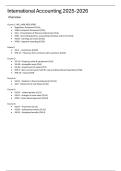
International Accounting 2025-2026
Overview
Course 1: IAS 1, IAS8, IAS33, IFRS8
• Regulatory framework (Ch1),
• IASB conceptual framework (Ch2),
• IAS1 - Presentation of financial statements (Ch3),
• IAS8 - Accounting policies, accounting estimates and errors (Ch4)
• IAS33 - Earnings per share (Ch23)
• IFRS8 - Segment reporting (Ch24)
Course 2:
• IAS 2 – Inventories (Ch10)
• IFRS 15 – Revenue from contracts with customers (Ch13)
Course 3:
• IAS 16 –Property, plant & equipment (Ch5)
• IAS 38 –Intangible asset (Ch6)
• IAS 36 –Impairment of assets (Ch7)
• IFRS 5 –Non-current assets held for sale and discontinued operations (Ch8)
• IFRS 16 –Leases (Ch9)
Course 4:
• IAS12 - Taxation in financial statements (Ch15)
• IAS7 - Statement of cash flows (Ch16)
Course 5:
• IAS24 - related parties (ch21)
• IAS21 - changes in forex rates (Ch21)
• IFRS2 - Share based payments (Ch14)
Course 6:
• IAS37 – Provisions (Ch12)
• IAS10 – Subsequent events (Ch12)
• IAS19 – Employee benefits (Ch14)
,Course 1: IAS 1, IAS8, IAS33, IFRS8
Agenda
Introduction (facilitators, objectives, materials, format, exam)
Chapter 1 – Regulatory framework
Chapter 2 – Conceptual framework for financial reporting
Chapter 3 – Presentation of financial statements (IAS1)
Chapter 4 – Accounting policies, accounting estimates and errors (IAS8)
Chapter 5 – Earnings per share (IAS33)
Chapter 6 – Segment reporting (IFRS8)
Chapters correlate with the handbook!
Overall objectives of the course
• The objective of this course is to illustrate how IFRS accounting standards and the judgment used within the
IFRS accounting framework affect financial statements.
• As a user, ask the right questions when analyzing the financial statements of a company
• Be critical when comparing financial statements of different companies
Key learning outcomes
• Improved understanding of IFRS accounting standards
• Be able to demonstrate how accounting standards (IFRS) influence the accounting fundamentals and the financial
statements
• Be able to show how the level of judgment used within an accounting framework influence the main accounting
fundamentals (earnings and equity).
• Prerequisite: basic knowledge of accounting concepts
Course materials – primary materials
• Book MELVILLE ALAN: ‘International Financial Reporting, A Practical Guide, Pearson’
• Hand-outs (slides): summary of the key aspects of the handbook
→Important: exercises in the handbook!
Handbook is most important but e-learning can push your knowledge to a higher
level
Other materials
E-learnings of the IFRS/IAS standards: https://www.deloitteifrslearning.com/
Useful website addresses:
- IASB: http://www.ifrs.org/Pages/default.aspx
- Deloitte: http://www.iasplus.com/en
- EY: http://www.ey.com/BE/en/Issues/IFRS
- KPMG: http://www.kpmg.com/global/en/topics/global-ifrs-institute/Pages/default.aspx
- PwC: https://www.pwc.com/gx/en/services/audit-assurance/ifrs-reporting.html
, Teaching format
• Lectures - Standard format / topic
– IFRS standard and the judgment needed
– Exercises/examples to get familiar with the topic
• E-learnings of the IFRS/IAS standards
Assessment method
• Open book exam
• All materials can be brought to the exam (handbook, slides, other)
• Typical structure of the exam:
– Multiple choice (without guessing correction) (2/3)
– Exercises/Open questions (1/3) → fairly short questions (no long answers needed)
Usefulness of accounting
Accounting is relevant as it summarizes financial information
• A firm’s financial statements support the decision making of different stakeholders as the primary objective of
financial statements
−Acquisitions or mergers
−Buying/Selling shares
−Getting a loan
−…
• Stakeholders: owners, employees, suppliers, banks, …
- Bank: will look at the cashflows to see if they would be able to repay
Depending on who you are you will ask different questions and find different numbers important
Remember the objectives of the course
• Illustrate how IFRS accounting standards and the judgment used within the IFRS accounting framework affect
financial statements.
• Ask the right questions when analysing the financial statements of a company
• Be critical when comparing financial statements of different companies
Let’s look at an example…
, Specific example – beer industry
• AB InBev
• Heineken
• Molson Coors
• Benchmarking useful and necessary:
– cross-sectional (comparing different companies)
– time series analysis (one company over a longer period)
• Ratio analysis is a common tool to provide useful information for decision making
Next exercise will be about specific points in time and specific companies
Financial ratios
Profitability ratios (reasonable profit level) Some examples:
−Is a company successful at generating profits • Return On Equity = profit / equity
over a time period? • Return On Assets = EBIT (=operating profit) / total
−A reasonable profit margin for long term survival assets
Liquidity (short-term ability to pay debt)
−Does a company have the short-term ability to
pay its maturing obligations? • Current ratio = current assets / current liabilities
−Essential for short-term survival
Leverage (appropriate long-term debt level)
−A protection for long-term creditors and • Debt / equity ratio
investors
−A firm should have an appropriate level of
borrowing
Overview
Course 1: IAS 1, IAS8, IAS33, IFRS8
• Regulatory framework (Ch1),
• IASB conceptual framework (Ch2),
• IAS1 - Presentation of financial statements (Ch3),
• IAS8 - Accounting policies, accounting estimates and errors (Ch4)
• IAS33 - Earnings per share (Ch23)
• IFRS8 - Segment reporting (Ch24)
Course 2:
• IAS 2 – Inventories (Ch10)
• IFRS 15 – Revenue from contracts with customers (Ch13)
Course 3:
• IAS 16 –Property, plant & equipment (Ch5)
• IAS 38 –Intangible asset (Ch6)
• IAS 36 –Impairment of assets (Ch7)
• IFRS 5 –Non-current assets held for sale and discontinued operations (Ch8)
• IFRS 16 –Leases (Ch9)
Course 4:
• IAS12 - Taxation in financial statements (Ch15)
• IAS7 - Statement of cash flows (Ch16)
Course 5:
• IAS24 - related parties (ch21)
• IAS21 - changes in forex rates (Ch21)
• IFRS2 - Share based payments (Ch14)
Course 6:
• IAS37 – Provisions (Ch12)
• IAS10 – Subsequent events (Ch12)
• IAS19 – Employee benefits (Ch14)
,Course 1: IAS 1, IAS8, IAS33, IFRS8
Agenda
Introduction (facilitators, objectives, materials, format, exam)
Chapter 1 – Regulatory framework
Chapter 2 – Conceptual framework for financial reporting
Chapter 3 – Presentation of financial statements (IAS1)
Chapter 4 – Accounting policies, accounting estimates and errors (IAS8)
Chapter 5 – Earnings per share (IAS33)
Chapter 6 – Segment reporting (IFRS8)
Chapters correlate with the handbook!
Overall objectives of the course
• The objective of this course is to illustrate how IFRS accounting standards and the judgment used within the
IFRS accounting framework affect financial statements.
• As a user, ask the right questions when analyzing the financial statements of a company
• Be critical when comparing financial statements of different companies
Key learning outcomes
• Improved understanding of IFRS accounting standards
• Be able to demonstrate how accounting standards (IFRS) influence the accounting fundamentals and the financial
statements
• Be able to show how the level of judgment used within an accounting framework influence the main accounting
fundamentals (earnings and equity).
• Prerequisite: basic knowledge of accounting concepts
Course materials – primary materials
• Book MELVILLE ALAN: ‘International Financial Reporting, A Practical Guide, Pearson’
• Hand-outs (slides): summary of the key aspects of the handbook
→Important: exercises in the handbook!
Handbook is most important but e-learning can push your knowledge to a higher
level
Other materials
E-learnings of the IFRS/IAS standards: https://www.deloitteifrslearning.com/
Useful website addresses:
- IASB: http://www.ifrs.org/Pages/default.aspx
- Deloitte: http://www.iasplus.com/en
- EY: http://www.ey.com/BE/en/Issues/IFRS
- KPMG: http://www.kpmg.com/global/en/topics/global-ifrs-institute/Pages/default.aspx
- PwC: https://www.pwc.com/gx/en/services/audit-assurance/ifrs-reporting.html
, Teaching format
• Lectures - Standard format / topic
– IFRS standard and the judgment needed
– Exercises/examples to get familiar with the topic
• E-learnings of the IFRS/IAS standards
Assessment method
• Open book exam
• All materials can be brought to the exam (handbook, slides, other)
• Typical structure of the exam:
– Multiple choice (without guessing correction) (2/3)
– Exercises/Open questions (1/3) → fairly short questions (no long answers needed)
Usefulness of accounting
Accounting is relevant as it summarizes financial information
• A firm’s financial statements support the decision making of different stakeholders as the primary objective of
financial statements
−Acquisitions or mergers
−Buying/Selling shares
−Getting a loan
−…
• Stakeholders: owners, employees, suppliers, banks, …
- Bank: will look at the cashflows to see if they would be able to repay
Depending on who you are you will ask different questions and find different numbers important
Remember the objectives of the course
• Illustrate how IFRS accounting standards and the judgment used within the IFRS accounting framework affect
financial statements.
• Ask the right questions when analysing the financial statements of a company
• Be critical when comparing financial statements of different companies
Let’s look at an example…
, Specific example – beer industry
• AB InBev
• Heineken
• Molson Coors
• Benchmarking useful and necessary:
– cross-sectional (comparing different companies)
– time series analysis (one company over a longer period)
• Ratio analysis is a common tool to provide useful information for decision making
Next exercise will be about specific points in time and specific companies
Financial ratios
Profitability ratios (reasonable profit level) Some examples:
−Is a company successful at generating profits • Return On Equity = profit / equity
over a time period? • Return On Assets = EBIT (=operating profit) / total
−A reasonable profit margin for long term survival assets
Liquidity (short-term ability to pay debt)
−Does a company have the short-term ability to
pay its maturing obligations? • Current ratio = current assets / current liabilities
−Essential for short-term survival
Leverage (appropriate long-term debt level)
−A protection for long-term creditors and • Debt / equity ratio
investors
−A firm should have an appropriate level of
borrowing


