

Part 1 - Asset payoffs; replication and hedging
28 October 2025 14:56
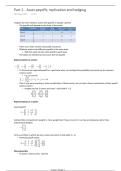
Imagine we have 4 distinct assets with payoffs in exactly 1 period
- The payoffs will depend on the state of the world
- There are a finite number of possible outcomes
- Different assets have different payoffs in the same state
○ Risk-free asset has the same payoff in each state
- The states are identical across assets but not payoffs
Representation as vectors
- To find out the expected payoff for a particular asset, we multiply the probability row vector by the relevant
column vector
○ E.g. for asset 4:
- Then if you were investing in some combination of these assets, we can take a linear combination of their payoff
column vectors
○ Imagine we buy 3 shares and short 2 calls (with E = 1)
Representation as a matrix
Asset payoffs:
Add portfolio composition (‘weights’) - here weights don’t have to sum to 1 as they are absolutes rather than
proportional weights:
Form a portfolio in which we buy 3 shares and short 2 calls (with E = 1)
- Portfolio payoff matrix:
More generally
- m states, n basis assets, 1 period
Fiance v2 Page 1
, Hedging via a replicating portfolio
- Using a set of basis assets, the aim here is to replicate a target set of payoffs i.e. any set portfolio we want to
replicate
- If we can find a vector of weights, x, which satisfies this, we can replicate the payoffs using our basis assets on b
Complete markets and redundant assets
Again using m states and n basis assets
- If all possible payoff profiles can be created (replicated) in a market, the market is said to be complete
○ Otherwise, the market is said to be incomplete - there will be some asset sets which you can't get to
- If there are 𝑚 states, then we need 𝑛 ≥ 𝑚 basis assets (the same or a greater number of basis assets) if the market
is to be complete
- An asset which can be created by combination amongst other basis assets is said to be redundant
○ Incomplete markets can have redundant basis assets
○ If the number of basis assets exceeds the number of states, then there are redundant basis assets
○ In a complete market with 𝑛 > 𝑚, there are 𝑛 − 𝑚 redundant basis assets
- If there are 𝑚 states, then 𝑛 = 𝑚 assets whose payoff vectors are linearly independent provide a complete market
with fewest possible basis assets (no redundant assets)
Hedging cases
We have to consider the following
- Complete market without redundant basis assets
m=n
○ In this case, the payoff matrix 𝐴 is a square (𝑚 × 𝑚) of full rank (= 𝑚, i.e., 𝑚 linearly independent
rows/columns)
i.e. the rows and columns of the payoff matrix are linearly independent one of another
□ You can't get the payoffs in a particular column by combining other columns --> can' replicate an
asset by combination of the other assets
○ Therefore it can be inverted to product A-1 such that:
○ NB: A multiplied by A-inverse is equal to the identity matrix AND A-inverse multiplied by A is equal to the
identity matrix
But C multiplied by matrix D is not necessarily the same as D multiplied by C
C-1 * C is equal to C * C-1
We want to find out what x is i.e. we want to find out the absolute weights of assets in this portfolio to get
Fiance v2 Page 2
28 October 2025 14:56
Imagine we have 4 distinct assets with payoffs in exactly 1 period
- The payoffs will depend on the state of the world
- There are a finite number of possible outcomes
- Different assets have different payoffs in the same state
○ Risk-free asset has the same payoff in each state
- The states are identical across assets but not payoffs
Representation as vectors
- To find out the expected payoff for a particular asset, we multiply the probability row vector by the relevant
column vector
○ E.g. for asset 4:
- Then if you were investing in some combination of these assets, we can take a linear combination of their payoff
column vectors
○ Imagine we buy 3 shares and short 2 calls (with E = 1)
Representation as a matrix
Asset payoffs:
Add portfolio composition (‘weights’) - here weights don’t have to sum to 1 as they are absolutes rather than
proportional weights:
Form a portfolio in which we buy 3 shares and short 2 calls (with E = 1)
- Portfolio payoff matrix:
More generally
- m states, n basis assets, 1 period
Fiance v2 Page 1
, Hedging via a replicating portfolio
- Using a set of basis assets, the aim here is to replicate a target set of payoffs i.e. any set portfolio we want to
replicate
- If we can find a vector of weights, x, which satisfies this, we can replicate the payoffs using our basis assets on b
Complete markets and redundant assets
Again using m states and n basis assets
- If all possible payoff profiles can be created (replicated) in a market, the market is said to be complete
○ Otherwise, the market is said to be incomplete - there will be some asset sets which you can't get to
- If there are 𝑚 states, then we need 𝑛 ≥ 𝑚 basis assets (the same or a greater number of basis assets) if the market
is to be complete
- An asset which can be created by combination amongst other basis assets is said to be redundant
○ Incomplete markets can have redundant basis assets
○ If the number of basis assets exceeds the number of states, then there are redundant basis assets
○ In a complete market with 𝑛 > 𝑚, there are 𝑛 − 𝑚 redundant basis assets
- If there are 𝑚 states, then 𝑛 = 𝑚 assets whose payoff vectors are linearly independent provide a complete market
with fewest possible basis assets (no redundant assets)
Hedging cases
We have to consider the following
- Complete market without redundant basis assets
m=n
○ In this case, the payoff matrix 𝐴 is a square (𝑚 × 𝑚) of full rank (= 𝑚, i.e., 𝑚 linearly independent
rows/columns)
i.e. the rows and columns of the payoff matrix are linearly independent one of another
□ You can't get the payoffs in a particular column by combining other columns --> can' replicate an
asset by combination of the other assets
○ Therefore it can be inverted to product A-1 such that:
○ NB: A multiplied by A-inverse is equal to the identity matrix AND A-inverse multiplied by A is equal to the
identity matrix
But C multiplied by matrix D is not necessarily the same as D multiplied by C
C-1 * C is equal to C * C-1
We want to find out what x is i.e. we want to find out the absolute weights of assets in this portfolio to get
Fiance v2 Page 2


