

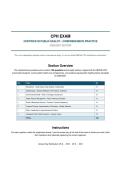
CPH EXAM
CERTIFIED IN PUBLIC HEALTH - COMPREHENSIVE PRACTICE
2026/2027 EDITION
This is an independent practice exam for educational study; it is not an official NBPHE CPH certification examination.
Section Overview
This comprehensive practice exam contains 100 questions across eight sections, aligned with the NBPHE CPH
examination blueprint, current public health core competencies, and evidence-based public health practice standards
for 2026/2027.
Sec Topic Qs
1 Biostatistics - Study Design, Data Analysis, Interpretation 15
2 Epidemiology - Disease Distribution, Risk Factors, Outbreaks 15
3 Environmental Health - Risks, Toxicology, Assessment 10
4 Health Policy & Management - Policy, Planning, Evaluation 15
5 Social & Behavioral Sciences - Theories, Cultural Competency 15
6 Program Planning, Implementation & Evaluation - Models, Methods 10
7 Ethics, Leadership, & Interprofessional Practice 10
8 Integrated Public Health Scenarios - Complex Cases 10
TOTAL 100
Instructions
For each question, select the single best answer. Use the answer key at the end of the exam to check your work. Each
item includes a brief rationale explaining the correct response.
Answer Key Distribution: 25 A · 25 B · 25 C · 25 D
, Section 1: Biostatistics - Study Design, Data Analysis, and Interpretation
Q1: The mean of the numbers 2, 4, 6, 8, and 10 is:
A. 4
B. 6 [CORRECT]
C. 8
D. 30
Correct Answer: B
Rationale: The mean = (2+4+6+8+10)/5 = 30/5 = 6. The other options misapply the average.
Q2: The median of the numbers 3, 7, 9, 12, 15 is:
A. 9 [CORRECT]
B. 7
C. 12
D. 15
Correct Answer: A
Rationale: The median is the middle value when sorted: 9. The other options are not the median.
Q3: The standard deviation measures:
A. The central value
B. The mode
C. The sample size
D. The spread or variability of data around the mean [CORRECT]
Correct Answer: D
Rationale: The standard deviation measures data variability around the mean. The other options are incorrect.
Q4: A p-value of 0.03 (at alpha 0.05) indicates:
A. No significance
B. Certainty of causation
C. A statistically significant result (reject the null hypothesis) [CORRECT]
D. A type II error
Correct Answer: C
Rationale: A p-value below 0.05 indicates statistical significance, rejecting the null. The other options are incorrect.
Q5: A 95% confidence interval that does not include the null value (e.g., 0 for a difference) indicates:
A. A statistically significant result [CORRECT]
B. No significance
C. Certainty
D. A type II error
Correct Answer: A
Rationale: A 95% CI excluding the null value indicates significance. The other options are incorrect.
Q6: A type I error is:
A. Failing to reject a false null hypothesis
B. Rejecting a true null hypothesis (false positive) [CORRECT]
C. A correct decision
D. An invalid study
Correct Answer: B
Rationale: A type I error is a false positive (rejecting a true null). A type II error is failing to reject a false null.
Q7: A type II error is:
A. Rejecting a true null
B. A correct decision
C. An invalid study
CPH Exam - Certified in Public Health - 2026/2027 Page 2
, D. Failing to reject a false null hypothesis (false negative) [CORRECT]
Correct Answer: D
Rationale: A type II error is a false negative. The other options are incorrect.
Q8: Which study design randomly assigns participants to intervention or control groups?
A. Randomized controlled trial (RCT) [CORRECT]
B. Cross-sectional study
C. Case-control study
D. Cohort study
Correct Answer: A
Rationale: An RCT randomly assigns participants to intervention/control groups. The other designs do not randomize.
Q9: A cross-sectional study measures:
A. Exposure and outcome at the same point in time [CORRECT]
B. Exposure before outcome over time
C. Outcome before exposure
D. Only exposure
Correct Answer: A
Rationale: A cross-sectional study measures exposure and outcome simultaneously. The other options describe other designs.
Q10: A cohort study is characterized by:
A. Measuring exposure and outcome at one time
B. Selecting cases and controls based on outcome
C. Following a group over time from exposure to outcome [CORRECT]
D. Randomizing participants
Correct Answer: C
Rationale: A cohort follows participants over time from exposure to outcome. The other options describe other designs.
Q11: In a case-control study, participants are selected based on:
A. Their exposure status
B. Random assignment
C. Their age only
D. Their outcome (disease) status [CORRECT]
Correct Answer: D
Rationale: Case-control studies select participants by outcome status. The other options are incorrect.
Q12: A p-value of 0.10 (at alpha 0.05) indicates:
A. A significant result
B. Certainty
C. A type I error
D. A result that is not statistically significant [CORRECT]
Correct Answer: D
Rationale: A p-value of 0.10 is above 0.05, so the result is not statistically significant. The other options are incorrect.
Q13: The power of a study is:
A. The probability of detecting a true effect (1 - type II error) [CORRECT]
B. The probability of a type I error
C. The sample size
D. The p-value
Correct Answer: A
Rationale: Power = 1 - beta (probability of detecting a true effect). The other options are incorrect.
Q14: The null hypothesis (H0) in a study typically states that:
A. There is no effect or no difference [CORRECT]
B. There is an effect
CPH Exam - Certified in Public Health - 2026/2027 Page 3
CERTIFIED IN PUBLIC HEALTH - COMPREHENSIVE PRACTICE
2026/2027 EDITION
This is an independent practice exam for educational study; it is not an official NBPHE CPH certification examination.
Section Overview
This comprehensive practice exam contains 100 questions across eight sections, aligned with the NBPHE CPH
examination blueprint, current public health core competencies, and evidence-based public health practice standards
for 2026/2027.
Sec Topic Qs
1 Biostatistics - Study Design, Data Analysis, Interpretation 15
2 Epidemiology - Disease Distribution, Risk Factors, Outbreaks 15
3 Environmental Health - Risks, Toxicology, Assessment 10
4 Health Policy & Management - Policy, Planning, Evaluation 15
5 Social & Behavioral Sciences - Theories, Cultural Competency 15
6 Program Planning, Implementation & Evaluation - Models, Methods 10
7 Ethics, Leadership, & Interprofessional Practice 10
8 Integrated Public Health Scenarios - Complex Cases 10
TOTAL 100
Instructions
For each question, select the single best answer. Use the answer key at the end of the exam to check your work. Each
item includes a brief rationale explaining the correct response.
Answer Key Distribution: 25 A · 25 B · 25 C · 25 D
, Section 1: Biostatistics - Study Design, Data Analysis, and Interpretation
Q1: The mean of the numbers 2, 4, 6, 8, and 10 is:
A. 4
B. 6 [CORRECT]
C. 8
D. 30
Correct Answer: B
Rationale: The mean = (2+4+6+8+10)/5 = 30/5 = 6. The other options misapply the average.
Q2: The median of the numbers 3, 7, 9, 12, 15 is:
A. 9 [CORRECT]
B. 7
C. 12
D. 15
Correct Answer: A
Rationale: The median is the middle value when sorted: 9. The other options are not the median.
Q3: The standard deviation measures:
A. The central value
B. The mode
C. The sample size
D. The spread or variability of data around the mean [CORRECT]
Correct Answer: D
Rationale: The standard deviation measures data variability around the mean. The other options are incorrect.
Q4: A p-value of 0.03 (at alpha 0.05) indicates:
A. No significance
B. Certainty of causation
C. A statistically significant result (reject the null hypothesis) [CORRECT]
D. A type II error
Correct Answer: C
Rationale: A p-value below 0.05 indicates statistical significance, rejecting the null. The other options are incorrect.
Q5: A 95% confidence interval that does not include the null value (e.g., 0 for a difference) indicates:
A. A statistically significant result [CORRECT]
B. No significance
C. Certainty
D. A type II error
Correct Answer: A
Rationale: A 95% CI excluding the null value indicates significance. The other options are incorrect.
Q6: A type I error is:
A. Failing to reject a false null hypothesis
B. Rejecting a true null hypothesis (false positive) [CORRECT]
C. A correct decision
D. An invalid study
Correct Answer: B
Rationale: A type I error is a false positive (rejecting a true null). A type II error is failing to reject a false null.
Q7: A type II error is:
A. Rejecting a true null
B. A correct decision
C. An invalid study
CPH Exam - Certified in Public Health - 2026/2027 Page 2
, D. Failing to reject a false null hypothesis (false negative) [CORRECT]
Correct Answer: D
Rationale: A type II error is a false negative. The other options are incorrect.
Q8: Which study design randomly assigns participants to intervention or control groups?
A. Randomized controlled trial (RCT) [CORRECT]
B. Cross-sectional study
C. Case-control study
D. Cohort study
Correct Answer: A
Rationale: An RCT randomly assigns participants to intervention/control groups. The other designs do not randomize.
Q9: A cross-sectional study measures:
A. Exposure and outcome at the same point in time [CORRECT]
B. Exposure before outcome over time
C. Outcome before exposure
D. Only exposure
Correct Answer: A
Rationale: A cross-sectional study measures exposure and outcome simultaneously. The other options describe other designs.
Q10: A cohort study is characterized by:
A. Measuring exposure and outcome at one time
B. Selecting cases and controls based on outcome
C. Following a group over time from exposure to outcome [CORRECT]
D. Randomizing participants
Correct Answer: C
Rationale: A cohort follows participants over time from exposure to outcome. The other options describe other designs.
Q11: In a case-control study, participants are selected based on:
A. Their exposure status
B. Random assignment
C. Their age only
D. Their outcome (disease) status [CORRECT]
Correct Answer: D
Rationale: Case-control studies select participants by outcome status. The other options are incorrect.
Q12: A p-value of 0.10 (at alpha 0.05) indicates:
A. A significant result
B. Certainty
C. A type I error
D. A result that is not statistically significant [CORRECT]
Correct Answer: D
Rationale: A p-value of 0.10 is above 0.05, so the result is not statistically significant. The other options are incorrect.
Q13: The power of a study is:
A. The probability of detecting a true effect (1 - type II error) [CORRECT]
B. The probability of a type I error
C. The sample size
D. The p-value
Correct Answer: A
Rationale: Power = 1 - beta (probability of detecting a true effect). The other options are incorrect.
Q14: The null hypothesis (H0) in a study typically states that:
A. There is no effect or no difference [CORRECT]
B. There is an effect
CPH Exam - Certified in Public Health - 2026/2027 Page 3


