

Hide definitions
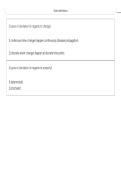
2 types of simulation (in regards to change)
1) continuous-time: changes happen continuoulsy (disease propagation)
2) discrete-event: changes happen at discrete time points
2 types of simulation (in regards to property)
1) deterministic
2) stochastic
,3 levels of neurons in a neural network
1) input
2) hidden (many layers)
3) output
in hidden level: each neuron gets inputs from the previous layer, calculates function of weighted inputs,
gives output to the next layer
after initial run: the weights are changed within all the simulated neurons depending on how wrong they
are (from outputs)
,A/B testing
Whenever we want to choose between 2 alternatives.
As long as the following 3 things are true:
1st, we need to be able to collect a lot of data quickly enough to get an answer in time to use it.
2nd, the data we collect has to be from a representative sample of the whole
3rd, the amount of data we collect has to be small compared to the total population we want to use the
answer on.
Before modeling and before collecting data
Adding a random value (up or down) to model-predicted imputed data
Perturbation. Less accurate on average, but more accurate w/ variability
Backward elimination
variable selection; classical
Opposite of forward selection. Start with model with all factors, at each step find worst factor and remove
from model. Continue until no more to add, # of factor threshold is satisfied. Remove factors at the end
that were not good enough
, Classical variable selection approaches
1. Forward selection
2. Backwards elimination
3. Stepwise regression
greedy algorithms
Communities in graphs focus on what
automated ways of finding highly-interconnected
subpopulations.
constant coefficients and variables from statistics and optimization points of view
Statistics:
xij are variables
aj are constant coefficients
Optimization:
xij are constant coefficients
aj are variables
2 types of simulation (in regards to change)
1) continuous-time: changes happen continuoulsy (disease propagation)
2) discrete-event: changes happen at discrete time points
2 types of simulation (in regards to property)
1) deterministic
2) stochastic
,3 levels of neurons in a neural network
1) input
2) hidden (many layers)
3) output
in hidden level: each neuron gets inputs from the previous layer, calculates function of weighted inputs,
gives output to the next layer
after initial run: the weights are changed within all the simulated neurons depending on how wrong they
are (from outputs)
,A/B testing
Whenever we want to choose between 2 alternatives.
As long as the following 3 things are true:
1st, we need to be able to collect a lot of data quickly enough to get an answer in time to use it.
2nd, the data we collect has to be from a representative sample of the whole
3rd, the amount of data we collect has to be small compared to the total population we want to use the
answer on.
Before modeling and before collecting data
Adding a random value (up or down) to model-predicted imputed data
Perturbation. Less accurate on average, but more accurate w/ variability
Backward elimination
variable selection; classical
Opposite of forward selection. Start with model with all factors, at each step find worst factor and remove
from model. Continue until no more to add, # of factor threshold is satisfied. Remove factors at the end
that were not good enough
, Classical variable selection approaches
1. Forward selection
2. Backwards elimination
3. Stepwise regression
greedy algorithms
Communities in graphs focus on what
automated ways of finding highly-interconnected
subpopulations.
constant coefficients and variables from statistics and optimization points of view
Statistics:
xij are variables
aj are constant coefficients
Optimization:
xij are constant coefficients
aj are variables


