

Page 1 of 151
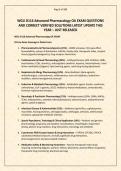
WGU D116 Advanced Pharmacology OA EXAM QUESTIONS
AND CORRECT VERIFIED SOLUTIONS LATEST UPDATE THIS
YEAR – JUST RELEASED
WGU D116 Advanced Pharmacology OA EXAM
10-Line Exam Coverage in Points Form
1. Pharmacokinetics & Pharmacodynamics (15%) – ADME processes, first-pass effect,
bioavailability, volume of distribution, half-life, steady state, therapeutic index, receptor
theory (agonists/antagonists), drug-receptor interactions
2. Cardiovascular & Renal Pharmacology (20%) – Antihypertensives (ACE inhibitors, ARBs,
beta-blockers, CCBs, diuretics), anticoagulants (warfarin, heparin), antiarrhythmics, heart
failure medications (digoxin), lipid-lowering agents, renal drug dosing adjustments
3. Respiratory & Allergy Pharmacology (10%) – Bronchodilators (beta-agonists,
anticholinergics), corticosteroids, antihistamines, mast cell stabilizers, leukotriene
modifiers, asthma management protocols
4. Endocrine & Metabolic Pharmacology (15%) – Antidiabetic agents (insulin, metformin,
sulfonylureas, GLP-1 agonists, SGLT2 inhibitors), thyroid medications, corticosteroids,
hormone replacement therapies
5. Neurologic & Psychiatric Pharmacology (15%) – Antidepressants (SSRIs, SNRIs, MAOIs,
TCAs), antipsychotics, anxiolytics (benzodiazepines), anticonvulsants, antiparkinsonian
agents, opioid analgesics
6. Infectious Disease & Antimicrobials (15%) – Antibiotics (penicillins, cephalosporins,
macrolides, fluoroquinolones, aminoglycosides), antifungals, antivirals, antimicrobial
resistance, appropriate antibiotic selection
7. Special Populations, Toxicology & Clinical Application (10%) – Pediatric and geriatric
pharmacology, pregnancy and lactation considerations, renal/hepatic impairment
dosing, adverse drug reactions, drug interactions, toxicology and antidotes
8. Cytochrome P450 Enzyme System & Drug Interactions – CYP3A4, CYP2D6, CYP2C9
substrates/inhibitors/inducers, clinically significant drug interactions,
pharmacogenomics and personalized medicine
9. Medication Safety & Monitoring Parameters – Narrow therapeutic index drugs
requiring monitoring (digoxin, warfarin, lithium, phenytoin), adverse effects recognition,
therapeutic drug monitoring, black box warnings
, Page 2 of 151
10. Evidence-Based Prescribing & Clinical Decision-Making – APRN prescribing authority,
treatment guidelines, patient education, adherence considerations, cost-effectiveness,
ethical prescribing practices
250 MCQs with Detailed Rationales
Questions 1-50: Pharmacokinetics & Pharmacodynamics
1. A 68-year-old patient with hepatic cirrhosis is prescribed a medication that undergoes
extensive first-pass metabolism in the liver. The nurse anticipates that this patient's oral dose
will need to be reduced because which of the following pharmacokinetic processes will be
most significantly affected?
A) The rate of drug absorption from the gastrointestinal tract into the portal circulation
B) The fraction of the administered drug that reaches the systemic circulation unchanged
C) The volume of distribution of the drug into peripheral tissues and organs
D) The rate of drug excretion by the kidneys through glomerular filtration
Answer: B
Rationale: First-pass metabolism occurs when a drug is metabolized in the liver before reaching
systemic circulation, which significantly reduces the bioavailability of orally administered drugs .
In patients with hepatic cirrhosis, impaired liver function reduces this first-pass metabolism,
resulting in a larger fraction of the drug reaching systemic circulation unchanged, which
increases bioavailability and the risk of toxicity . The nurse should anticipate the need for dose
reduction to prevent drug accumulation. The rate of absorption (A) may be affected by other
, Page 3 of 151
factors, but the first-pass effect specifically relates to metabolism before systemic circulation,
not absorption rate or volume of distribution (C). Renal excretion (D) would be affected by renal
function, not hepatic impairment.
2. A patient receiving warfarin therapy for atrial fibrillation is started on amiodarone for
rhythm control. The nurse recognizes that this drug interaction will most likely result in which
of the following clinical outcomes requiring careful monitoring?
A) Decreased warfarin metabolism leading to elevated INR and increased bleeding risk
B) Increased warfarin metabolism requiring higher doses to achieve therapeutic effect
C) Enhanced warfarin excretion through the kidneys reducing its anticoagulant effect
D) Reduced warfarin binding to plasma proteins increasing its volume of distribution
Answer: A
Rationale: Amiodarone is a strong inhibitor of CYP2C9, the enzyme responsible for metabolizing
warfarin . When co-administered, amiodarone decreases warfarin metabolism, leading to
elevated warfarin levels, increased international normalized ratio (INR), and significantly
increased bleeding risk . The patient requires close INR monitoring and likely dose reduction of
warfarin. This represents a clinically significant drug-drug interaction that can lead to life-
threatening hemorrhage. Option B describes enzyme induction which is incorrect, as
amiodarone is an inhibitor. Option C describes enhanced excretion which does not occur. Option
D describes altered protein binding which is not the primary mechanism of this interaction.
, Page 4 of 151
3. The nurse is preparing to administer gentamicin to a patient with acute kidney injury who
has a glomerular filtration rate of 25 mL/min. Understanding the pharmacokinetic principles,
which prescribing adjustment best minimizes the risk of drug accumulation and toxicity?
A) Administering a larger loading dose to quickly achieve therapeutic levels
B) Maintaining the standard dosing interval but reducing each individual dose by 50%
C) Reducing the maintenance dose or extending the dosing interval based on renal function
D) Switching to a once-daily dosing regimen to improve patient compliance
Answer: C
Rationale: Gentamicin is primarily eliminated unchanged through the kidneys via glomerular
filtration. In patients with renal impairment, clearance is significantly reduced, leading to drug
accumulation and increased risk of nephrotoxicity and ototoxicity . The appropriate prescribing
adjustment is to reduce the maintenance dose or extend the dosing interval based on
calculated renal function . A loading dose (A) is based on volume of distribution rather than
clearance and does not address the issue of accumulation. Standard dosing (B) would still lead
to accumulation. Once-daily dosing (D) may be appropriate in patients with normal renal
function but does not address the need for dose adjustment in renal impairment.
4. A patient who is a poor metabolizer of CYP2D6 is prescribed codeine for postoperative pain
management following orthopedic surgery. Which clinical outcome should the nurse
anticipate and assess for in this patient?
WGU D116 Advanced Pharmacology OA EXAM QUESTIONS
AND CORRECT VERIFIED SOLUTIONS LATEST UPDATE THIS
YEAR – JUST RELEASED
WGU D116 Advanced Pharmacology OA EXAM
10-Line Exam Coverage in Points Form
1. Pharmacokinetics & Pharmacodynamics (15%) – ADME processes, first-pass effect,
bioavailability, volume of distribution, half-life, steady state, therapeutic index, receptor
theory (agonists/antagonists), drug-receptor interactions
2. Cardiovascular & Renal Pharmacology (20%) – Antihypertensives (ACE inhibitors, ARBs,
beta-blockers, CCBs, diuretics), anticoagulants (warfarin, heparin), antiarrhythmics, heart
failure medications (digoxin), lipid-lowering agents, renal drug dosing adjustments
3. Respiratory & Allergy Pharmacology (10%) – Bronchodilators (beta-agonists,
anticholinergics), corticosteroids, antihistamines, mast cell stabilizers, leukotriene
modifiers, asthma management protocols
4. Endocrine & Metabolic Pharmacology (15%) – Antidiabetic agents (insulin, metformin,
sulfonylureas, GLP-1 agonists, SGLT2 inhibitors), thyroid medications, corticosteroids,
hormone replacement therapies
5. Neurologic & Psychiatric Pharmacology (15%) – Antidepressants (SSRIs, SNRIs, MAOIs,
TCAs), antipsychotics, anxiolytics (benzodiazepines), anticonvulsants, antiparkinsonian
agents, opioid analgesics
6. Infectious Disease & Antimicrobials (15%) – Antibiotics (penicillins, cephalosporins,
macrolides, fluoroquinolones, aminoglycosides), antifungals, antivirals, antimicrobial
resistance, appropriate antibiotic selection
7. Special Populations, Toxicology & Clinical Application (10%) – Pediatric and geriatric
pharmacology, pregnancy and lactation considerations, renal/hepatic impairment
dosing, adverse drug reactions, drug interactions, toxicology and antidotes
8. Cytochrome P450 Enzyme System & Drug Interactions – CYP3A4, CYP2D6, CYP2C9
substrates/inhibitors/inducers, clinically significant drug interactions,
pharmacogenomics and personalized medicine
9. Medication Safety & Monitoring Parameters – Narrow therapeutic index drugs
requiring monitoring (digoxin, warfarin, lithium, phenytoin), adverse effects recognition,
therapeutic drug monitoring, black box warnings
, Page 2 of 151
10. Evidence-Based Prescribing & Clinical Decision-Making – APRN prescribing authority,
treatment guidelines, patient education, adherence considerations, cost-effectiveness,
ethical prescribing practices
250 MCQs with Detailed Rationales
Questions 1-50: Pharmacokinetics & Pharmacodynamics
1. A 68-year-old patient with hepatic cirrhosis is prescribed a medication that undergoes
extensive first-pass metabolism in the liver. The nurse anticipates that this patient's oral dose
will need to be reduced because which of the following pharmacokinetic processes will be
most significantly affected?
A) The rate of drug absorption from the gastrointestinal tract into the portal circulation
B) The fraction of the administered drug that reaches the systemic circulation unchanged
C) The volume of distribution of the drug into peripheral tissues and organs
D) The rate of drug excretion by the kidneys through glomerular filtration
Answer: B
Rationale: First-pass metabolism occurs when a drug is metabolized in the liver before reaching
systemic circulation, which significantly reduces the bioavailability of orally administered drugs .
In patients with hepatic cirrhosis, impaired liver function reduces this first-pass metabolism,
resulting in a larger fraction of the drug reaching systemic circulation unchanged, which
increases bioavailability and the risk of toxicity . The nurse should anticipate the need for dose
reduction to prevent drug accumulation. The rate of absorption (A) may be affected by other
, Page 3 of 151
factors, but the first-pass effect specifically relates to metabolism before systemic circulation,
not absorption rate or volume of distribution (C). Renal excretion (D) would be affected by renal
function, not hepatic impairment.
2. A patient receiving warfarin therapy for atrial fibrillation is started on amiodarone for
rhythm control. The nurse recognizes that this drug interaction will most likely result in which
of the following clinical outcomes requiring careful monitoring?
A) Decreased warfarin metabolism leading to elevated INR and increased bleeding risk
B) Increased warfarin metabolism requiring higher doses to achieve therapeutic effect
C) Enhanced warfarin excretion through the kidneys reducing its anticoagulant effect
D) Reduced warfarin binding to plasma proteins increasing its volume of distribution
Answer: A
Rationale: Amiodarone is a strong inhibitor of CYP2C9, the enzyme responsible for metabolizing
warfarin . When co-administered, amiodarone decreases warfarin metabolism, leading to
elevated warfarin levels, increased international normalized ratio (INR), and significantly
increased bleeding risk . The patient requires close INR monitoring and likely dose reduction of
warfarin. This represents a clinically significant drug-drug interaction that can lead to life-
threatening hemorrhage. Option B describes enzyme induction which is incorrect, as
amiodarone is an inhibitor. Option C describes enhanced excretion which does not occur. Option
D describes altered protein binding which is not the primary mechanism of this interaction.
, Page 4 of 151
3. The nurse is preparing to administer gentamicin to a patient with acute kidney injury who
has a glomerular filtration rate of 25 mL/min. Understanding the pharmacokinetic principles,
which prescribing adjustment best minimizes the risk of drug accumulation and toxicity?
A) Administering a larger loading dose to quickly achieve therapeutic levels
B) Maintaining the standard dosing interval but reducing each individual dose by 50%
C) Reducing the maintenance dose or extending the dosing interval based on renal function
D) Switching to a once-daily dosing regimen to improve patient compliance
Answer: C
Rationale: Gentamicin is primarily eliminated unchanged through the kidneys via glomerular
filtration. In patients with renal impairment, clearance is significantly reduced, leading to drug
accumulation and increased risk of nephrotoxicity and ototoxicity . The appropriate prescribing
adjustment is to reduce the maintenance dose or extend the dosing interval based on
calculated renal function . A loading dose (A) is based on volume of distribution rather than
clearance and does not address the issue of accumulation. Standard dosing (B) would still lead
to accumulation. Once-daily dosing (D) may be appropriate in patients with normal renal
function but does not address the need for dose adjustment in renal impairment.
4. A patient who is a poor metabolizer of CYP2D6 is prescribed codeine for postoperative pain
management following orthopedic surgery. Which clinical outcome should the nurse
anticipate and assess for in this patient?


