

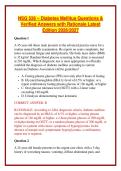
NSG 526 – Diabetes Mellitus Questions &
Verified Answers with Rationale Latest
Edition 2026/2027
Question 1
A 45-year-old obese male presents to the advanced practice nurse for a
routine annual health examination. He reports no acute complaints, but
notes occasional fatigue and mild polyuria. His body mass index (BMI)
is 32 kg/m². Random blood glucose screening in the clinic is measured
at 210 mg/dL. Which diagnostic test is most appropriate to officially
establish the diagnosis of diabetes mellitus according to current
American Diabetes Association (ADA) guidelines?
A. Fasting plasma glucose (FPG) test only after 8 hours of fasting
B. Glycated hemoglobin (HbA1c) level of 6.5% or higher, or a
repeat confirmatory fasting plasma glucose of 126 mg/dL or higher
C. Oral glucose tolerance test (OGTT) with a 2-hour value
exceeding 140 mg/dL
D. Urinalysis demonstrating trace ketonuria
CORRECT ANSWER: B
RATIONALE: According to ADA diagnostic criteria, diabetes mellitus
can be diagnosed by an HbA1c of 6.5% or higher, a fasting plasma
glucose of 126 mg/dL or higher, a 2-hour plasma glucose of 200 mg/dL
or higher during an OGTT, or a random plasma glucose of 200 mg/dL or
higher in a patient with classic symptoms of hyperglycemia. In the
absence of unequivocal symptomatic hyperglycemia, a confirmatory
repeat test is required.
Question 2
A 24-year-old female presents to the urgent care clinic with a 3-day
history of worsening nausea, vomiting, diffuse abdominal pain, and
,polydipsia. She reports a 15-pound weight loss over the past month. On
examination, her breathing is deep and rapid (Kussmaul respirations)
with a fruity odor on her breath. Laboratory evaluation reveals a serum
glucose of 450 mg/dL, arterial blood gas pH of 7.18, serum bicarbonate
of 12 mEq/L, and an increased anion gap. What is the primary
underlying pathophysiology responsible for this acute presentation?
A. Complete insulin deficiency resulting in uninhibited lipolysis,
hepatic ketogenesis, and metabolic acidosis
B. Severe peripheral insulin resistance coupled with hyperosmolar
hyperglycemia and normal pH
C. Autoimmune destruction of pancreatic alpha cells leading to
glucagon depletion
D. Excessive ingestion of exogenous carbohydrates and subsequent
renal failure
CORRECT ANSWER: A
RATIONALE: Diabetic ketoacidosis (DKA) is a life-threatening
emergency classically seen in Type 1 diabetes caused by absolute or
near-absolute insulin deficiency. The lack of insulin unleashes lipolysis,
releasing free fatty acids that the liver converts into ketone bodies,
leading to a high anion gap metabolic acidosis.
Question 3
A 62-year-old male with a 10-year history of poorly controlled Type 2
diabetes mellitus presents with a 3-week history of painless, progressive
blurry vision in his right eye. Fundoscopic examination reveals
microaneurysms, retinal hemorrhages, hard exudates, and cotton-wool
spots. Which pathophysiological mechanism is primarily responsible for
these early microvascular retinal changes?
A. Atherosclerotic occlusion of the internal carotid artery
B. Pericyte loss, thickening of the basement membrane, and
increased capillary permeability in retinal microvasculature
, C. Demyelination of the optic nerve head
D. Acute elevation of intraocular pressure resulting in optic disc
cupping
CORRECT ANSWER: B
RATIONALE: Chronic hyperglycemia damages retinal capillary
microvasculature through pathways involving advanced glycation end-
products and oxidative stress, leading to pericyte degeneration, basement
membrane thickening, microaneurysm formation, and plasma leakage
manifested as exudates and hemorrhages (non-proliferative diabetic
retinopathy).
Question 4
A 55-year-old male with Type 2 diabetes mellitus is evaluated for renal
function. His routine urinalysis shows persistent albuminuria, with a
urinary albumin-to-creatinine ratio (UACR) of 180 mg/g on two
consecutive spot urine samples. His estimated glomerular filtration rate
(eGFR) is 65 mL/min/1.73m². What is the primary pharmacological
class recommended to slow the progression of diabetic kidney disease in
this patient, independent of its glucose-lowering effects?
A. Loop diuretics (e.g., Furosemide)
B. Angiotensin-converting enzyme (ACE) inhibitors or
Angiotensin II receptor blockers (ARBs)
C. Beta-adrenergic blocking agents (e.g., Metoprolol)
D. Calcium channel blockers (e.g., Amlodipine)
CORRECT ANSWER: B
RATIONALE: ACE inhibitors or ARBs are the first-line
pharmacotherapy for patients with diabetes and albuminuria (UACR 30
mg/g or higher). They reduce intraglomerular pressure by preferentially
dilating the efferent arteriole, thereby reducing proteinuria and slowing
the progression of diabetic nephropathy.
, Question 5
A 50-year-old female with a 15-year history of Type 2 diabetes presents
with a 6-month history of burning pain, numbness, and paresthesias in a
stocking-glove distribution involving both lower extremities. Symptoms
are characteristically worse at night. Neurological examination reveals
absent ankle reflexes and impaired vibratory sensation in the toes. What
is the most appropriate initial pharmacological treatment for painful
diabetic peripheral neuropathy?
A. High-dose narcotic analgesics (e.g., Oxycodone)
B. Pregabalin or Duloxetine
C. Intravenous corticosteroids
D. Nonsteroidal anti-inflammatory drugs (e.g., Ibuprofen)
CORRECT ANSWER: B
RATIONALE: Pregabalin (a gabapentinoid) and duloxetine (a
serotonin-norepinephrine reuptake inhibitor) are FDA-approved first-
line pharmacological treatments for painful diabetic peripheral
neuropathy. Tricyclic antidepressants are also utilized, while opioids are
avoided due to dependency risks.
Question 6
A 58-year-old male with Type 2 diabetes is brought to the emergency
department with profound lethargy, confusion, and dehydration. Family
members report he has been ill with a viral gastroenteritis for 5 days and
unable to keep fluids down. Laboratory evaluation reveals a serum
glucose of 920 mg/dL, serum sodium of 152 mEq/L, serum osmolality
of 335 mOsm/kg, serum bicarbonate of 24 mEq/L, and a pH of 7.36 with
negative serum ketones. What is the diagnosis?
A. Diabetic ketoacidosis (DKA)
B. Hyperglycemic hyperosmolar state (HHS)
C. Lactic acidosis secondary to metformin toxicity
Verified Answers with Rationale Latest
Edition 2026/2027
Question 1
A 45-year-old obese male presents to the advanced practice nurse for a
routine annual health examination. He reports no acute complaints, but
notes occasional fatigue and mild polyuria. His body mass index (BMI)
is 32 kg/m². Random blood glucose screening in the clinic is measured
at 210 mg/dL. Which diagnostic test is most appropriate to officially
establish the diagnosis of diabetes mellitus according to current
American Diabetes Association (ADA) guidelines?
A. Fasting plasma glucose (FPG) test only after 8 hours of fasting
B. Glycated hemoglobin (HbA1c) level of 6.5% or higher, or a
repeat confirmatory fasting plasma glucose of 126 mg/dL or higher
C. Oral glucose tolerance test (OGTT) with a 2-hour value
exceeding 140 mg/dL
D. Urinalysis demonstrating trace ketonuria
CORRECT ANSWER: B
RATIONALE: According to ADA diagnostic criteria, diabetes mellitus
can be diagnosed by an HbA1c of 6.5% or higher, a fasting plasma
glucose of 126 mg/dL or higher, a 2-hour plasma glucose of 200 mg/dL
or higher during an OGTT, or a random plasma glucose of 200 mg/dL or
higher in a patient with classic symptoms of hyperglycemia. In the
absence of unequivocal symptomatic hyperglycemia, a confirmatory
repeat test is required.
Question 2
A 24-year-old female presents to the urgent care clinic with a 3-day
history of worsening nausea, vomiting, diffuse abdominal pain, and
,polydipsia. She reports a 15-pound weight loss over the past month. On
examination, her breathing is deep and rapid (Kussmaul respirations)
with a fruity odor on her breath. Laboratory evaluation reveals a serum
glucose of 450 mg/dL, arterial blood gas pH of 7.18, serum bicarbonate
of 12 mEq/L, and an increased anion gap. What is the primary
underlying pathophysiology responsible for this acute presentation?
A. Complete insulin deficiency resulting in uninhibited lipolysis,
hepatic ketogenesis, and metabolic acidosis
B. Severe peripheral insulin resistance coupled with hyperosmolar
hyperglycemia and normal pH
C. Autoimmune destruction of pancreatic alpha cells leading to
glucagon depletion
D. Excessive ingestion of exogenous carbohydrates and subsequent
renal failure
CORRECT ANSWER: A
RATIONALE: Diabetic ketoacidosis (DKA) is a life-threatening
emergency classically seen in Type 1 diabetes caused by absolute or
near-absolute insulin deficiency. The lack of insulin unleashes lipolysis,
releasing free fatty acids that the liver converts into ketone bodies,
leading to a high anion gap metabolic acidosis.
Question 3
A 62-year-old male with a 10-year history of poorly controlled Type 2
diabetes mellitus presents with a 3-week history of painless, progressive
blurry vision in his right eye. Fundoscopic examination reveals
microaneurysms, retinal hemorrhages, hard exudates, and cotton-wool
spots. Which pathophysiological mechanism is primarily responsible for
these early microvascular retinal changes?
A. Atherosclerotic occlusion of the internal carotid artery
B. Pericyte loss, thickening of the basement membrane, and
increased capillary permeability in retinal microvasculature
, C. Demyelination of the optic nerve head
D. Acute elevation of intraocular pressure resulting in optic disc
cupping
CORRECT ANSWER: B
RATIONALE: Chronic hyperglycemia damages retinal capillary
microvasculature through pathways involving advanced glycation end-
products and oxidative stress, leading to pericyte degeneration, basement
membrane thickening, microaneurysm formation, and plasma leakage
manifested as exudates and hemorrhages (non-proliferative diabetic
retinopathy).
Question 4
A 55-year-old male with Type 2 diabetes mellitus is evaluated for renal
function. His routine urinalysis shows persistent albuminuria, with a
urinary albumin-to-creatinine ratio (UACR) of 180 mg/g on two
consecutive spot urine samples. His estimated glomerular filtration rate
(eGFR) is 65 mL/min/1.73m². What is the primary pharmacological
class recommended to slow the progression of diabetic kidney disease in
this patient, independent of its glucose-lowering effects?
A. Loop diuretics (e.g., Furosemide)
B. Angiotensin-converting enzyme (ACE) inhibitors or
Angiotensin II receptor blockers (ARBs)
C. Beta-adrenergic blocking agents (e.g., Metoprolol)
D. Calcium channel blockers (e.g., Amlodipine)
CORRECT ANSWER: B
RATIONALE: ACE inhibitors or ARBs are the first-line
pharmacotherapy for patients with diabetes and albuminuria (UACR 30
mg/g or higher). They reduce intraglomerular pressure by preferentially
dilating the efferent arteriole, thereby reducing proteinuria and slowing
the progression of diabetic nephropathy.
, Question 5
A 50-year-old female with a 15-year history of Type 2 diabetes presents
with a 6-month history of burning pain, numbness, and paresthesias in a
stocking-glove distribution involving both lower extremities. Symptoms
are characteristically worse at night. Neurological examination reveals
absent ankle reflexes and impaired vibratory sensation in the toes. What
is the most appropriate initial pharmacological treatment for painful
diabetic peripheral neuropathy?
A. High-dose narcotic analgesics (e.g., Oxycodone)
B. Pregabalin or Duloxetine
C. Intravenous corticosteroids
D. Nonsteroidal anti-inflammatory drugs (e.g., Ibuprofen)
CORRECT ANSWER: B
RATIONALE: Pregabalin (a gabapentinoid) and duloxetine (a
serotonin-norepinephrine reuptake inhibitor) are FDA-approved first-
line pharmacological treatments for painful diabetic peripheral
neuropathy. Tricyclic antidepressants are also utilized, while opioids are
avoided due to dependency risks.
Question 6
A 58-year-old male with Type 2 diabetes is brought to the emergency
department with profound lethargy, confusion, and dehydration. Family
members report he has been ill with a viral gastroenteritis for 5 days and
unable to keep fluids down. Laboratory evaluation reveals a serum
glucose of 920 mg/dL, serum sodium of 152 mEq/L, serum osmolality
of 335 mOsm/kg, serum bicarbonate of 24 mEq/L, and a pH of 7.36 with
negative serum ketones. What is the diagnosis?
A. Diabetic ketoacidosis (DKA)
B. Hyperglycemic hyperosmolar state (HHS)
C. Lactic acidosis secondary to metformin toxicity


