

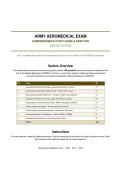
ARMY AEROMEDICAL EXAM
COMPREHENSIVE STUDY GUIDE & PRACTICE
2026/2027 EDITION
This is an independent practice exam for educational study; it is not an official U.S. Army AMEDD examination.
Section Overview
This comprehensive practice exam and study guide contains 100 questions across nine sections, aligned with the
U.S. Army Medical Department (AMEDD) curriculum, current Army aviation medical standards, aeromedical
evacuation protocols, and evidence-based flight medicine practices for 2026/2027.
Sec Topic Qs
1 Aeromedical Principles & Physiology - Hypoxia, Disorientation, G-Forces 15
2 Aviation Medical Standards & Flight Physicals - FDME, FDHS, Classes 15
3 Aeromedical Evacuation (MEDEVAC) - Transport, In-Flight Care, Equipment 12
4 Emergency Procedures & Survival - Egress, Smoke/Fume, Landings 10
5 Flight Surgeon & Aeromedical Team Roles - AMNP, Psychologist, USAAMA 12
6 Aviation Accident Investigation - Process, Reporting, Prevention 8
7 Pharmacology & Aeromedical Implications - Medications, Flight Status 10
8 Aeromedical Research & Organizations - AAMA, USAARL, USASAM 8
9 Integrated Clinical Scenarios - Complex Aeromedical Cases 10
TOTAL 100
Instructions
For each question, select the single best answer. Use the answer key at the end of the exam to check your work. Each
item includes a brief rationale explaining the correct response.
Answer Key Distribution: 25 A · 25 B · 25 C · 25 D
, Section 1: Aeromedical Principles & Physiology - Hypoxia, Spatial Disorientation,
G-Forces, and Altitude Physiology
Q1: Hypoxic hypoxia is best defined as:
A. Inadequate oxygen-carrying capacity of the blood
B. Inadequate oxygen in the air due to reduced partial pressure at altitude [CORRECT]
C. Inability of tissues to use oxygen
D. Reduced blood flow to tissues
Correct Answer: B
Rationale: Hypoxic hypoxia results from reduced oxygen partial pressure at altitude. Hypemic hypoxia involves low blood oxygen
capacity, histotoxic is tissue inability, stagnant is poor flow.
Q2: Hypemic hypoxia is caused by:
A. A reduced ability of the blood to carry oxygen (e.g., anemia, carbon monoxide) [CORRECT]
B. Reduced oxygen in the air
C. Tissue inability to use oxygen
D. Decreased blood flow
Correct Answer: A
Rationale: Hypemic hypoxia involves reduced oxygen-carrying capacity of the blood. The other types have different causes.
Q3: Stagnant hypoxia results from:
A. Low oxygen in the air
B. Anemia
C. Tissue enzyme failure
D. Inadequate circulation of blood to tissues [CORRECT]
Correct Answer: D
Rationale: Stagnant hypoxia is due to inadequate blood flow. The other options describe other hypoxia types.
Q4: Histotoxic hypoxia is caused by:
A. Low oxygen in the air
B. Reduced blood flow
C. The tissues being unable to use oxygen (e.g., cyanide poisoning) [CORRECT]
D. Anemia
Correct Answer: C
Rationale: Histotoxic hypoxia is tissue inability to use oxygen. The other options describe other types.
Q5: The first symptom of hypoxia is often:
A. Euphoria or impaired judgment [CORRECT]
B. Loss of consciousness
C. Convulsions
D. Blindness
Correct Answer: A
Rationale: Early hypoxia often causes euphoria and impaired judgment. Loss of consciousness is a later, severe sign.
Q6: A physiologic training device (e.g., hypobaric chamber) is used to:
A. Test aircraft engines
B. Help aircrew recognize their personal hypoxia symptoms [CORRECT]
C. Measure fuel
D. Train on navigation
Correct Answer: B
Rationale: Physiologic training helps aircrew recognize personal hypoxia symptoms. The other options are incorrect.
Q7: Spatial disorientation occurs when:
A. The aircraft is level
Army Aeromedical Exam & Study Guide - 2026/2027 Page 2
, B. The pilot is well rested
C. Visibility is perfect
D. A pilot misperceives the aircraft's position relative to the Earth [CORRECT]
Correct Answer: D
Rationale: Spatial disorientation is a misperception of the aircraft's position/attitude. The other options do not describe it.
Q8: The 'leans' in flight refers to:
A. A false sensation of banking when the vestibular system is confused [CORRECT]
B. The aircraft being level
C. A fuel warning
D. An engine issue
Correct Answer: A
Rationale: The 'leans' is a vestibular illusion of banking. The other options are not this phenomenon.
Q9: A common cause of spatial disorientation is:
A. Flying in instrument conditions without visual reference [CORRECT]
B. Perfect visibility
C. Flying straight and level
D. A calm cockpit
Correct Answer: A
Rationale: Spatial disorientation commonly occurs in instrument conditions without visual reference. The other options reduce the
risk.
Q10: The best way to overcome spatial disorientation is to:
A. Trust body sensations
B. Close the eyes
C. Trust the instruments [CORRECT]
D. Turn randomly
Correct Answer: C
Rationale: Pilots should trust instruments over unreliable body sensations. The other options are unsafe.
Q11: Positive G-forces (+Gz) primarily cause blood to pool:
A. In the head
B. In the lungs only
C. Nowhere
D. In the lower body (feet/legs), reducing blood to the brain [CORRECT]
Correct Answer: D
Rationale: Positive Gz pulls blood to the lower body, reducing cerebral perfusion. The other options are incorrect.
Q12: An anti-G straining maneuver (AGSM) is used to:
A. Relax completely
B. Hold the breath
C. Close the eyes
D. Counteract the effects of +Gz by tensing muscles and controlled breathing [CORRECT]
Correct Answer: D
Rationale: The AGSM counters +Gz by muscle tensing and controlled breathing. The other options are incorrect.
Q13: Decompression sickness (evolved gas) is caused by:
A. Nitrogen bubbles forming in tissues and blood during rapid decompression [CORRECT]
B. Low oxygen only
C. Excess CO2
D. Dehydration
Correct Answer: A
Rationale: Decompression sickness is caused by nitrogen bubble formation. The other options are not the primary cause.
Army Aeromedical Exam & Study Guide - 2026/2027 Page 3
COMPREHENSIVE STUDY GUIDE & PRACTICE
2026/2027 EDITION
This is an independent practice exam for educational study; it is not an official U.S. Army AMEDD examination.
Section Overview
This comprehensive practice exam and study guide contains 100 questions across nine sections, aligned with the
U.S. Army Medical Department (AMEDD) curriculum, current Army aviation medical standards, aeromedical
evacuation protocols, and evidence-based flight medicine practices for 2026/2027.
Sec Topic Qs
1 Aeromedical Principles & Physiology - Hypoxia, Disorientation, G-Forces 15
2 Aviation Medical Standards & Flight Physicals - FDME, FDHS, Classes 15
3 Aeromedical Evacuation (MEDEVAC) - Transport, In-Flight Care, Equipment 12
4 Emergency Procedures & Survival - Egress, Smoke/Fume, Landings 10
5 Flight Surgeon & Aeromedical Team Roles - AMNP, Psychologist, USAAMA 12
6 Aviation Accident Investigation - Process, Reporting, Prevention 8
7 Pharmacology & Aeromedical Implications - Medications, Flight Status 10
8 Aeromedical Research & Organizations - AAMA, USAARL, USASAM 8
9 Integrated Clinical Scenarios - Complex Aeromedical Cases 10
TOTAL 100
Instructions
For each question, select the single best answer. Use the answer key at the end of the exam to check your work. Each
item includes a brief rationale explaining the correct response.
Answer Key Distribution: 25 A · 25 B · 25 C · 25 D
, Section 1: Aeromedical Principles & Physiology - Hypoxia, Spatial Disorientation,
G-Forces, and Altitude Physiology
Q1: Hypoxic hypoxia is best defined as:
A. Inadequate oxygen-carrying capacity of the blood
B. Inadequate oxygen in the air due to reduced partial pressure at altitude [CORRECT]
C. Inability of tissues to use oxygen
D. Reduced blood flow to tissues
Correct Answer: B
Rationale: Hypoxic hypoxia results from reduced oxygen partial pressure at altitude. Hypemic hypoxia involves low blood oxygen
capacity, histotoxic is tissue inability, stagnant is poor flow.
Q2: Hypemic hypoxia is caused by:
A. A reduced ability of the blood to carry oxygen (e.g., anemia, carbon monoxide) [CORRECT]
B. Reduced oxygen in the air
C. Tissue inability to use oxygen
D. Decreased blood flow
Correct Answer: A
Rationale: Hypemic hypoxia involves reduced oxygen-carrying capacity of the blood. The other types have different causes.
Q3: Stagnant hypoxia results from:
A. Low oxygen in the air
B. Anemia
C. Tissue enzyme failure
D. Inadequate circulation of blood to tissues [CORRECT]
Correct Answer: D
Rationale: Stagnant hypoxia is due to inadequate blood flow. The other options describe other hypoxia types.
Q4: Histotoxic hypoxia is caused by:
A. Low oxygen in the air
B. Reduced blood flow
C. The tissues being unable to use oxygen (e.g., cyanide poisoning) [CORRECT]
D. Anemia
Correct Answer: C
Rationale: Histotoxic hypoxia is tissue inability to use oxygen. The other options describe other types.
Q5: The first symptom of hypoxia is often:
A. Euphoria or impaired judgment [CORRECT]
B. Loss of consciousness
C. Convulsions
D. Blindness
Correct Answer: A
Rationale: Early hypoxia often causes euphoria and impaired judgment. Loss of consciousness is a later, severe sign.
Q6: A physiologic training device (e.g., hypobaric chamber) is used to:
A. Test aircraft engines
B. Help aircrew recognize their personal hypoxia symptoms [CORRECT]
C. Measure fuel
D. Train on navigation
Correct Answer: B
Rationale: Physiologic training helps aircrew recognize personal hypoxia symptoms. The other options are incorrect.
Q7: Spatial disorientation occurs when:
A. The aircraft is level
Army Aeromedical Exam & Study Guide - 2026/2027 Page 2
, B. The pilot is well rested
C. Visibility is perfect
D. A pilot misperceives the aircraft's position relative to the Earth [CORRECT]
Correct Answer: D
Rationale: Spatial disorientation is a misperception of the aircraft's position/attitude. The other options do not describe it.
Q8: The 'leans' in flight refers to:
A. A false sensation of banking when the vestibular system is confused [CORRECT]
B. The aircraft being level
C. A fuel warning
D. An engine issue
Correct Answer: A
Rationale: The 'leans' is a vestibular illusion of banking. The other options are not this phenomenon.
Q9: A common cause of spatial disorientation is:
A. Flying in instrument conditions without visual reference [CORRECT]
B. Perfect visibility
C. Flying straight and level
D. A calm cockpit
Correct Answer: A
Rationale: Spatial disorientation commonly occurs in instrument conditions without visual reference. The other options reduce the
risk.
Q10: The best way to overcome spatial disorientation is to:
A. Trust body sensations
B. Close the eyes
C. Trust the instruments [CORRECT]
D. Turn randomly
Correct Answer: C
Rationale: Pilots should trust instruments over unreliable body sensations. The other options are unsafe.
Q11: Positive G-forces (+Gz) primarily cause blood to pool:
A. In the head
B. In the lungs only
C. Nowhere
D. In the lower body (feet/legs), reducing blood to the brain [CORRECT]
Correct Answer: D
Rationale: Positive Gz pulls blood to the lower body, reducing cerebral perfusion. The other options are incorrect.
Q12: An anti-G straining maneuver (AGSM) is used to:
A. Relax completely
B. Hold the breath
C. Close the eyes
D. Counteract the effects of +Gz by tensing muscles and controlled breathing [CORRECT]
Correct Answer: D
Rationale: The AGSM counters +Gz by muscle tensing and controlled breathing. The other options are incorrect.
Q13: Decompression sickness (evolved gas) is caused by:
A. Nitrogen bubbles forming in tissues and blood during rapid decompression [CORRECT]
B. Low oxygen only
C. Excess CO2
D. Dehydration
Correct Answer: A
Rationale: Decompression sickness is caused by nitrogen bubble formation. The other options are not the primary cause.
Army Aeromedical Exam & Study Guide - 2026/2027 Page 3


