

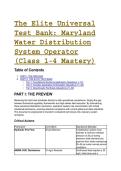
The Elite Universal
Test Bank: Maryland
Water Distribution
System Operator
(Class 1-4 Mastery)
Table of Contents
1. PART I: THE PREVIEW
2. PART II: THE ELITE TEST BANK
○ Tier 1: Foundational Syntax & Application (Questions 1–10)
○ Tier 2: Complex Application & Simulation (Questions 11–20)
○ Tier 3: Grandmaster Synthesis (Questions 21–30)
PART I: THE PREVIEW
Mastering this test bank translates directly to elite operational competence, forging the gap
between theoretical regulatory frameworks and high-stakes field execution. By internalizing
these advanced distribution mechanics, operators replace rote memorization with critical
situational dominance, ensuring absolute compliance with current global and state standards.
This document is engineered to transform competent technicians into visionary system
architects.
Critical Axioms
Framework Core Metric Operational Mandate
Hydraulic Fire Flow 20 psi Minimum A distribution system must
maintain a minimum residual
pressure of 20 psi during
maximum daily demand plus
peak fire flow, while maintaining
35–40 psi under normal service
conditions.
AWWA C651 Disinfection 10 mg/L Residual Continuous feed requires a 25
mg/L initial dose and a
,Framework Core Metric Operational Mandate
minimum 10 mg/L residual after
24 hours. Emergency break
repairs utilize 300 mg/L for 15
minutes.
RTCR Compliance 24-Hour Action Window An E. coli positive routine
sample followed by any total
coliform positive repeat (or
failure to collect repeats)
mandates an immediate Level
2 Assessment and a Tier 1
Public Notice within 24 hours.
NFPA 291 Hydrants Flow Capacity Hierarchy Hydrant bonnets dictate tactical
flow: Class AA (Light Blue,
≥1500 GPM), Class A (Green,
1000–1499 GPM), Class B
(Orange, 500–999 GPM), and
Class C (Red, <500 GPM).
Transient Mitigation Orifice Sizing Air/Vacuum valves exhaust
large air volumes during filling,
while Air Release valves
exhaust micro-accumulations
continuously under dynamic
pressure.
PART II: THE ELITE TEST BANK
Tier 1: Foundational Syntax & Application
Q1: A fully certified Class 4 Water Distribution Operator in Maryland is preparing to renew their
license. Under COMAR 26.06.01, and incorporating recent federal regulatory updates, which
action is MANDATORY for their triennial renewal? A) Acquiring 30 Continuing Education Units
(CEUs) exclusively in business management, combined with a mandatory retake of the Class 4
state examination. B) Accumulating 30 Board-approved CEUs, combined with an active
Out-of-State reciprocity application to maintain superintendent status. C) Completing 30
Board-approved CEUs and completing the EPA Cybersecurity Training for Water and
Wastewater Systems prior to expiration. D) Earning 16 CEUs of process-related training and
passing a practical hands-on skills test administered by the Maryland Rural Water Association.
● Answer: C (Completing 30 Board-approved CEUs and completing the EPA Cybersecurity
Training for Water and Wastewater Systems prior to expiration.)
● Distractor Analysis:
○ A is incorrect: Operators are never required to retake the examination for a
standard, on-time renewal. Furthermore, business management units are
specifically reserved as an additional requirement for Superintendents, not standard
operators.
○ B is incorrect: Reciprocity is an initial licensing pathway designed for out-of-state
operators seeking Maryland credentials; it has no bearing on the triennial renewal
of an already certified Maryland operator.
, ○ D is incorrect: A Class 4 Operator requires a rigorous 30 CEUs, whereas the 16
CEU threshold is reserved for lower-tier Class 1 and 2 operators. Hands-on skills
tests are specific to sampler certifications, not advanced distribution renewals.
The Mentor's Analysis: When navigating triennial renewals, the immediate priority is
understanding exact statutory CEU thresholds and emerging federal mandates. By adhering to
COMAR 26.06.01 combined with the July 2025 EPA Cybersecurity mandate, you bypass the
common trap of confusing standard operator CEU targets with superintendent administrative
add-ons.
Certification Level Standard CEUs Required Superintendent Add-On
Class 1 & 2 16 units +7 units (Management)
Class 3 & 4 30 units +7 units (Management)
Professional/Academic Intuition: Class 3 and 4 operators must secure 30 CEUs every
three years, and cybersecurity compliance is now a non-negotiable hard deck for all
active licenses.
Q2: During the installation of a new 12-inch potable water main, an operator opts to use the
AWWA C651 Continuous-Feed Method for disinfection. What is the MINIMUM required free
chlorine residual that must be detected after the mandated 24-hour retention period? A) 0.2
mg/L B) 10.0 mg/L C) 25.0 mg/L D) 50.0 mg/L
● Answer: B (10.0 mg/L)
● Distractor Analysis:
○ A is incorrect: 0.2 mg/L is the minimum residual required after 24 hours when using
the Tablet Method. The Tablet Method has a lower starting threshold since it cannot
be pre-flushed to remove initial organic demand.
○ C is incorrect: 25.0 mg/L is the initial starting concentration required as the water
enters the new main, not the residual after 24 hours of organic consumption and
decay.
○ D is incorrect: 50.0 mg/L is a common maximum allowable limit or a dosage used in
specialized slug methods, not the standard 24-hour continuous-feed residual.
The Mentor's Analysis: When commissioning new mains, the immediate priority is verifying
pathogenic destruction without excessively degrading the pipeline's internal lining. By utilizing
the Continuous-Feed residual standard of 10.0 mg/L, you bypass the common trap of confusing
initial dosing parameters with final retention requirements. Professional/Academic Intuition:
Continuous-Feed requires a 25 mg/L initial dose and a minimum 10 mg/L residual after 24
hours; Tablet requires 25 mg/L initial but only a 0.2 mg/L residual due to the lack of
pre-flushing.
Q3: A municipal fire department is assessing water supply for a rapidly expanding industrial
park. An operator installs a new fire hydrant with a light blue bonnet and nozzle caps. According
to NFPA 291 standards, what does this specific color coding INDICATE regarding the hydrant's
tactical flow capacity? A) The hydrant is supplied by a private, non-potable water system. B) The
hydrant operates at a standard flow rate of 500 to 999 GPM. C) The hydrant is capable of
delivering 1,500 GPM or greater. D) The hydrant is currently out of service and drained to
prevent freezing.
● Answer: C (The hydrant is capable of delivering 1,500 GPM or greater.)
● Distractor Analysis:
○ A is incorrect: Violet or pale purple typically designates non-potable or reclaimed
water, while the barrel color (not the bonnet) often signifies private vs. municipal
systems (e.g., Red barrel for private).
Test Bank: Maryland
Water Distribution
System Operator
(Class 1-4 Mastery)
Table of Contents
1. PART I: THE PREVIEW
2. PART II: THE ELITE TEST BANK
○ Tier 1: Foundational Syntax & Application (Questions 1–10)
○ Tier 2: Complex Application & Simulation (Questions 11–20)
○ Tier 3: Grandmaster Synthesis (Questions 21–30)
PART I: THE PREVIEW
Mastering this test bank translates directly to elite operational competence, forging the gap
between theoretical regulatory frameworks and high-stakes field execution. By internalizing
these advanced distribution mechanics, operators replace rote memorization with critical
situational dominance, ensuring absolute compliance with current global and state standards.
This document is engineered to transform competent technicians into visionary system
architects.
Critical Axioms
Framework Core Metric Operational Mandate
Hydraulic Fire Flow 20 psi Minimum A distribution system must
maintain a minimum residual
pressure of 20 psi during
maximum daily demand plus
peak fire flow, while maintaining
35–40 psi under normal service
conditions.
AWWA C651 Disinfection 10 mg/L Residual Continuous feed requires a 25
mg/L initial dose and a
,Framework Core Metric Operational Mandate
minimum 10 mg/L residual after
24 hours. Emergency break
repairs utilize 300 mg/L for 15
minutes.
RTCR Compliance 24-Hour Action Window An E. coli positive routine
sample followed by any total
coliform positive repeat (or
failure to collect repeats)
mandates an immediate Level
2 Assessment and a Tier 1
Public Notice within 24 hours.
NFPA 291 Hydrants Flow Capacity Hierarchy Hydrant bonnets dictate tactical
flow: Class AA (Light Blue,
≥1500 GPM), Class A (Green,
1000–1499 GPM), Class B
(Orange, 500–999 GPM), and
Class C (Red, <500 GPM).
Transient Mitigation Orifice Sizing Air/Vacuum valves exhaust
large air volumes during filling,
while Air Release valves
exhaust micro-accumulations
continuously under dynamic
pressure.
PART II: THE ELITE TEST BANK
Tier 1: Foundational Syntax & Application
Q1: A fully certified Class 4 Water Distribution Operator in Maryland is preparing to renew their
license. Under COMAR 26.06.01, and incorporating recent federal regulatory updates, which
action is MANDATORY for their triennial renewal? A) Acquiring 30 Continuing Education Units
(CEUs) exclusively in business management, combined with a mandatory retake of the Class 4
state examination. B) Accumulating 30 Board-approved CEUs, combined with an active
Out-of-State reciprocity application to maintain superintendent status. C) Completing 30
Board-approved CEUs and completing the EPA Cybersecurity Training for Water and
Wastewater Systems prior to expiration. D) Earning 16 CEUs of process-related training and
passing a practical hands-on skills test administered by the Maryland Rural Water Association.
● Answer: C (Completing 30 Board-approved CEUs and completing the EPA Cybersecurity
Training for Water and Wastewater Systems prior to expiration.)
● Distractor Analysis:
○ A is incorrect: Operators are never required to retake the examination for a
standard, on-time renewal. Furthermore, business management units are
specifically reserved as an additional requirement for Superintendents, not standard
operators.
○ B is incorrect: Reciprocity is an initial licensing pathway designed for out-of-state
operators seeking Maryland credentials; it has no bearing on the triennial renewal
of an already certified Maryland operator.
, ○ D is incorrect: A Class 4 Operator requires a rigorous 30 CEUs, whereas the 16
CEU threshold is reserved for lower-tier Class 1 and 2 operators. Hands-on skills
tests are specific to sampler certifications, not advanced distribution renewals.
The Mentor's Analysis: When navigating triennial renewals, the immediate priority is
understanding exact statutory CEU thresholds and emerging federal mandates. By adhering to
COMAR 26.06.01 combined with the July 2025 EPA Cybersecurity mandate, you bypass the
common trap of confusing standard operator CEU targets with superintendent administrative
add-ons.
Certification Level Standard CEUs Required Superintendent Add-On
Class 1 & 2 16 units +7 units (Management)
Class 3 & 4 30 units +7 units (Management)
Professional/Academic Intuition: Class 3 and 4 operators must secure 30 CEUs every
three years, and cybersecurity compliance is now a non-negotiable hard deck for all
active licenses.
Q2: During the installation of a new 12-inch potable water main, an operator opts to use the
AWWA C651 Continuous-Feed Method for disinfection. What is the MINIMUM required free
chlorine residual that must be detected after the mandated 24-hour retention period? A) 0.2
mg/L B) 10.0 mg/L C) 25.0 mg/L D) 50.0 mg/L
● Answer: B (10.0 mg/L)
● Distractor Analysis:
○ A is incorrect: 0.2 mg/L is the minimum residual required after 24 hours when using
the Tablet Method. The Tablet Method has a lower starting threshold since it cannot
be pre-flushed to remove initial organic demand.
○ C is incorrect: 25.0 mg/L is the initial starting concentration required as the water
enters the new main, not the residual after 24 hours of organic consumption and
decay.
○ D is incorrect: 50.0 mg/L is a common maximum allowable limit or a dosage used in
specialized slug methods, not the standard 24-hour continuous-feed residual.
The Mentor's Analysis: When commissioning new mains, the immediate priority is verifying
pathogenic destruction without excessively degrading the pipeline's internal lining. By utilizing
the Continuous-Feed residual standard of 10.0 mg/L, you bypass the common trap of confusing
initial dosing parameters with final retention requirements. Professional/Academic Intuition:
Continuous-Feed requires a 25 mg/L initial dose and a minimum 10 mg/L residual after 24
hours; Tablet requires 25 mg/L initial but only a 0.2 mg/L residual due to the lack of
pre-flushing.
Q3: A municipal fire department is assessing water supply for a rapidly expanding industrial
park. An operator installs a new fire hydrant with a light blue bonnet and nozzle caps. According
to NFPA 291 standards, what does this specific color coding INDICATE regarding the hydrant's
tactical flow capacity? A) The hydrant is supplied by a private, non-potable water system. B) The
hydrant operates at a standard flow rate of 500 to 999 GPM. C) The hydrant is capable of
delivering 1,500 GPM or greater. D) The hydrant is currently out of service and drained to
prevent freezing.
● Answer: C (The hydrant is capable of delivering 1,500 GPM or greater.)
● Distractor Analysis:
○ A is incorrect: Violet or pale purple typically designates non-potable or reclaimed
water, while the barrel color (not the bonnet) often signifies private vs. municipal
systems (e.g., Red barrel for private).


