

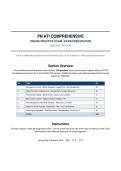
PN ATI COMPREHENSIVE
ONLINE PRACTICE EXAM - EXAM PREPARATION
2026/2027 EDITION
This is an independent practice exam for educational study; it is not an official ATI Testing proctored assessment.
Section Overview
This comprehensive online practice exam contains 150 questions across seven sections, aligned with the ATI PN
Comprehensive blueprint, the current NCLEX-PN test plan, NCSBN standards, and evidence-based practical nursing
practice for 2026/2027.
Sec Topic Qs
1 Management of Care - Safety, Delegation, Legal/Ethical, Case Management 25
2 Health Promotion & Maintenance - Development, Prenatal, Screening 20
3 Psychosocial Integrity - Mental Health, Coping, Communication 18
4 Basic Care & Comfort - Hygiene, Nutrition, Mobility, Pain 15
5 Pharmacological & Parenteral Therapies - Medications, IV, Blood 25
6 Reduction of Risk Potential - Diagnostics, Vitals, Labs, Complications 22
7 Physiological Adaptation - Fluid/Electrolytes, Pathophysiology, Acute/Chronic 25
TOTAL 150
Instructions
For each question, select the single best answer. Use the answer key at the end of the exam to check your work. Each
item includes a brief rationale explaining the correct response.
Answer Key Distribution: 38 A · 38 B · 37 C · 37 D
, Section 1: Management of Care - Safety, Delegation, Legal/Ethical, Case Management,
Infection Control
Q1: Which task can the PN appropriately delegate to a UAP?
A. Administering IV push medications
B. Assessing a client's new chest pain
C. Measuring routine vital signs on a stable client [CORRECT]
D. Developing the plan of care
Correct Answer: C
Rationale: UAPs can measure routine vital signs on stable clients. IV push, assessment, and care planning require licensed staff.
Q2: Which task is within the scope of a practical nurse (PN) when appropriately supervised?
A. Performing the initial comprehensive assessment
B. Evaluating client outcomes
C. Developing the nursing care plan
D. Reinforcing teaching and administering routine medications [CORRECT]
Correct Answer: D
Rationale: PNs reinforce teaching and give routine medications under supervision. Initial assessment, evaluation, and care-plan
development are RN responsibilities.
Q3: The PN is prioritizing care for four clients. Which client should be seen first?
A. A client requesting a snack
B. A client due for a routine dressing change
C. A client with new-onset chest pain and diaphoresis [CORRECT]
D. A client wanting discharge papers
Correct Answer: C
Rationale: New chest pain with diaphoresis suggests a cardiac emergency and takes priority using ABCs. The others are
lower-acuity.
Q4: A client with a do-not-resuscitate (DNR) order arrests. The PN should:
A. Begin CPR immediately
B. Call the family first
C. Provide comfort care as directed and not initiate resuscitation [CORRECT]
D. Ignore the DNR
Correct Answer: C
Rationale: A valid DNR means resuscitation should not be initiated; comfort care is provided per the order. Resuscitation would
violate the order.
Q5: Which action demonstrates client advocacy?
A. Following orders without question
B. Withholding information from the client
C. Speaking up when a client's stated wishes are not being followed [CORRECT]
D. Prioritizing the family over the client
Correct Answer: C
Rationale: Advocacy means supporting the client's rights and wishes. The other options are not advocacy.
Q6: The PN observes a colleague documenting care that was not provided. The PN should:
A. Ignore it
B. Do the same
C. Report the falsified documentation to the supervisor [CORRECT]
D. Keep it confidential
Correct Answer: C
Rationale: Falsified documentation is a serious violation that must be reported. Ignoring or participating is unacceptable.
Q7: When a fire is discovered, the PN's first priority is to:
PN ATI Comprehensive Online Practice - 2026/2027 Page 2
, A. Call the family
B. Remove clients from immediate danger (RACE) [CORRECT]
C. Document
D. Gather belongings
Correct Answer: B
Rationale: RACE prioritizes Rescue/Remove clients first, then Alarm, Contain, Extinguish. Client safety is the priority.
Q8: Which of the following is a primary responsibility of the PN in delegation?
A. Assigning tasks appropriately to UAPs and supervising them [CORRECT]
B. Delegating initial assessments
C. Delegating tasks outside the UAP's scope
D. Avoiding supervision
Correct Answer: A
Rationale: The PN assigns tasks within the UAP's scope and supervises. Initial assessments are not delegated.
Q9: A client's family asks the PN for a copy of the client's medical record. The PN should:
A. Hand over the records
B. Refuse to acknowledge the request
C. Explain that the client's authorization is required before releasing records [CORRECT]
D. Provide only verbal details
Correct Answer: C
Rationale: Releasing records to family generally requires the client's authorization. The other options are incorrect.
Q10: The PN is applying standard precautions. Which action is required?
A. Wearing gloves at all times
B. Avoiding all client contact
C. Hand hygiene and gloves when body-fluid contact is possible [CORRECT]
D. Using only contact precautions
Correct Answer: C
Rationale: Standard precautions include hand hygiene and gloves when blood/body-fluid contact is possible. The other options are
not standard precautions.
Q11: A client on transmission-based precautions for airborne infection (e.g., TB) requires:
A. Only gloves
B. No precautions
C. A negative-pressure room and an N95 respirator [CORRECT]
D. A private room with no mask
Correct Answer: C
Rationale: Airborne precautions require a negative-pressure room and N95 respirator. The other options are insufficient.
Q12: Which infection-control precaution is used for a client with a droplet-spread infection (e.g., influenza)?
A. Airborne precautions
B. Contact precautions only
C. No precautions
D. Droplet precautions with a surgical mask [CORRECT]
Correct Answer: D
Rationale: Droplet precautions require a surgical mask. Airborne is for smaller particles; contact is for skin contact.
Q13: A client signs an against-medical-advice (AMA) form. The PN should:
A. Ensure the client understands the risks, document, and support their decision [CORRECT]
B. Physically prevent them from leaving
C. Ignore them
D. Force treatment
Correct Answer: A
Rationale: The PN ensures informed decision-making, documents, and respects autonomy. Physical restraint or forcing treatment
is wrong.
PN ATI Comprehensive Online Practice - 2026/2027 Page 3
ONLINE PRACTICE EXAM - EXAM PREPARATION
2026/2027 EDITION
This is an independent practice exam for educational study; it is not an official ATI Testing proctored assessment.
Section Overview
This comprehensive online practice exam contains 150 questions across seven sections, aligned with the ATI PN
Comprehensive blueprint, the current NCLEX-PN test plan, NCSBN standards, and evidence-based practical nursing
practice for 2026/2027.
Sec Topic Qs
1 Management of Care - Safety, Delegation, Legal/Ethical, Case Management 25
2 Health Promotion & Maintenance - Development, Prenatal, Screening 20
3 Psychosocial Integrity - Mental Health, Coping, Communication 18
4 Basic Care & Comfort - Hygiene, Nutrition, Mobility, Pain 15
5 Pharmacological & Parenteral Therapies - Medications, IV, Blood 25
6 Reduction of Risk Potential - Diagnostics, Vitals, Labs, Complications 22
7 Physiological Adaptation - Fluid/Electrolytes, Pathophysiology, Acute/Chronic 25
TOTAL 150
Instructions
For each question, select the single best answer. Use the answer key at the end of the exam to check your work. Each
item includes a brief rationale explaining the correct response.
Answer Key Distribution: 38 A · 38 B · 37 C · 37 D
, Section 1: Management of Care - Safety, Delegation, Legal/Ethical, Case Management,
Infection Control
Q1: Which task can the PN appropriately delegate to a UAP?
A. Administering IV push medications
B. Assessing a client's new chest pain
C. Measuring routine vital signs on a stable client [CORRECT]
D. Developing the plan of care
Correct Answer: C
Rationale: UAPs can measure routine vital signs on stable clients. IV push, assessment, and care planning require licensed staff.
Q2: Which task is within the scope of a practical nurse (PN) when appropriately supervised?
A. Performing the initial comprehensive assessment
B. Evaluating client outcomes
C. Developing the nursing care plan
D. Reinforcing teaching and administering routine medications [CORRECT]
Correct Answer: D
Rationale: PNs reinforce teaching and give routine medications under supervision. Initial assessment, evaluation, and care-plan
development are RN responsibilities.
Q3: The PN is prioritizing care for four clients. Which client should be seen first?
A. A client requesting a snack
B. A client due for a routine dressing change
C. A client with new-onset chest pain and diaphoresis [CORRECT]
D. A client wanting discharge papers
Correct Answer: C
Rationale: New chest pain with diaphoresis suggests a cardiac emergency and takes priority using ABCs. The others are
lower-acuity.
Q4: A client with a do-not-resuscitate (DNR) order arrests. The PN should:
A. Begin CPR immediately
B. Call the family first
C. Provide comfort care as directed and not initiate resuscitation [CORRECT]
D. Ignore the DNR
Correct Answer: C
Rationale: A valid DNR means resuscitation should not be initiated; comfort care is provided per the order. Resuscitation would
violate the order.
Q5: Which action demonstrates client advocacy?
A. Following orders without question
B. Withholding information from the client
C. Speaking up when a client's stated wishes are not being followed [CORRECT]
D. Prioritizing the family over the client
Correct Answer: C
Rationale: Advocacy means supporting the client's rights and wishes. The other options are not advocacy.
Q6: The PN observes a colleague documenting care that was not provided. The PN should:
A. Ignore it
B. Do the same
C. Report the falsified documentation to the supervisor [CORRECT]
D. Keep it confidential
Correct Answer: C
Rationale: Falsified documentation is a serious violation that must be reported. Ignoring or participating is unacceptable.
Q7: When a fire is discovered, the PN's first priority is to:
PN ATI Comprehensive Online Practice - 2026/2027 Page 2
, A. Call the family
B. Remove clients from immediate danger (RACE) [CORRECT]
C. Document
D. Gather belongings
Correct Answer: B
Rationale: RACE prioritizes Rescue/Remove clients first, then Alarm, Contain, Extinguish. Client safety is the priority.
Q8: Which of the following is a primary responsibility of the PN in delegation?
A. Assigning tasks appropriately to UAPs and supervising them [CORRECT]
B. Delegating initial assessments
C. Delegating tasks outside the UAP's scope
D. Avoiding supervision
Correct Answer: A
Rationale: The PN assigns tasks within the UAP's scope and supervises. Initial assessments are not delegated.
Q9: A client's family asks the PN for a copy of the client's medical record. The PN should:
A. Hand over the records
B. Refuse to acknowledge the request
C. Explain that the client's authorization is required before releasing records [CORRECT]
D. Provide only verbal details
Correct Answer: C
Rationale: Releasing records to family generally requires the client's authorization. The other options are incorrect.
Q10: The PN is applying standard precautions. Which action is required?
A. Wearing gloves at all times
B. Avoiding all client contact
C. Hand hygiene and gloves when body-fluid contact is possible [CORRECT]
D. Using only contact precautions
Correct Answer: C
Rationale: Standard precautions include hand hygiene and gloves when blood/body-fluid contact is possible. The other options are
not standard precautions.
Q11: A client on transmission-based precautions for airborne infection (e.g., TB) requires:
A. Only gloves
B. No precautions
C. A negative-pressure room and an N95 respirator [CORRECT]
D. A private room with no mask
Correct Answer: C
Rationale: Airborne precautions require a negative-pressure room and N95 respirator. The other options are insufficient.
Q12: Which infection-control precaution is used for a client with a droplet-spread infection (e.g., influenza)?
A. Airborne precautions
B. Contact precautions only
C. No precautions
D. Droplet precautions with a surgical mask [CORRECT]
Correct Answer: D
Rationale: Droplet precautions require a surgical mask. Airborne is for smaller particles; contact is for skin contact.
Q13: A client signs an against-medical-advice (AMA) form. The PN should:
A. Ensure the client understands the risks, document, and support their decision [CORRECT]
B. Physically prevent them from leaving
C. Ignore them
D. Force treatment
Correct Answer: A
Rationale: The PN ensures informed decision-making, documents, and respects autonomy. Physical restraint or forcing treatment
is wrong.
PN ATI Comprehensive Online Practice - 2026/2027 Page 3


