
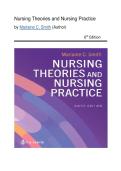
Nursing Theories and Nursing Practice
by Marlaine C. Smith (Author)
6th Edition
,TABLE OF CONTENTS
I. An Introduction to Nursing Theory
1. Nursing Theory and the Discipline of Nursing
2. A Guide for Theory-Informed Education and Practice
II. Conceptual Influences on the Evolution of Nursing
3. Florence Nightingale's Conceptualizations of Nursing
4. Early Conceptualizations About Nursing
III. Conceptual Models/Grand Theories in the Integrative-Interactive Paradigm
5. Dorothea Orem's Self-Care Deficit Theory
6. Imogene King's Conceptual System and Theory of Goal Attainment
7. Callista Roy's Adaptation Model
8. Betty Neuman's Systems Model
9. Helen Erickson, Evelyn Tomlin, and Mary Ann Swain's Theory of Modeling and Role Modeling
10. Barbara Dossey's Theory of Integral Nursing
11. Madeleine Leininger’s Theory of Culture Care Diversity and Universality
12. Boykin and Schoenhofer’s Theory of Nursing as Caring
IV. Conceptual Models/Grand Theories in the Unitary-Transformative Paradigm
13. Martha E. Rogers’s Science of Unitary Human Beings
14. Rosemarie Rizzo Parse’s Humanbecoming Paradigm
15. Margaret Newman’s Theory of Health as Expanding Consciousness
16. Jean Watson’s Unitary Caring Science and Transpersonal Theory of Human Caring
V. Middle-Range Theories
17. Afaf Meleis’s Transitions Theory
18. Katharine Kolcaba's Comfort Theory
19. Joanne Duffy's Quality-Caring Model
20. Pamela Reed's Theory of Self-Transcendence
21. Patricia Liehr and Mary Jane Smith's Story Theory
22. Marilyn Ray’s Theory of Bureaucratic Caring
,23. Rozzano Locsin's Theory of Technological Competency as Caring in Nursing
24. Elizabeth Ann Manhart Barrett’s Theory of Power as Knowing Participation in Change
25. Marlaine Smith's Theory of Unitary Caring
26. Kristen Swanson's Theory of Caring
27. Adeline Falk-Rafael’s Critical Caring Theory
28. Marilyn Parker, Charlotte Barry, and Beth King’s Community Nursing Practice Model
29. John Lowe’s Theory of Native Self-Reliance
30. Mona Wicks’s Family Health Model
31. Peggy Chinn’s Peace and Power: Philosophy, Theory, and Practice
, Test Bank: Nursing Theories and Nursing Practice, 6th Edition
Smith (2025) | Chapters 1–31
MULTIPLE CHOICE
UNIT I: EVOLUTION OF NURSING THEORY
CHAPTER 1: Introduction to Nursing Theory: Its History, Significance, and Analysis
1. A nursing student asks why nursing theories are important to professional practice. The best response
by the nursing instructor would be:
A) "Nursing theories are primarily used in academic settings and have little practical application."
B) "Nursing theories provide a systematic framework to guide practice, research, and education."
C) "Nursing theories were developed only to distinguish nursing from medicine."
D) "Nursing theories are optional tools that experienced nurses rarely use."
Answer: B
Rationale: Nursing theories provide structured frameworks that guide clinical practice, inform research,
and shape nursing education. They are foundational to the professional identity of nursing.
2. Which of the following best defines a nursing theory?
A) A set of rigid rules governing nursing practice
B) A collection of unrelated concepts used to describe patient care
C) An organized framework of concepts and propositions that describes, explains, or predicts
phenomena of concern to nursing
D) A philosophy about the meaning of human existence
Answer: C
Rationale: A nursing theory is defined as an organized set of concepts, definitions, and propositions that
projects a systematic view of phenomena by specifying relationships among variables.
by Marlaine C. Smith (Author)
6th Edition
,TABLE OF CONTENTS
I. An Introduction to Nursing Theory
1. Nursing Theory and the Discipline of Nursing
2. A Guide for Theory-Informed Education and Practice
II. Conceptual Influences on the Evolution of Nursing
3. Florence Nightingale's Conceptualizations of Nursing
4. Early Conceptualizations About Nursing
III. Conceptual Models/Grand Theories in the Integrative-Interactive Paradigm
5. Dorothea Orem's Self-Care Deficit Theory
6. Imogene King's Conceptual System and Theory of Goal Attainment
7. Callista Roy's Adaptation Model
8. Betty Neuman's Systems Model
9. Helen Erickson, Evelyn Tomlin, and Mary Ann Swain's Theory of Modeling and Role Modeling
10. Barbara Dossey's Theory of Integral Nursing
11. Madeleine Leininger’s Theory of Culture Care Diversity and Universality
12. Boykin and Schoenhofer’s Theory of Nursing as Caring
IV. Conceptual Models/Grand Theories in the Unitary-Transformative Paradigm
13. Martha E. Rogers’s Science of Unitary Human Beings
14. Rosemarie Rizzo Parse’s Humanbecoming Paradigm
15. Margaret Newman’s Theory of Health as Expanding Consciousness
16. Jean Watson’s Unitary Caring Science and Transpersonal Theory of Human Caring
V. Middle-Range Theories
17. Afaf Meleis’s Transitions Theory
18. Katharine Kolcaba's Comfort Theory
19. Joanne Duffy's Quality-Caring Model
20. Pamela Reed's Theory of Self-Transcendence
21. Patricia Liehr and Mary Jane Smith's Story Theory
22. Marilyn Ray’s Theory of Bureaucratic Caring
,23. Rozzano Locsin's Theory of Technological Competency as Caring in Nursing
24. Elizabeth Ann Manhart Barrett’s Theory of Power as Knowing Participation in Change
25. Marlaine Smith's Theory of Unitary Caring
26. Kristen Swanson's Theory of Caring
27. Adeline Falk-Rafael’s Critical Caring Theory
28. Marilyn Parker, Charlotte Barry, and Beth King’s Community Nursing Practice Model
29. John Lowe’s Theory of Native Self-Reliance
30. Mona Wicks’s Family Health Model
31. Peggy Chinn’s Peace and Power: Philosophy, Theory, and Practice
, Test Bank: Nursing Theories and Nursing Practice, 6th Edition
Smith (2025) | Chapters 1–31
MULTIPLE CHOICE
UNIT I: EVOLUTION OF NURSING THEORY
CHAPTER 1: Introduction to Nursing Theory: Its History, Significance, and Analysis
1. A nursing student asks why nursing theories are important to professional practice. The best response
by the nursing instructor would be:
A) "Nursing theories are primarily used in academic settings and have little practical application."
B) "Nursing theories provide a systematic framework to guide practice, research, and education."
C) "Nursing theories were developed only to distinguish nursing from medicine."
D) "Nursing theories are optional tools that experienced nurses rarely use."
Answer: B
Rationale: Nursing theories provide structured frameworks that guide clinical practice, inform research,
and shape nursing education. They are foundational to the professional identity of nursing.
2. Which of the following best defines a nursing theory?
A) A set of rigid rules governing nursing practice
B) A collection of unrelated concepts used to describe patient care
C) An organized framework of concepts and propositions that describes, explains, or predicts
phenomena of concern to nursing
D) A philosophy about the meaning of human existence
Answer: C
Rationale: A nursing theory is defined as an organized set of concepts, definitions, and propositions that
projects a systematic view of phenomena by specifying relationships among variables.


