

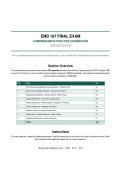
EMD 197 FINAL EXAM
COMPREHENSIVE PRACTICE EXAMINATION
2026/2027 EDITION
This is an independent practice exam for educational study; it is not an official APCO Institute EMD course final examination.
Section Overview
This comprehensive practice exam contains 250 questions across nine sections, aligned with the APCO Institute EMD
course 197 curriculum, current medical priority dispatch protocols, NAEMD standards, and evidence-based emergency
communications practices for 2026/2027.
Sec Topic Qs
1 EMD Roles, Responsibilities & Communications - Call-taking, DLS 40
2 Medical Priority Dispatch Protocols - BLS/ALS, Prioritization 35
3 Respiratory Emergencies - Dyspnea, Asthma, COPD, Airway 35
4 Cardiac Emergencies - Chest Pain, Cardiac Arrest 30
5 Medical Emergencies - Stroke, Diabetic, Anaphylaxis, Poisoning 30
6 Trauma Emergencies - Bleeding, Falls, MVCs 25
7 Obstetric, Pediatric & Geriatric Emergencies 25
8 Legal, Ethical & Operational Issues - HIPAA, Liability 15
9 Integrated Case Studies - Complex Scenarios 15
TOTAL 250
Instructions
For each question, select the single best answer. Use the answer key at the end of the exam to check your work. Each
item includes a brief rationale explaining the correct response.
Answer Key Distribution: 63 A · 63 B · 62 C · 62 D
, Section 1: EMD Roles, Responsibilities & Communications - Call-taking, Interrogation,
and Dispatch Life Support
Q1: The primary role of an Emergency Medical Dispatcher (EMD) is to:
A. Diagnose the patient's condition
B. Provide definitive medical care
C. Manage the call and provide appropriate dispatch and instructions to help the caller [CORRECT]
D. Transport the patient
Correct Answer: C
Rationale: The EMD manages calls, gathers information, dispatches appropriate resources, and provides instructions. They do not
diagnose, transport, or provide hands-on care.
Q2: 'Dispatch Life Support' (DLS) refers to:
A. Instructions provided by the EMD to help the caller manage the patient before responders arrive [CORRECT]
B. Physical care given by responders
C. Hospital care
D. Equipment checks
Correct Answer: A
Rationale: DLS is the telephone instructions the EMD gives to the caller to help the patient until responders arrive. It is not hands-on
care by the EMD.
Q3: The 'communications cycle' involves:
A. Only speaking
B. Only listening
C. A sender transmitting a message and a receiver providing feedback [CORRECT]
D. Sending without feedback
Correct Answer: C
Rationale: The communications cycle includes a sender, a message, a receiver, and feedback. Without feedback, communication is
incomplete.
Q4: Active listening by an EMD includes:
A. Speaking over the caller
B. Restating or summarizing what the caller said to confirm understanding [CORRECT]
C. Guessing the caller's meaning
D. Interrupting frequently
Correct Answer: B
Rationale: Active listening includes clarifying and summarizing to confirm understanding. Speaking over or interrupting the caller is not
active listening.
Q5: When a caller is hysterical and difficult to control, the EMD should:
A. Speak quietly and slowly with no urgency
B. Use a calm, firm, authoritative voice and redirect the caller to the priority questions [CORRECT]
C. Hang up
D. Argue with the caller
Correct Answer: B
Rationale: Call control uses a calm, firm, authoritative tone to redirect the caller. Hanging up, arguing, or lacking urgency are not
appropriate.
Q6: The purpose of telephone interrogation by the EMD is to:
A. Entertain the caller
B. Delay the response
C. Collect billing data
D. Gather critical information to determine the appropriate response and instructions [CORRECT]
Correct Answer: D
Rationale: Interrogation gathers critical information to prioritize and determine the response. It is not for entertainment or delay.
Q7: Which of the following is a 'critical EMD information' (CEI) element?
EMD 197 Final Exam - 2026/2027 Practice Page 2
, A. The caller's favorite color
B. The patient's income
C. The caller's phone number and the patient's chief complaint [CORRECT]
D. The caller's opinion
Correct Answer: C
Rationale: CEI includes essential elements such as the callback number, location, and chief complaint. The other options are not CEI.
Q8: Post-dispatch instructions (PDI) are given to the caller:
A. Before gathering any information
B. Only to non-emergency callers
C. Never
D. After resources have been dispatched, to help the patient until they arrive [CORRECT]
Correct Answer: D
Rationale: PDI are instructions provided after dispatch to help the caller manage the patient until responders arrive. They are an
important EMD function.
Q9: The first priority of an EMD when answering a 911 call is to:
A. Ask the caller's name only
B. Diagnose the problem
C. Dispatch immediately without questions
D. Determine the location of the emergency [CORRECT]
Correct Answer: D
Rationale: Establishing the location is the first priority so help can be sent. Other information is gathered after location is confirmed.
Q10: A 'hot' response (using lights and sirens) is appropriate when:
A. The call is clearly non-emergent
B. The call involves a life-threatening condition requiring rapid response [CORRECT]
C. The caller requests it
D. No one is injured
Correct Answer: B
Rationale: A hot response is used for life-threatening emergencies requiring rapid response. Non-emergent calls do not warrant lights
and sirens.
Q11: A 'cold' response (no lights and sirens) is appropriate when:
A. The patient is in cardiac arrest
B. The call is non-life-threatening and rapid response is not required [CORRECT]
C. There is a mass casualty
D. Airway compromise exists
Correct Answer: B
Rationale: A cold response is used for non-life-threatening calls. Life-threatening calls require a hot response.
Q12: Which is an example of 'call control'?
A. Allowing the caller to talk about anything
B. Redirecting the caller to answer key questions while keeping them calm [CORRECT]
C. Ending the call quickly
D. Speaking over the caller constantly
Correct Answer: B
Rationale: Call control keeps the call focused and the caller calm while gathering key information. Allowing rambling or constant
interruption is not call control.
Q13: The EMD should give instructions to the caller:
A. Using clear, simple, step-by-step language [CORRECT]
B. Using medical jargon
C. Quickly without explanation
D. Only if asked
Correct Answer: A
Rationale: Instructions should be clear, simple, and step-by-step so the caller can follow them. Jargon and rushed instructions confuse
callers.
EMD 197 Final Exam - 2026/2027 Practice Page 3
, Q14: A caller reports difficulty understanding the EMD. The EMD should:
A. Speak faster
B. Use more jargon
C. End the call
D. Slow down, use simpler terms, and confirm understanding [CORRECT]
Correct Answer: D
Rationale: The EMD should adapt by slowing down, simplifying, and confirming understanding. Faster speech or jargon worsens the
problem.
Q15: The primary goal of EMD interrogation is to:
A. Fill time
B. Collect personal data
C. Determine the priority of the call and the appropriate resources [CORRECT]
D. Rank callers
Correct Answer: C
Rationale: Interrogation determines call priority and resource needs. It is not about filling time or collecting unnecessary data.
Q16: When gathering information, the EMD should:
A. Ask one question at a time and listen to the answer [CORRECT]
B. Ask many questions at once
C. Ignore answers
D. Rush the caller
Correct Answer: A
Rationale: Asking one question at a time and listening promotes accuracy. Overwhelming the caller with multiple questions causes
confusion.
Q17: The EMD's responsibility regarding the caller's emotional state is to:
A. Recognize distress and provide reassurance while maintaining control [CORRECT]
B. Ignore emotions
C. Only focus on the questions
D. Become emotional too
Correct Answer: A
Rationale: The EMD should recognize and manage the caller's distress while maintaining control of the call. Ignoring emotions or
becoming emotional is not effective.
Q18: Which is an appropriate way to end a 911 call?
A. Immediately after questions
B. Without confirmation
C. Only after confirming the caller has no further needs and appropriate help is dispatched [CORRECT]
D. Before dispatch
Correct Answer: C
Rationale: The call is ended after confirming the caller is informed, help is dispatched, and there are no further needs. Ending too
early is unsafe.
Q19: The EMD's role in providing DLS instructions is:
A. To replace EMS care
B. To assist the caller in helping the patient until responders arrive [CORRECT]
C. To diagnose
D. To transport
Correct Answer: B
Rationale: DLS provides caller assistance until responders arrive. It does not replace EMS care or involve diagnosis/transport.
Q20: A caller is providing incomplete information. The EMD should:
A. Ask specific, focused questions to gather the needed information [CORRECT]
B. Accept the incomplete information
C. End the call
D. Guess
EMD 197 Final Exam - 2026/2027 Practice Page 4
COMPREHENSIVE PRACTICE EXAMINATION
2026/2027 EDITION
This is an independent practice exam for educational study; it is not an official APCO Institute EMD course final examination.
Section Overview
This comprehensive practice exam contains 250 questions across nine sections, aligned with the APCO Institute EMD
course 197 curriculum, current medical priority dispatch protocols, NAEMD standards, and evidence-based emergency
communications practices for 2026/2027.
Sec Topic Qs
1 EMD Roles, Responsibilities & Communications - Call-taking, DLS 40
2 Medical Priority Dispatch Protocols - BLS/ALS, Prioritization 35
3 Respiratory Emergencies - Dyspnea, Asthma, COPD, Airway 35
4 Cardiac Emergencies - Chest Pain, Cardiac Arrest 30
5 Medical Emergencies - Stroke, Diabetic, Anaphylaxis, Poisoning 30
6 Trauma Emergencies - Bleeding, Falls, MVCs 25
7 Obstetric, Pediatric & Geriatric Emergencies 25
8 Legal, Ethical & Operational Issues - HIPAA, Liability 15
9 Integrated Case Studies - Complex Scenarios 15
TOTAL 250
Instructions
For each question, select the single best answer. Use the answer key at the end of the exam to check your work. Each
item includes a brief rationale explaining the correct response.
Answer Key Distribution: 63 A · 63 B · 62 C · 62 D
, Section 1: EMD Roles, Responsibilities & Communications - Call-taking, Interrogation,
and Dispatch Life Support
Q1: The primary role of an Emergency Medical Dispatcher (EMD) is to:
A. Diagnose the patient's condition
B. Provide definitive medical care
C. Manage the call and provide appropriate dispatch and instructions to help the caller [CORRECT]
D. Transport the patient
Correct Answer: C
Rationale: The EMD manages calls, gathers information, dispatches appropriate resources, and provides instructions. They do not
diagnose, transport, or provide hands-on care.
Q2: 'Dispatch Life Support' (DLS) refers to:
A. Instructions provided by the EMD to help the caller manage the patient before responders arrive [CORRECT]
B. Physical care given by responders
C. Hospital care
D. Equipment checks
Correct Answer: A
Rationale: DLS is the telephone instructions the EMD gives to the caller to help the patient until responders arrive. It is not hands-on
care by the EMD.
Q3: The 'communications cycle' involves:
A. Only speaking
B. Only listening
C. A sender transmitting a message and a receiver providing feedback [CORRECT]
D. Sending without feedback
Correct Answer: C
Rationale: The communications cycle includes a sender, a message, a receiver, and feedback. Without feedback, communication is
incomplete.
Q4: Active listening by an EMD includes:
A. Speaking over the caller
B. Restating or summarizing what the caller said to confirm understanding [CORRECT]
C. Guessing the caller's meaning
D. Interrupting frequently
Correct Answer: B
Rationale: Active listening includes clarifying and summarizing to confirm understanding. Speaking over or interrupting the caller is not
active listening.
Q5: When a caller is hysterical and difficult to control, the EMD should:
A. Speak quietly and slowly with no urgency
B. Use a calm, firm, authoritative voice and redirect the caller to the priority questions [CORRECT]
C. Hang up
D. Argue with the caller
Correct Answer: B
Rationale: Call control uses a calm, firm, authoritative tone to redirect the caller. Hanging up, arguing, or lacking urgency are not
appropriate.
Q6: The purpose of telephone interrogation by the EMD is to:
A. Entertain the caller
B. Delay the response
C. Collect billing data
D. Gather critical information to determine the appropriate response and instructions [CORRECT]
Correct Answer: D
Rationale: Interrogation gathers critical information to prioritize and determine the response. It is not for entertainment or delay.
Q7: Which of the following is a 'critical EMD information' (CEI) element?
EMD 197 Final Exam - 2026/2027 Practice Page 2
, A. The caller's favorite color
B. The patient's income
C. The caller's phone number and the patient's chief complaint [CORRECT]
D. The caller's opinion
Correct Answer: C
Rationale: CEI includes essential elements such as the callback number, location, and chief complaint. The other options are not CEI.
Q8: Post-dispatch instructions (PDI) are given to the caller:
A. Before gathering any information
B. Only to non-emergency callers
C. Never
D. After resources have been dispatched, to help the patient until they arrive [CORRECT]
Correct Answer: D
Rationale: PDI are instructions provided after dispatch to help the caller manage the patient until responders arrive. They are an
important EMD function.
Q9: The first priority of an EMD when answering a 911 call is to:
A. Ask the caller's name only
B. Diagnose the problem
C. Dispatch immediately without questions
D. Determine the location of the emergency [CORRECT]
Correct Answer: D
Rationale: Establishing the location is the first priority so help can be sent. Other information is gathered after location is confirmed.
Q10: A 'hot' response (using lights and sirens) is appropriate when:
A. The call is clearly non-emergent
B. The call involves a life-threatening condition requiring rapid response [CORRECT]
C. The caller requests it
D. No one is injured
Correct Answer: B
Rationale: A hot response is used for life-threatening emergencies requiring rapid response. Non-emergent calls do not warrant lights
and sirens.
Q11: A 'cold' response (no lights and sirens) is appropriate when:
A. The patient is in cardiac arrest
B. The call is non-life-threatening and rapid response is not required [CORRECT]
C. There is a mass casualty
D. Airway compromise exists
Correct Answer: B
Rationale: A cold response is used for non-life-threatening calls. Life-threatening calls require a hot response.
Q12: Which is an example of 'call control'?
A. Allowing the caller to talk about anything
B. Redirecting the caller to answer key questions while keeping them calm [CORRECT]
C. Ending the call quickly
D. Speaking over the caller constantly
Correct Answer: B
Rationale: Call control keeps the call focused and the caller calm while gathering key information. Allowing rambling or constant
interruption is not call control.
Q13: The EMD should give instructions to the caller:
A. Using clear, simple, step-by-step language [CORRECT]
B. Using medical jargon
C. Quickly without explanation
D. Only if asked
Correct Answer: A
Rationale: Instructions should be clear, simple, and step-by-step so the caller can follow them. Jargon and rushed instructions confuse
callers.
EMD 197 Final Exam - 2026/2027 Practice Page 3
, Q14: A caller reports difficulty understanding the EMD. The EMD should:
A. Speak faster
B. Use more jargon
C. End the call
D. Slow down, use simpler terms, and confirm understanding [CORRECT]
Correct Answer: D
Rationale: The EMD should adapt by slowing down, simplifying, and confirming understanding. Faster speech or jargon worsens the
problem.
Q15: The primary goal of EMD interrogation is to:
A. Fill time
B. Collect personal data
C. Determine the priority of the call and the appropriate resources [CORRECT]
D. Rank callers
Correct Answer: C
Rationale: Interrogation determines call priority and resource needs. It is not about filling time or collecting unnecessary data.
Q16: When gathering information, the EMD should:
A. Ask one question at a time and listen to the answer [CORRECT]
B. Ask many questions at once
C. Ignore answers
D. Rush the caller
Correct Answer: A
Rationale: Asking one question at a time and listening promotes accuracy. Overwhelming the caller with multiple questions causes
confusion.
Q17: The EMD's responsibility regarding the caller's emotional state is to:
A. Recognize distress and provide reassurance while maintaining control [CORRECT]
B. Ignore emotions
C. Only focus on the questions
D. Become emotional too
Correct Answer: A
Rationale: The EMD should recognize and manage the caller's distress while maintaining control of the call. Ignoring emotions or
becoming emotional is not effective.
Q18: Which is an appropriate way to end a 911 call?
A. Immediately after questions
B. Without confirmation
C. Only after confirming the caller has no further needs and appropriate help is dispatched [CORRECT]
D. Before dispatch
Correct Answer: C
Rationale: The call is ended after confirming the caller is informed, help is dispatched, and there are no further needs. Ending too
early is unsafe.
Q19: The EMD's role in providing DLS instructions is:
A. To replace EMS care
B. To assist the caller in helping the patient until responders arrive [CORRECT]
C. To diagnose
D. To transport
Correct Answer: B
Rationale: DLS provides caller assistance until responders arrive. It does not replace EMS care or involve diagnosis/transport.
Q20: A caller is providing incomplete information. The EMD should:
A. Ask specific, focused questions to gather the needed information [CORRECT]
B. Accept the incomplete information
C. End the call
D. Guess
EMD 197 Final Exam - 2026/2027 Practice Page 4


