

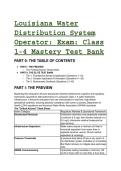
Louisiana Water
Distribution System
Operator: Exam: Class
1-4 Mastery Test Bank
PART 0: THE TABLE OF CONTENTS
● PART I: THE PREVIEW
○ The "Critical Axioms" Cheat Sheet
● PART II: THE ELITE TEST BANK
○ Tier 1: Foundational Syntax & Application (Questions 1–10)
○ Tier 2: Complex Application & Simulation (Questions 11–20)
○ Tier 3: Grandmaster Synthesis (Questions 21–30)
PART I: THE PREVIEW
Mastering this exhaustive 30-point assessment directly hardwires the cognitive and regulatory
frameworks required for elite performance in Louisiana's Class 1-4 water distribution
infrastructure. It forces the transition from rote memorization to real-time, high-stakes
operational synthesis, ensuring absolute compliance with current Louisiana Department of
Health (LDH) regulations and American Water Works Association (AWWA) standards.
The "Critical Axioms" Cheat Sheet:
Axiom Category Regulatory Mandate & Operational Framework
Disinfectant Residuals Distribution networks must perpetually maintain
a minimum 0.5 mg/L free chlorine residual or a
0.5 mg/L chloramine residual (measured as
total chlorine).
Infrastructure Separation Water mains require a minimum of 6 feet of
horizontal separation from sewer lines in
separate trenches, and an 18-inch vertical
separation at crossings.
Pressure Thresholds A pressure drop below 20 psi in any sector of
the distribution system mandates an immediate
Boil Water Advisory to mitigate back-siphonage
risks.
AWWA Commissioning Hydrostatic testing mandates a minimum 150
psi for 2 hours with no more than a 5 psi drop.
,Axiom Category Regulatory Mandate & Operational Framework
Main disinfection via continuous-feed requires
an initial 25 mg/L dose and a minimum 10 mg/L
residual after 24 hours.
Accountability & RTCR Failing to collect repeat positive Total Coliform
samples within 24 hours violates the Revised
Total Coliform Rule (RTCR). An "F" grade under
the Community Water System Accountability
Rule blocks a municipality from diverting water
revenue.
PART II: THE ELITE TEST BANK
Tier 1: Foundational Syntax & Application
Q1: A Louisiana municipality is expanding its utility infrastructure to accommodate a growing
population, which has recently surpassed 28,000 residents. Based on the principles of the
Louisiana Operator Certification Program, which action/conclusion is the MOST ACCURATE
regarding the classification of this system? A) The system is classified as a Class 1 facility, as it
operates under 50,000 service connections. B) The system is classified as a Class 2 facility,
because the population threshold remains strictly below 50,000 residents. C) The system is
unequivocally classified as a Class 4 facility, because the infrastructure serves a population
greater than 25,000. D) The system remains a Class 3 facility, because population
classifications for standard municipal distributions cap at 25,000.
● Answer: C (The system is unequivocally classified as a Class 4 facility, because the
infrastructure serves a population greater than 25,000.)
● Distractor Analysis:
○ A is incorrect: Class 1 applies strictly to systems serving fewer than 1,000 people.
Applying a "service connection" metric of 50,000 is an analytical error drawn from
out-of-state regulations.
○ B is incorrect: Class 2 applies to systems serving 1,001 to 5,000 people, not
populations up to 50,000. This reflects a misunderstanding of the tier scaling.
○ D is incorrect: The classification system does not cap at Class 3 (which covers
5,001 to 25,000 residents). Class 4 specifically captures any system serving a
population greater than 25,000.
The Mentor's Analysis: Population metrics dictate the rigorousness of required oversight and
the level of licensure demanded of the Chief Operator. When facing population expansions, the
immediate priority is aligning operator credentials with the new facility classification to prevent
regulatory operating violations. By utilizing LDH Classification Standards, you bypass the
common trap of misapplying wastewater treatment design capacity to drinking water population
metrics. Professional/Academic Intuition: System classification scales linearly with
population risk; Class 4 is the apex designation for populations over 25,000.
Q2: A certified Class 2 Water Distribution Operator in Louisiana is nearing the end of their
certification cycle. Based on the principles of the LDH Operator Certification Rule, which
action/conclusion is the MOST ACCURATE to ensure lawful renewal? A) The operator must
complete 10 Continuing Education Units (CEUs) specifically in advanced mathematics every
year. B) The operator must complete a 32-hour exam prep course strictly in the month prior to
expiration to re-certify their credentials. C) The operator must complete 24 continuing education
, hours (CEH) per certificate over the 3-year renewal period. D) The operator must retake the
Class 2 written exam with a score of at least 70 percent to prove ongoing competency.
● Answer: C (The operator must complete 24 continuing education hours (CEH) per
certificate over the 3-year renewal period.)
● Distractor Analysis:
○ A is incorrect: While mathematics is a vital competency, the regulatory requirement
is strictly 24 hours of total approved CEH over three years, not an arbitrary annual
CEU metric dedicated solely to math.
○ B is incorrect: A 32-hour prep course is an initial prerequisite for sitting for closed
exams, not the ongoing renewal standard for active operators.
○ D is incorrect: Re-testing is only required if the license has lapsed beyond the grace
period (usually 2 years), not for standard ongoing renewal of an active certificate.
The Mentor's Analysis: Regulatory compliance requires continuous professional development
to prevent operational stagnation and protect public health. When facing certification renewal,
the immediate priority is tracking approved continuing education hours accurately over the
compliance cycle. By utilizing the 3-year/24-CEH Rule, you bypass the common trap of
assuming initial licensure exam requirements apply to standard operational renewals.
Professional/Academic Intuition: Maintain 24 continuing education hours every three
years to sustain operational authority and prevent licensure lapse.
Q3: A newly constructed groundwater public water supply system is coming online to serve a
rural subdivision. Based on the principles of LAC 51:XII, which action/conclusion regarding the
minimum required disinfectant residual in the distribution system is the MOST ACCURATE? A)
The system must maintain a 0.2 mg/L free chlorine residual to match legacy federal EPA
guidelines. B) The system must maintain a 4.0 mg/L free chlorine residual at all dead-end
flushing points to prevent biofilm accumulation. C) The system must maintain a minimum free
chlorine residual of 0.5 mg/L at all points throughout the distribution network at all times. D) The
system must inject chlorite to achieve a 0.5 mg/L residual before the water reaches the first
customer.
● Answer: C (The system must maintain a minimum free chlorine residual of 0.5 mg/L at all
points throughout the distribution network at all times.)
● Distractor Analysis:
○ A is incorrect: While 0.2 mg/L is a known historical minimum in some jurisdictions
(and a common novice misconception), Louisiana specifically mandates a stricter
0.5 mg/L minimum to counter persistent microbial threats.
○ B is incorrect: 4.0 mg/L is the Maximum Residual Disinfectant Level (MRDL) under
federal law, representing the legal ceiling, not the required operational minimum.
○ D is incorrect: Chlorite is a toxic disinfection byproduct of chlorine dioxide, not an
approved primary residual disinfectant for distribution networks.
The Mentor's Analysis: Pathogen intrusion remains a constant, invisible threat in pressurized
networks due to micro-leaks and cross-connections. When facing distribution water quality
management, the immediate priority is maintaining an aggressive, measurable chemical barrier
at all extremities of the grid. By utilizing LAC 51:XII Mandatory Disinfection Minimums, you
bypass the common trap of adhering to outdated or out-of-state federal minimums that leave the
network vulnerable to opportunistic pathogens. Professional/Academic Intuition: 0.5 mg/L
free chlorine is the absolute operational floor for Louisiana distribution systems;
anything lower is an actionable sanitary defect.
Q4: A contractor is designing a parallel trenching plan for a new subdivision's utility corridor.
Based on the principles of the Louisiana Sanitary Code (LAC 51:XII.341), which
Distribution System
Operator: Exam: Class
1-4 Mastery Test Bank
PART 0: THE TABLE OF CONTENTS
● PART I: THE PREVIEW
○ The "Critical Axioms" Cheat Sheet
● PART II: THE ELITE TEST BANK
○ Tier 1: Foundational Syntax & Application (Questions 1–10)
○ Tier 2: Complex Application & Simulation (Questions 11–20)
○ Tier 3: Grandmaster Synthesis (Questions 21–30)
PART I: THE PREVIEW
Mastering this exhaustive 30-point assessment directly hardwires the cognitive and regulatory
frameworks required for elite performance in Louisiana's Class 1-4 water distribution
infrastructure. It forces the transition from rote memorization to real-time, high-stakes
operational synthesis, ensuring absolute compliance with current Louisiana Department of
Health (LDH) regulations and American Water Works Association (AWWA) standards.
The "Critical Axioms" Cheat Sheet:
Axiom Category Regulatory Mandate & Operational Framework
Disinfectant Residuals Distribution networks must perpetually maintain
a minimum 0.5 mg/L free chlorine residual or a
0.5 mg/L chloramine residual (measured as
total chlorine).
Infrastructure Separation Water mains require a minimum of 6 feet of
horizontal separation from sewer lines in
separate trenches, and an 18-inch vertical
separation at crossings.
Pressure Thresholds A pressure drop below 20 psi in any sector of
the distribution system mandates an immediate
Boil Water Advisory to mitigate back-siphonage
risks.
AWWA Commissioning Hydrostatic testing mandates a minimum 150
psi for 2 hours with no more than a 5 psi drop.
,Axiom Category Regulatory Mandate & Operational Framework
Main disinfection via continuous-feed requires
an initial 25 mg/L dose and a minimum 10 mg/L
residual after 24 hours.
Accountability & RTCR Failing to collect repeat positive Total Coliform
samples within 24 hours violates the Revised
Total Coliform Rule (RTCR). An "F" grade under
the Community Water System Accountability
Rule blocks a municipality from diverting water
revenue.
PART II: THE ELITE TEST BANK
Tier 1: Foundational Syntax & Application
Q1: A Louisiana municipality is expanding its utility infrastructure to accommodate a growing
population, which has recently surpassed 28,000 residents. Based on the principles of the
Louisiana Operator Certification Program, which action/conclusion is the MOST ACCURATE
regarding the classification of this system? A) The system is classified as a Class 1 facility, as it
operates under 50,000 service connections. B) The system is classified as a Class 2 facility,
because the population threshold remains strictly below 50,000 residents. C) The system is
unequivocally classified as a Class 4 facility, because the infrastructure serves a population
greater than 25,000. D) The system remains a Class 3 facility, because population
classifications for standard municipal distributions cap at 25,000.
● Answer: C (The system is unequivocally classified as a Class 4 facility, because the
infrastructure serves a population greater than 25,000.)
● Distractor Analysis:
○ A is incorrect: Class 1 applies strictly to systems serving fewer than 1,000 people.
Applying a "service connection" metric of 50,000 is an analytical error drawn from
out-of-state regulations.
○ B is incorrect: Class 2 applies to systems serving 1,001 to 5,000 people, not
populations up to 50,000. This reflects a misunderstanding of the tier scaling.
○ D is incorrect: The classification system does not cap at Class 3 (which covers
5,001 to 25,000 residents). Class 4 specifically captures any system serving a
population greater than 25,000.
The Mentor's Analysis: Population metrics dictate the rigorousness of required oversight and
the level of licensure demanded of the Chief Operator. When facing population expansions, the
immediate priority is aligning operator credentials with the new facility classification to prevent
regulatory operating violations. By utilizing LDH Classification Standards, you bypass the
common trap of misapplying wastewater treatment design capacity to drinking water population
metrics. Professional/Academic Intuition: System classification scales linearly with
population risk; Class 4 is the apex designation for populations over 25,000.
Q2: A certified Class 2 Water Distribution Operator in Louisiana is nearing the end of their
certification cycle. Based on the principles of the LDH Operator Certification Rule, which
action/conclusion is the MOST ACCURATE to ensure lawful renewal? A) The operator must
complete 10 Continuing Education Units (CEUs) specifically in advanced mathematics every
year. B) The operator must complete a 32-hour exam prep course strictly in the month prior to
expiration to re-certify their credentials. C) The operator must complete 24 continuing education
, hours (CEH) per certificate over the 3-year renewal period. D) The operator must retake the
Class 2 written exam with a score of at least 70 percent to prove ongoing competency.
● Answer: C (The operator must complete 24 continuing education hours (CEH) per
certificate over the 3-year renewal period.)
● Distractor Analysis:
○ A is incorrect: While mathematics is a vital competency, the regulatory requirement
is strictly 24 hours of total approved CEH over three years, not an arbitrary annual
CEU metric dedicated solely to math.
○ B is incorrect: A 32-hour prep course is an initial prerequisite for sitting for closed
exams, not the ongoing renewal standard for active operators.
○ D is incorrect: Re-testing is only required if the license has lapsed beyond the grace
period (usually 2 years), not for standard ongoing renewal of an active certificate.
The Mentor's Analysis: Regulatory compliance requires continuous professional development
to prevent operational stagnation and protect public health. When facing certification renewal,
the immediate priority is tracking approved continuing education hours accurately over the
compliance cycle. By utilizing the 3-year/24-CEH Rule, you bypass the common trap of
assuming initial licensure exam requirements apply to standard operational renewals.
Professional/Academic Intuition: Maintain 24 continuing education hours every three
years to sustain operational authority and prevent licensure lapse.
Q3: A newly constructed groundwater public water supply system is coming online to serve a
rural subdivision. Based on the principles of LAC 51:XII, which action/conclusion regarding the
minimum required disinfectant residual in the distribution system is the MOST ACCURATE? A)
The system must maintain a 0.2 mg/L free chlorine residual to match legacy federal EPA
guidelines. B) The system must maintain a 4.0 mg/L free chlorine residual at all dead-end
flushing points to prevent biofilm accumulation. C) The system must maintain a minimum free
chlorine residual of 0.5 mg/L at all points throughout the distribution network at all times. D) The
system must inject chlorite to achieve a 0.5 mg/L residual before the water reaches the first
customer.
● Answer: C (The system must maintain a minimum free chlorine residual of 0.5 mg/L at all
points throughout the distribution network at all times.)
● Distractor Analysis:
○ A is incorrect: While 0.2 mg/L is a known historical minimum in some jurisdictions
(and a common novice misconception), Louisiana specifically mandates a stricter
0.5 mg/L minimum to counter persistent microbial threats.
○ B is incorrect: 4.0 mg/L is the Maximum Residual Disinfectant Level (MRDL) under
federal law, representing the legal ceiling, not the required operational minimum.
○ D is incorrect: Chlorite is a toxic disinfection byproduct of chlorine dioxide, not an
approved primary residual disinfectant for distribution networks.
The Mentor's Analysis: Pathogen intrusion remains a constant, invisible threat in pressurized
networks due to micro-leaks and cross-connections. When facing distribution water quality
management, the immediate priority is maintaining an aggressive, measurable chemical barrier
at all extremities of the grid. By utilizing LAC 51:XII Mandatory Disinfection Minimums, you
bypass the common trap of adhering to outdated or out-of-state federal minimums that leave the
network vulnerable to opportunistic pathogens. Professional/Academic Intuition: 0.5 mg/L
free chlorine is the absolute operational floor for Louisiana distribution systems;
anything lower is an actionable sanitary defect.
Q4: A contractor is designing a parallel trenching plan for a new subdivision's utility corridor.
Based on the principles of the Louisiana Sanitary Code (LAC 51:XII.341), which


