

Oregon Drinking Water
Treatment Operator
Exam: S-Tier Universal
Mastery Test Bank
PART 0: THE TABLE OF CONTENTS
● PART I: THE PREVIEW
● PART II: THE ELITE TEST BANK
○ Tier 1: Foundational Syntax & Application (Questions 1–10)
○ Tier 2: Complex Application & Simulation (Questions 11–20)
○ Tier 3: Grandmaster Synthesis (Questions 21–30)
● PART III: STRATEGIC SYNTHESIS & CONCLUSIONS
PART I: THE PREVIEW
Mastering this elite test bank translates directly to operational supremacy, transforming baseline
academic knowledge into high-stakes, real-world analytical competence required for top-tier
facility management. The rigorous cognitive progression within this document systematically
eliminates reliance on rote memorization, replacing it with an impenetrable understanding of the
interconnected physical, chemical, and regulatory frameworks governing global and
Oregon-specific drinking water standards.
To operate at the highest echelons of public health engineering, you must internalize the
following structural, chemical, and regulatory hard decks. The data provided below is not for
casual review; it constitutes the mathematical and legislative boundaries of your profession.
The "Critical Axioms" Data Matrix
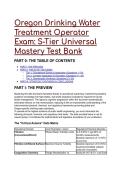
Operational Domain Core Parameter / Axiom Regulatory/Chemical Absolute
Filtration Filtered Water Turbidity Limits \le 0.3 NTU in \ge 95\% of
(Conventional/Direct) monthly measurements;
Absolute maximum of 1.0 NTU
at any time.
Filtration (Unfiltered Surface) Maximum Source Turbidity Absolute maximum of 5.0 NTU,
requiring immediate violation
protocols if exceeded.
Coagulation Chemistry Charge Neutralization vs. Acidic pH (4.5–6.0) + Low Dose
,Operational Domain Core Parameter / Axiom Regulatory/Chemical Absolute
Sweep = Charge Neutralization
(Targets Organics/Color);
Neutral pH (6.0–8.0) + High
Dose = Sweep Flocculation
(Targets Turbidity).
Oxidation Stoichiometry \text{KMnO}_4 Dosing Ratios 0.94 mg/L \text{KMnO}_4
required per 1.0 mg/L Iron
(\text{Fe}); 1.92 mg/L
\text{KMnO}_4 required per 1.0
mg/L Manganese (\text{Mn}).
Chemical Safety Chlorine Cylinder Fusible Plug Melts strictly between
158^\circ\text{F} and
165^\circ\text{F}
(70^\circ\text{C}–74^\circ\text{C
}) to prevent catastrophic
vessel rupture.
Disinfection Byproducts TTHM and HAA5 Compliance Calculated strictly via
(DBP) Locational Running Annual
Average (LRAA). Limits: TTHM
0.080 mg/L; HAA5 0.060 mg/L.
Operator Credentialing CEU to Academic Equivalency 45 Continuing Education Units
(CEUs) equates exactly to 12
months of post-high school
collegiate education.
GWUDI Timelines Interim Operation to Filtration 18 months maximum to install
filtration. Interim standards
require < 5.0 NTU and 1.0-log
Giardia inactivation daily.
Baffling Hydraulics Unbaffled Tank T_{10} Factor Factor of 0.1; Assume 90\% of
theoretical volume is lost to
extreme hydraulic
short-circuiting.
PART II: THE ELITE TEST BANK
Tier 1: Foundational Syntax & Application (Questions 1–10)
Q1: A 5 MGD conventional filtration plant is experiencing high source water turbidity due to a
recent storm event. The operator increases the aluminum sulfate (alum) dosage to 50 mg/L and
adjusts the pH to 7.2. Based on the principles of Coagulation Chemistry, which
action/conclusion is the MOST ACCURATE? A) The primary mechanism of particle
destabilization will be charge neutralization due to the high coagulant dose compressing the
electrical double layer. B) The alum will preferentially target and remove dissolved organic
matter (DOM) over suspended colloidal particles at this pH. C) The primary mechanism of
particle removal will be sweep flocculation due to the neutral pH and high coagulant dosage. D)
The coagulation process will fail because aluminum sulfate requires an alkaline pH above 8.5 to
, form precipitates.
● Answer: C (The primary mechanism of particle removal will be sweep flocculation due to
the neutral pH and high coagulant dosage.)
● Distractor Analysis:
○ A is incorrect: Charge neutralization is dominant at lower coagulant dosages and
acidic pH levels (typically 4.5 to 6.0), not at high dosages with neutral pH where
precipitation dominates.
○ B is incorrect: Targeting dissolved organic matter (NOM/DOM) is highly efficient
under charge neutralization conditions (acidic pH), not the sweep flocculation
conditions present here.
○ D is incorrect: Alum coagulation efficiency deteriorates rapidly at a pH above 8.5
due to the formation of soluble aluminate ions, not insoluble precipitates.
The Mentor's Analysis: The physical chemistry of aluminum-based coagulants is highly pH
and dose-dependent. At neutral pH (6.0–8.0) and elevated dosages, amorphous solid-phase
aluminum hydroxide rapidly precipitates, physically enmeshing colloidal particles in a heavy
"sweep floc". By leveraging this mechanism, operators effectively manage massive particulate
and turbidity loading. Professional/Academic Intuition: Alum coagulation mechanisms
pivot on pH: Acidic pH drives charge neutralization for color/organics; neutral pH drives
sweep flocculation for heavy turbidity.
Q2: During a severe summer heatwave, an operator notices that 150-pound liquid chlorine
cylinders stored outdoors in direct sunlight are becoming dangerously hot. Based on the
principles of Hazardous Gas Storage and Safety, which action/conclusion is the FIRST and
MOST ACCURATE consequence of this condition? A) The chlorine gas will auto-ignite if the
internal cylinder temperature reaches 135^\circ\text{F}. B) The internal rupture disc will shatter,
releasing the gas into the secondary containment scrubber. C) The fusible plug on the cylinder
valve will melt at temperatures between 158^\circ\text{F} and 165^\circ\text{F}, venting the gas
to the atmosphere. D) The liquid chlorine will undergo rapid phase separation, rendering the
vacuum regulator inoperable.
● Answer: C (The fusible plug on the cylinder valve will melt at temperatures between
158^\circ\text{F} and 165^\circ\text{F}, venting the gas to the atmosphere.)
● Distractor Analysis:
○ A is incorrect: Chlorine is a powerful oxidizer but it is not flammable and does not
auto-ignite, though it fiercely supports the combustion of other materials.
○ B is incorrect: Standard 150-pound and ton cylinders utilize specific fusible metal
plugs, not pressure-shattering rupture discs, as their primary catastrophic
overpressure safeguard.
○ D is incorrect: While temperature heavily affects vapor pressure, phase separation
is not the primary immediate hazard; engineered catastrophic pressure release is
the designed safety response.
The Mentor's Analysis: Standard compressed gas containment relies on predictable thermal
failure points to prevent explosive vessel rupture. Fusible plugs are engineered with a specific
bismuth/lead/tin alloy that melts strictly between 158^\circ\text{F} and 165^\circ\text{F}
(70^\circ\text{C}–74^\circ\text{C}). Unshaded outdoor storage poses a severe risk of triggering
these safety mechanisms, turning a thermal problem into a toxic gas emergency.
Professional/Academic Intuition: Never store chlorine cylinders in direct sunlight; the
158^\circ\text{F} fusible plug is a final fail-safe to prevent explosions, not an operational
venting mechanism.
Q3: A community water system utilizes a conventional filtration treatment plant treating surface
Treatment Operator
Exam: S-Tier Universal
Mastery Test Bank
PART 0: THE TABLE OF CONTENTS
● PART I: THE PREVIEW
● PART II: THE ELITE TEST BANK
○ Tier 1: Foundational Syntax & Application (Questions 1–10)
○ Tier 2: Complex Application & Simulation (Questions 11–20)
○ Tier 3: Grandmaster Synthesis (Questions 21–30)
● PART III: STRATEGIC SYNTHESIS & CONCLUSIONS
PART I: THE PREVIEW
Mastering this elite test bank translates directly to operational supremacy, transforming baseline
academic knowledge into high-stakes, real-world analytical competence required for top-tier
facility management. The rigorous cognitive progression within this document systematically
eliminates reliance on rote memorization, replacing it with an impenetrable understanding of the
interconnected physical, chemical, and regulatory frameworks governing global and
Oregon-specific drinking water standards.
To operate at the highest echelons of public health engineering, you must internalize the
following structural, chemical, and regulatory hard decks. The data provided below is not for
casual review; it constitutes the mathematical and legislative boundaries of your profession.
The "Critical Axioms" Data Matrix
Operational Domain Core Parameter / Axiom Regulatory/Chemical Absolute
Filtration Filtered Water Turbidity Limits \le 0.3 NTU in \ge 95\% of
(Conventional/Direct) monthly measurements;
Absolute maximum of 1.0 NTU
at any time.
Filtration (Unfiltered Surface) Maximum Source Turbidity Absolute maximum of 5.0 NTU,
requiring immediate violation
protocols if exceeded.
Coagulation Chemistry Charge Neutralization vs. Acidic pH (4.5–6.0) + Low Dose
,Operational Domain Core Parameter / Axiom Regulatory/Chemical Absolute
Sweep = Charge Neutralization
(Targets Organics/Color);
Neutral pH (6.0–8.0) + High
Dose = Sweep Flocculation
(Targets Turbidity).
Oxidation Stoichiometry \text{KMnO}_4 Dosing Ratios 0.94 mg/L \text{KMnO}_4
required per 1.0 mg/L Iron
(\text{Fe}); 1.92 mg/L
\text{KMnO}_4 required per 1.0
mg/L Manganese (\text{Mn}).
Chemical Safety Chlorine Cylinder Fusible Plug Melts strictly between
158^\circ\text{F} and
165^\circ\text{F}
(70^\circ\text{C}–74^\circ\text{C
}) to prevent catastrophic
vessel rupture.
Disinfection Byproducts TTHM and HAA5 Compliance Calculated strictly via
(DBP) Locational Running Annual
Average (LRAA). Limits: TTHM
0.080 mg/L; HAA5 0.060 mg/L.
Operator Credentialing CEU to Academic Equivalency 45 Continuing Education Units
(CEUs) equates exactly to 12
months of post-high school
collegiate education.
GWUDI Timelines Interim Operation to Filtration 18 months maximum to install
filtration. Interim standards
require < 5.0 NTU and 1.0-log
Giardia inactivation daily.
Baffling Hydraulics Unbaffled Tank T_{10} Factor Factor of 0.1; Assume 90\% of
theoretical volume is lost to
extreme hydraulic
short-circuiting.
PART II: THE ELITE TEST BANK
Tier 1: Foundational Syntax & Application (Questions 1–10)
Q1: A 5 MGD conventional filtration plant is experiencing high source water turbidity due to a
recent storm event. The operator increases the aluminum sulfate (alum) dosage to 50 mg/L and
adjusts the pH to 7.2. Based on the principles of Coagulation Chemistry, which
action/conclusion is the MOST ACCURATE? A) The primary mechanism of particle
destabilization will be charge neutralization due to the high coagulant dose compressing the
electrical double layer. B) The alum will preferentially target and remove dissolved organic
matter (DOM) over suspended colloidal particles at this pH. C) The primary mechanism of
particle removal will be sweep flocculation due to the neutral pH and high coagulant dosage. D)
The coagulation process will fail because aluminum sulfate requires an alkaline pH above 8.5 to
, form precipitates.
● Answer: C (The primary mechanism of particle removal will be sweep flocculation due to
the neutral pH and high coagulant dosage.)
● Distractor Analysis:
○ A is incorrect: Charge neutralization is dominant at lower coagulant dosages and
acidic pH levels (typically 4.5 to 6.0), not at high dosages with neutral pH where
precipitation dominates.
○ B is incorrect: Targeting dissolved organic matter (NOM/DOM) is highly efficient
under charge neutralization conditions (acidic pH), not the sweep flocculation
conditions present here.
○ D is incorrect: Alum coagulation efficiency deteriorates rapidly at a pH above 8.5
due to the formation of soluble aluminate ions, not insoluble precipitates.
The Mentor's Analysis: The physical chemistry of aluminum-based coagulants is highly pH
and dose-dependent. At neutral pH (6.0–8.0) and elevated dosages, amorphous solid-phase
aluminum hydroxide rapidly precipitates, physically enmeshing colloidal particles in a heavy
"sweep floc". By leveraging this mechanism, operators effectively manage massive particulate
and turbidity loading. Professional/Academic Intuition: Alum coagulation mechanisms
pivot on pH: Acidic pH drives charge neutralization for color/organics; neutral pH drives
sweep flocculation for heavy turbidity.
Q2: During a severe summer heatwave, an operator notices that 150-pound liquid chlorine
cylinders stored outdoors in direct sunlight are becoming dangerously hot. Based on the
principles of Hazardous Gas Storage and Safety, which action/conclusion is the FIRST and
MOST ACCURATE consequence of this condition? A) The chlorine gas will auto-ignite if the
internal cylinder temperature reaches 135^\circ\text{F}. B) The internal rupture disc will shatter,
releasing the gas into the secondary containment scrubber. C) The fusible plug on the cylinder
valve will melt at temperatures between 158^\circ\text{F} and 165^\circ\text{F}, venting the gas
to the atmosphere. D) The liquid chlorine will undergo rapid phase separation, rendering the
vacuum regulator inoperable.
● Answer: C (The fusible plug on the cylinder valve will melt at temperatures between
158^\circ\text{F} and 165^\circ\text{F}, venting the gas to the atmosphere.)
● Distractor Analysis:
○ A is incorrect: Chlorine is a powerful oxidizer but it is not flammable and does not
auto-ignite, though it fiercely supports the combustion of other materials.
○ B is incorrect: Standard 150-pound and ton cylinders utilize specific fusible metal
plugs, not pressure-shattering rupture discs, as their primary catastrophic
overpressure safeguard.
○ D is incorrect: While temperature heavily affects vapor pressure, phase separation
is not the primary immediate hazard; engineered catastrophic pressure release is
the designed safety response.
The Mentor's Analysis: Standard compressed gas containment relies on predictable thermal
failure points to prevent explosive vessel rupture. Fusible plugs are engineered with a specific
bismuth/lead/tin alloy that melts strictly between 158^\circ\text{F} and 165^\circ\text{F}
(70^\circ\text{C}–74^\circ\text{C}). Unshaded outdoor storage poses a severe risk of triggering
these safety mechanisms, turning a thermal problem into a toxic gas emergency.
Professional/Academic Intuition: Never store chlorine cylinders in direct sunlight; the
158^\circ\text{F} fusible plug is a final fail-safe to prevent explosions, not an operational
venting mechanism.
Q3: A community water system utilizes a conventional filtration treatment plant treating surface


