

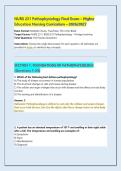
Exam Format: Multiple Choice, True/False, Fill-in-the-Blank
Target Course: NURS 231 / BIOD 331 Pathophysiology – Portage Learning
Total Questions: 150 Practice Questions
Instructions: Choose the single best answer for each question. All rationales are
provided in to reinforce key concepts.
1. Which of the following best defines pathophysiology?
A) The study of disease occurrence in human populations
B) The structural changes in cells and tissues during disease
C) The cellular and organ changes that occur with disease and the effects on total body
function
D) The naming and identification of a disease
Answer: C
2. A patient has an elevated temperature of 101°F and swelling in their right ankle
after a fall. The temperature and swelling are examples of:
A) Symptoms
B) Signs
C) Manifestations
D) Diagnosis
,Answer: B
3. Which of the following is an example of a chemical etiologic factor?
A) A virus
B) A burn
C) Alcohol poisoning
D) Genetic inheritance
Answer: C
4. The number of new cases of a disease in a population at a given time is called:
A) Prevalence
B) Incidence
C) Morbidity
D) Mortality
Answer: B
5. Which type of prevention is aimed at removing risk factors to prevent disease
from occurring?
A) Primary prevention
B) Secondary prevention
, C) Tertiary prevention
D) Quaternary prevention
Answer: A
6. A screening test has a high proportion of people with a disease who test
positive. This describes:
A) Specificity
B) Reliability
C) Sensitivity
D) Validity
Answer: C
7. A patient with chronic hypertension develops an enlarged left ventricle. This
cellular adaptation is best described as:
A) Hyperplasia
B) Hypertrophy
C) Atrophy
D) Metaplasia
Answer: B
Target Course: NURS 231 / BIOD 331 Pathophysiology – Portage Learning
Total Questions: 150 Practice Questions
Instructions: Choose the single best answer for each question. All rationales are
provided in to reinforce key concepts.
1. Which of the following best defines pathophysiology?
A) The study of disease occurrence in human populations
B) The structural changes in cells and tissues during disease
C) The cellular and organ changes that occur with disease and the effects on total body
function
D) The naming and identification of a disease
Answer: C
2. A patient has an elevated temperature of 101°F and swelling in their right ankle
after a fall. The temperature and swelling are examples of:
A) Symptoms
B) Signs
C) Manifestations
D) Diagnosis
,Answer: B
3. Which of the following is an example of a chemical etiologic factor?
A) A virus
B) A burn
C) Alcohol poisoning
D) Genetic inheritance
Answer: C
4. The number of new cases of a disease in a population at a given time is called:
A) Prevalence
B) Incidence
C) Morbidity
D) Mortality
Answer: B
5. Which type of prevention is aimed at removing risk factors to prevent disease
from occurring?
A) Primary prevention
B) Secondary prevention
, C) Tertiary prevention
D) Quaternary prevention
Answer: A
6. A screening test has a high proportion of people with a disease who test
positive. This describes:
A) Specificity
B) Reliability
C) Sensitivity
D) Validity
Answer: C
7. A patient with chronic hypertension develops an enlarged left ventricle. This
cellular adaptation is best described as:
A) Hyperplasia
B) Hypertrophy
C) Atrophy
D) Metaplasia
Answer: B


