
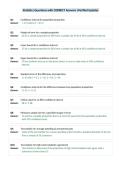
Statistics Questions with CORRECT Answers (Verified Update)
Q1: Confidence interval for population proportion
Answer: ± 2⁄() where () = √(1-)/
Q2: Margin of error for a sample proportion
Answer: 03 for a sample proportion of 30% from a sample size of 40 at 95% confidence interval.
Q3: Lower bound for a confidence interval
Answer: 27 for a sample proportion of 30% from a sample size of 40 at 95% confidence interval.
Q4: Upper bound for a confidence interval
Answer: 1% for students who use an electronic device in class to take notes at 90% confidence
interval.
Q5: Standard error of the difference of proportions
Answer: (1 -2) with 1 = 0.3, 1 = 56, 2 = 0.4, 2 = 64.
Q6: Confidence interval for the difference between two population proportions
Answer: (1 -2) ± × (1 -2)
Q7: Critical value for an 80% confidence interval
Answer: 28 or -1.28.
Q8: Minimum sample size for a specified margin of error
Answer: To achieve a sample proportion that is at most 4% away from the population proportion
with 95% confidence level.
Q9: Test statistic for average spending at amusement park
Answer: Value of the test statistic for a mean spending of $52.43 with a standard deviation of $14.32
from a sample of 35 customers.
Q10: Test statistic for high school students' agreement
Answer: Test statistic to determine if the proportion of high school students who agree with a
statement is lower than 0.5.
, Q11: P-value for a right-tailed test
Answer: P-value associated with a test statistic of = 1.4.
Q12: Critical value for a left-tailed test
Answer: Critical value for = 0.05.
Q13: Decision rule based on p-value
Answer: If the p-value is smaller than , the null hypothesis should be rejected.
Q14: Finding p-value in hypothesis testing
Answer: The p-value is found using the critical value.
Q15: Sample size for margin of error
Answer: Minimum sample size to achieve a margin of error of 4% at 95% confidence level.
Q16: Upper limit of confidence interval
Answer: Upper limit for a population proportion based on survey results.
Q17: Critical value for hypothesis testing
Answer: Critical value for a left-tailed test with = 0.05.
Q18: hypothesis test for a single population proportion
Answer: A statistical method used to determine if a sample proportion is significantly different from
a hypothesized population proportion.
Q19: hypothesis test for a single population mean
Answer: A statistical method used to determine if a sample mean is significantly different from a
hypothesized population mean.
Q20: confidence interval for the population mean
Answer: An interval estimate of a population parameter that is likely to contain the true population
mean.
Q21: standard error of the sample regression slope ((1))
Answer: A measure of the variability of the estimated slope in a regression analysis.
Q1: Confidence interval for population proportion
Answer: ± 2⁄() where () = √(1-)/
Q2: Margin of error for a sample proportion
Answer: 03 for a sample proportion of 30% from a sample size of 40 at 95% confidence interval.
Q3: Lower bound for a confidence interval
Answer: 27 for a sample proportion of 30% from a sample size of 40 at 95% confidence interval.
Q4: Upper bound for a confidence interval
Answer: 1% for students who use an electronic device in class to take notes at 90% confidence
interval.
Q5: Standard error of the difference of proportions
Answer: (1 -2) with 1 = 0.3, 1 = 56, 2 = 0.4, 2 = 64.
Q6: Confidence interval for the difference between two population proportions
Answer: (1 -2) ± × (1 -2)
Q7: Critical value for an 80% confidence interval
Answer: 28 or -1.28.
Q8: Minimum sample size for a specified margin of error
Answer: To achieve a sample proportion that is at most 4% away from the population proportion
with 95% confidence level.
Q9: Test statistic for average spending at amusement park
Answer: Value of the test statistic for a mean spending of $52.43 with a standard deviation of $14.32
from a sample of 35 customers.
Q10: Test statistic for high school students' agreement
Answer: Test statistic to determine if the proportion of high school students who agree with a
statement is lower than 0.5.
, Q11: P-value for a right-tailed test
Answer: P-value associated with a test statistic of = 1.4.
Q12: Critical value for a left-tailed test
Answer: Critical value for = 0.05.
Q13: Decision rule based on p-value
Answer: If the p-value is smaller than , the null hypothesis should be rejected.
Q14: Finding p-value in hypothesis testing
Answer: The p-value is found using the critical value.
Q15: Sample size for margin of error
Answer: Minimum sample size to achieve a margin of error of 4% at 95% confidence level.
Q16: Upper limit of confidence interval
Answer: Upper limit for a population proportion based on survey results.
Q17: Critical value for hypothesis testing
Answer: Critical value for a left-tailed test with = 0.05.
Q18: hypothesis test for a single population proportion
Answer: A statistical method used to determine if a sample proportion is significantly different from
a hypothesized population proportion.
Q19: hypothesis test for a single population mean
Answer: A statistical method used to determine if a sample mean is significantly different from a
hypothesized population mean.
Q20: confidence interval for the population mean
Answer: An interval estimate of a population parameter that is likely to contain the true population
mean.
Q21: standard error of the sample regression slope ((1))
Answer: A measure of the variability of the estimated slope in a regression analysis.


