

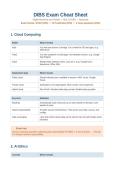
DIBS Exam Cheat Sheet
Digital Business and Society • MSc 33-DBS • Nyenrode
Exam format: 30 MC (33%) + 10 True/False (33%) + 4 Case questions (33%)
1. Cloud Computing
Model What it means
IaaS You rent raw servers & storage. You control the OS and apps. (e.g.
AWS EC2)
PaaS You rent a platform to build apps. No hardware worries. (e.g. Google
App Engine)
SaaS Ready-made software online. Just use it. (e.g. Google Docs,
Salesforce, Office 365)
Deployment type What it means
Public cloud Shared infrastructure, available to anyone. AWS, Azure, Google
Cloud.
Private cloud Dedicated to one organisation. More control, more expensive.
Hybrid cloud Mix of both. Sensitive data stays private; flexible tasks go public.
Key term Definition
Elasticity Automatically scale resources up or down based on demand. Core
benefit of cloud.
Shared responsibility Provider secures infrastructure. YOU secure your data, access, and
configs.
Data sovereignty Laws that restrict where data can be stored. Key risk with foreign cloud
providers.
⚠️ Exam trap
Cloud computing transfers cybersecurity responsibility ENTIRELY to the provider. → FALSE.
It is always shared responsibility.
2. AI Ethics
Concept What it means
, Black box problem AI gives an answer but cannot explain HOW it decided. Problem in
healthcare/finance where decisions must be explainable.
Algorithmic bias If training data excludes certain groups, the AI performs worse for
them. Causes unfair outcomes even if unintentional.
Fairness AI decisions should not disproportionately harm marginalised groups.
Violated when a model discriminates.
Transparency Stakeholders have the right to understand how AI decisions are made.
Without it, no accountability.
⚠️ Exam trap
Do NOT confuse transparency (explaining decisions) with efficiency (doing things fast).
Completely different ethical concepts.
✓ Real exam Q
Which ethical principle is violated if AI disproportionately impacts marginalised communities?
→ FAIRNESS
3. Cybersecurity
Term Definition
Defence in depth Multiple layers of security controls together. If one fails, others protect
you. Firewall + encryption + training + monitoring.
Firewall Controls incoming and outgoing network traffic. A gatekeeper — NOT
a complete security solution.
Encryption Converts data into unreadable code. Only authorised parties with the
key can read it.
GDPR EU law for personal data of EU residents. Applies to ANY company
worldwide handling EU data. Key: consent, right to erasure, breach
notification.
Ransomware Malware that encrypts your files and demands payment to unlock
them.
Zero-trust Never trust, always verify. Every user and device must be
authenticated, even inside the network.
Cybersecurity governance Company-wide policies and controls to manage digital risk — not just
IT department.
⚠️ Exam trap
A strong perimeter defence (firewall) is SUFFICIENT to protect a modern organisation. →
FALSE. Modern threats bypass perimeters via phishing, insider attacks, and cloud
misconfigurations.
Digital Business and Society • MSc 33-DBS • Nyenrode
Exam format: 30 MC (33%) + 10 True/False (33%) + 4 Case questions (33%)
1. Cloud Computing
Model What it means
IaaS You rent raw servers & storage. You control the OS and apps. (e.g.
AWS EC2)
PaaS You rent a platform to build apps. No hardware worries. (e.g. Google
App Engine)
SaaS Ready-made software online. Just use it. (e.g. Google Docs,
Salesforce, Office 365)
Deployment type What it means
Public cloud Shared infrastructure, available to anyone. AWS, Azure, Google
Cloud.
Private cloud Dedicated to one organisation. More control, more expensive.
Hybrid cloud Mix of both. Sensitive data stays private; flexible tasks go public.
Key term Definition
Elasticity Automatically scale resources up or down based on demand. Core
benefit of cloud.
Shared responsibility Provider secures infrastructure. YOU secure your data, access, and
configs.
Data sovereignty Laws that restrict where data can be stored. Key risk with foreign cloud
providers.
⚠️ Exam trap
Cloud computing transfers cybersecurity responsibility ENTIRELY to the provider. → FALSE.
It is always shared responsibility.
2. AI Ethics
Concept What it means
, Black box problem AI gives an answer but cannot explain HOW it decided. Problem in
healthcare/finance where decisions must be explainable.
Algorithmic bias If training data excludes certain groups, the AI performs worse for
them. Causes unfair outcomes even if unintentional.
Fairness AI decisions should not disproportionately harm marginalised groups.
Violated when a model discriminates.
Transparency Stakeholders have the right to understand how AI decisions are made.
Without it, no accountability.
⚠️ Exam trap
Do NOT confuse transparency (explaining decisions) with efficiency (doing things fast).
Completely different ethical concepts.
✓ Real exam Q
Which ethical principle is violated if AI disproportionately impacts marginalised communities?
→ FAIRNESS
3. Cybersecurity
Term Definition
Defence in depth Multiple layers of security controls together. If one fails, others protect
you. Firewall + encryption + training + monitoring.
Firewall Controls incoming and outgoing network traffic. A gatekeeper — NOT
a complete security solution.
Encryption Converts data into unreadable code. Only authorised parties with the
key can read it.
GDPR EU law for personal data of EU residents. Applies to ANY company
worldwide handling EU data. Key: consent, right to erasure, breach
notification.
Ransomware Malware that encrypts your files and demands payment to unlock
them.
Zero-trust Never trust, always verify. Every user and device must be
authenticated, even inside the network.
Cybersecurity governance Company-wide policies and controls to manage digital risk — not just
IT department.
⚠️ Exam trap
A strong perimeter defence (firewall) is SUFFICIENT to protect a modern organisation. →
FALSE. Modern threats bypass perimeters via phishing, insider attacks, and cloud
misconfigurations.


