

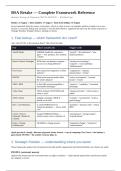
BSA Retake — Complete Framework Reference
Business Strategy & Alignment (MSC34-M-BUSA) — Nazlihan Ugur
Retake: 21 August | Q&A (online): 17 August | Back from holiday: 18 August
Every framework from the course, in one place: what it is, when to use it, an example, and how to apply it in a case.
Section 1 is your fast lookup tool. Sections 2–4 are the full reference, organised the same way the course structures it:
Strategic Position, Strategic Choices, Strategy in Action.
1. Fast lookup — which framework do I need?
Ask: what LEVEL is this question about? Then check the table.
Pair What it actually asks Trigger words
Ansoff Matrix WHERE should the corporation "growth", "diversification", "new
grow — new products, new markets, markets/products"
or both?
Porter's Generic Strategies HOW does one business compete — "business-level strategy",
on cost or on being different? "compete", "cost leadership",
"differentiation"
Five Forces How attractive/competitive is THIS "competitors", "industry
industry? attractiveness", "rivalry"
PESTEL What broad external trends affect "macro environment", "external
the whole industry? factors", "trends"
VRIO / RBV Is this ONE resource/capability a "resource", "capability", "sustained
sustainable advantage? advantage"
Value Chain Which internal ACTIVITIES add "internal activities", "where value is
value or cost? added"
SAFE Criteria Judging a strategic CHOICE — "evaluate", "recommend", "is this a
should we do this? good strategy"
BCG / GE-McKinsey A whole PORTFOLIO of "portfolio", "business units", "which
businesses/products — invest, hold, SBU"
exit?
CAGE / Porter's Going INTERNATIONAL — "international", "foreign market",
Diamond / Bartlett & which country, how to structure it? "expand abroad"
Ghoshal
Kotter / Change LEADING a change process "implement change", "resistance",
Kaleidoscope "transformation"
Quick gut-check: Ansoff = direction of growth. Porter Generic = way of competing. Five Forces = the industry's
game board. PESTEL = the weather everyone plays in.
2. Strategic Position — understanding where you stand
These frameworks analyse the environment (external) and the organisation itself (internal) before any choices are made.
PESTEL (external, macro)
Analyses the broad external environment that can affect a business — helps identify opportunities and threats outside
the company's control.
, ● Political: government policy, trade, taxation, stability
● Economic: GDP, inflation, interest rates, unemployment, purchasing power
● Social: demographics, lifestyle trends, cultural norms
● Technological: innovation, automation, R&D, access to new tech
● Environmental: climate policy, sustainability, waste management
● Legal: labour law, health & safety, industry regulation
Example: A rise in interest rates (Economic) making car loans more expensive for a car manufacturer.
How to use it in a case:
○ Scan the bigger picture of the country/region the company operates in.
○ Ask: which of these factors help or hurt the company's success?
Porter's Five Forces (external, industry)
Assesses the attractiveness and competitiveness of an industry through five forces.
● Threat of new entrants — how easy is it for new players to enter? (barriers, capital, regulation)
● Bargaining power of suppliers — can suppliers demand high prices?
● Bargaining power of buyers — can customers demand discounts or switch easily?
● Threat of substitutes — are there alternative products/services?
● Rivalry among existing competitors — how intense is the competition?
Example: Streaming services face high rivalry (many platforms) and a high threat of substitutes (cable, piracy,
gaming).
How to use it in a case:
○ Analyse how each force impacts the industry the company operates in.
○ Conclude on how attractive that industry is to invest or grow in.
Three Levels of the Business Environment
Shows how a company is influenced by three nested layers: organisation, industry/sector, and macro-environment.
● Organisation: internal resources, capabilities, culture, leadership
● Industry or sector: competitors, customers, suppliers, market structure
● Macro-environment: broader forces — politics, economy, society, tech (→ use PESTEL here)
How to use it in a case:
○ Start internal (organisation), then industry, then macro (PESTEL).
○ Ask: what factors at each level are most critical to strategy and success?
VRIO / Resource-Based View (internal)
Evaluates whether a company's resources or capabilities give it a sustainable competitive advantage. Focus: what does
the company have that others don't?
● Value — does it create value for customers or exploit opportunities?
● Rarity — is it rare among competitors?
● Inimitability — is it hard/expensive for others to copy?
● Organisation — is the company set up to fully exploit it?
● Outcomes: No to Value = competitive disadvantage. Yes/No to Rarity = competitive parity. Yes/Yes/No to
Inimitability = temporary advantage. Yes to all four = sustained competitive advantage.
Example: Coca-Cola's brand and secret formula: valuable, rare, hard to imitate, and the company is organised to
exploit it — sustained competitive advantage.
How to use it in a case:
○ Take one internal strength (brand, tech, skilled staff) and run it through VRIO.
○ Ask: is this resource giving them a long-term edge?
Business Strategy & Alignment (MSC34-M-BUSA) — Nazlihan Ugur
Retake: 21 August | Q&A (online): 17 August | Back from holiday: 18 August
Every framework from the course, in one place: what it is, when to use it, an example, and how to apply it in a case.
Section 1 is your fast lookup tool. Sections 2–4 are the full reference, organised the same way the course structures it:
Strategic Position, Strategic Choices, Strategy in Action.
1. Fast lookup — which framework do I need?
Ask: what LEVEL is this question about? Then check the table.
Pair What it actually asks Trigger words
Ansoff Matrix WHERE should the corporation "growth", "diversification", "new
grow — new products, new markets, markets/products"
or both?
Porter's Generic Strategies HOW does one business compete — "business-level strategy",
on cost or on being different? "compete", "cost leadership",
"differentiation"
Five Forces How attractive/competitive is THIS "competitors", "industry
industry? attractiveness", "rivalry"
PESTEL What broad external trends affect "macro environment", "external
the whole industry? factors", "trends"
VRIO / RBV Is this ONE resource/capability a "resource", "capability", "sustained
sustainable advantage? advantage"
Value Chain Which internal ACTIVITIES add "internal activities", "where value is
value or cost? added"
SAFE Criteria Judging a strategic CHOICE — "evaluate", "recommend", "is this a
should we do this? good strategy"
BCG / GE-McKinsey A whole PORTFOLIO of "portfolio", "business units", "which
businesses/products — invest, hold, SBU"
exit?
CAGE / Porter's Going INTERNATIONAL — "international", "foreign market",
Diamond / Bartlett & which country, how to structure it? "expand abroad"
Ghoshal
Kotter / Change LEADING a change process "implement change", "resistance",
Kaleidoscope "transformation"
Quick gut-check: Ansoff = direction of growth. Porter Generic = way of competing. Five Forces = the industry's
game board. PESTEL = the weather everyone plays in.
2. Strategic Position — understanding where you stand
These frameworks analyse the environment (external) and the organisation itself (internal) before any choices are made.
PESTEL (external, macro)
Analyses the broad external environment that can affect a business — helps identify opportunities and threats outside
the company's control.
, ● Political: government policy, trade, taxation, stability
● Economic: GDP, inflation, interest rates, unemployment, purchasing power
● Social: demographics, lifestyle trends, cultural norms
● Technological: innovation, automation, R&D, access to new tech
● Environmental: climate policy, sustainability, waste management
● Legal: labour law, health & safety, industry regulation
Example: A rise in interest rates (Economic) making car loans more expensive for a car manufacturer.
How to use it in a case:
○ Scan the bigger picture of the country/region the company operates in.
○ Ask: which of these factors help or hurt the company's success?
Porter's Five Forces (external, industry)
Assesses the attractiveness and competitiveness of an industry through five forces.
● Threat of new entrants — how easy is it for new players to enter? (barriers, capital, regulation)
● Bargaining power of suppliers — can suppliers demand high prices?
● Bargaining power of buyers — can customers demand discounts or switch easily?
● Threat of substitutes — are there alternative products/services?
● Rivalry among existing competitors — how intense is the competition?
Example: Streaming services face high rivalry (many platforms) and a high threat of substitutes (cable, piracy,
gaming).
How to use it in a case:
○ Analyse how each force impacts the industry the company operates in.
○ Conclude on how attractive that industry is to invest or grow in.
Three Levels of the Business Environment
Shows how a company is influenced by three nested layers: organisation, industry/sector, and macro-environment.
● Organisation: internal resources, capabilities, culture, leadership
● Industry or sector: competitors, customers, suppliers, market structure
● Macro-environment: broader forces — politics, economy, society, tech (→ use PESTEL here)
How to use it in a case:
○ Start internal (organisation), then industry, then macro (PESTEL).
○ Ask: what factors at each level are most critical to strategy and success?
VRIO / Resource-Based View (internal)
Evaluates whether a company's resources or capabilities give it a sustainable competitive advantage. Focus: what does
the company have that others don't?
● Value — does it create value for customers or exploit opportunities?
● Rarity — is it rare among competitors?
● Inimitability — is it hard/expensive for others to copy?
● Organisation — is the company set up to fully exploit it?
● Outcomes: No to Value = competitive disadvantage. Yes/No to Rarity = competitive parity. Yes/Yes/No to
Inimitability = temporary advantage. Yes to all four = sustained competitive advantage.
Example: Coca-Cola's brand and secret formula: valuable, rare, hard to imitate, and the company is organised to
exploit it — sustained competitive advantage.
How to use it in a case:
○ Take one internal strength (brand, tech, skilled staff) and run it through VRIO.
○ Ask: is this resource giving them a long-term edge?


