
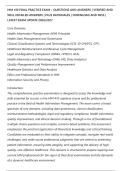
HIM 410 FINAL PRACTICE EXAM – QUESTIONS AND ANSWERS | VERIFIED AND
WELL DETAILED ANSWERS | PLUS RATIONALES | DOWNLOAD AND PASS |
LATEST EXAM UPDATE 2026/2027
Core Domains:
Health Information Management (HIM) Principles
Health Data Management and Governance
Clinical Classification Systems and Terminologies (ICD-10-CM/PCS, CPT)
Healthcare Reimbursement and Revenue Cycle Management
Legal and Regulatory Compliance (HIPAA, HITECH, ACA)
Health Informatics and Technology (EHRs, HIE, Data Analytics)
Quality Management and Performance Improvement
Healthcare Statistics and Data Analysis
Ethics and Professional Standards in HIM
Information Security and Privacy
Introduction:
This comprehensive practice examination is designed to assess the knowledge and
skills essential for success in the HIM 410 capstone course and for professional
practice in the field of Health Information Management. The exam covers a broad
spectrum of core domains, including data governance, clinical classification,
reimbursement methodologies, legal and regulatory compliance, health informatics,
quality improvement, and ethical decision-making. Through a mix of foundational
multiple-choice questions and complex, scenario-based problems, this assessment
emphasizes the practical application of theoretical knowledge and critical thinking.
Candidates are evaluated on their ability to integrate concepts, navigate real-world
challenges, and make sound professional judgments that are central to protecting
patient information, ensuring data integrity, and supporting the delivery of high-
quality, cost-effective healthcare. This resource is structured to prepare aspiring and
current HIM professionals for the rigors of their final examination and the demands
of a dynamic healthcare environment.
,SECTION ONE: QUESTIONS 1-50
1. A healthcare facility is transitioning from a paper-based system to a fully
electronic health record (EHR). Which of the following represents the most
significant ethical and professional challenge directly related to this transition
for the Health Information Management (HIM) department?
A. The increased cost of paper and storage supplies.
B. The need to retrain all clinical staff on basic computer skills.
C. The potential for unauthorized access and breach of patient data during and
after implementation.
D. The temporary decrease in productivity as staff learn the new system.
🟢 Correct Answer: C. The potential for unauthorized access and breach of
patient data during and after implementation.
🔴 Explanation: While retraining and productivity are valid operational concerns,
the primary ethical and professional responsibility of the HIM department is to
protect the confidentiality, integrity, and availability (CIA triad) of patient health
information. The digitization of records introduces new and significant security
risks related to data privacy, access controls, and cybersecurity threats.
2. Under the Health Insurance Portability and Accountability Act (HIPAA)
Privacy Rule, which of the following is a required element of a valid
Authorization for the release of protected health information (PHI)?
A. The patient's medical record number.
B. A list of all treating physicians.
C. A specific description of the information to be used or disclosed.
D. The signature of the patient's next of kin.
🟢 Correct Answer: C. A specific description of the information to be used or
disclosed.
,🔴 Explanation: The HIPAA Privacy Rule mandates that a valid authorization must
include a specific and meaningful description of the PHI to be used or disclosed.
This is a core element, along with who is authorized to make the disclosure, who
it is to be disclosed to, the purpose of the disclosure, an expiration date, and the
patient's signature.
3. A medical coder is reviewing a patient's record for an outpatient surgery. The
surgeon performed a laparoscopic cholecystectomy and, upon entering the
abdomen, discovered an unexpected umbilical hernia, which was also repaired
during the same operative session. What is the most appropriate coding and
reporting principle to apply?
A. Code both procedures separately, as they are distinct surgical events.
B. Code only the laparoscopic cholecystectomy as it was the primary planned
procedure.
C. Code the laparoscopic cholecystectomy as the primary procedure and the
hernia repair as a secondary procedure, appending a modifier to indicate it was a
distinct procedure.
D. Code the hernia repair as the primary procedure because it was an unexpected
finding.
🟢 Correct Answer: C. Code the laparoscopic cholecystectomy as the primary
procedure and the hernia repair as a secondary procedure, appending a modifier
to indicate it was a distinct procedure.
🔴 Explanation: When multiple procedures are performed during a single
operative session, the primary (planned) procedure is listed first. Additional or
secondary procedures are listed subsequently. In this case, a modifier (such as -59
for a distinct procedural service) is typically appended to the secondary
procedure to indicate it was separate and distinct from the primary procedure.
4. In the context of a healthcare organization's data governance framework,
what is the primary role of a Data Steward?
, A. To manage the technical infrastructure and database systems.
B. To ensure data quality, integrity, and compliance within a specific domain or
department.
C. To serve as the Chief Information Officer (CIO) overseeing all technology
strategies.
D. To perform audits of the organization's financial records.
🟢 Correct Answer: B. To ensure data quality, integrity, and compliance within a
specific domain or department.
🔴 Explanation: Data stewards are subject matter experts responsible for the
quality, consistency, and appropriate use of data assets within their purview. They
manage data definitions, monitor data quality, and ensure compliance with data
governance policies, bridging the gap between business needs and technical data
management.
5. A Health Information Management (HIM) professional is asked to calculate
the hospital's average length of stay (ALOS) for the month of June. The total
number of inpatient days for June was 1,200, and the total number of
discharges (excluding deaths) was 150. What is the ALOS?
A. 8 days
B. 12 days
C. 18 days
D. 1,200 days
🟢 Correct Answer: A. 8 days
🔴 Explanation: The Average Length of Stay is calculated by dividing the total
number of inpatient days by the total number of discharges (and sometimes
deaths, depending on the specific formula used, but the most common definition
excludes deaths for the standard ALOS). 1,200 inpatient days / 150 discharges = 8
days.
WELL DETAILED ANSWERS | PLUS RATIONALES | DOWNLOAD AND PASS |
LATEST EXAM UPDATE 2026/2027
Core Domains:
Health Information Management (HIM) Principles
Health Data Management and Governance
Clinical Classification Systems and Terminologies (ICD-10-CM/PCS, CPT)
Healthcare Reimbursement and Revenue Cycle Management
Legal and Regulatory Compliance (HIPAA, HITECH, ACA)
Health Informatics and Technology (EHRs, HIE, Data Analytics)
Quality Management and Performance Improvement
Healthcare Statistics and Data Analysis
Ethics and Professional Standards in HIM
Information Security and Privacy
Introduction:
This comprehensive practice examination is designed to assess the knowledge and
skills essential for success in the HIM 410 capstone course and for professional
practice in the field of Health Information Management. The exam covers a broad
spectrum of core domains, including data governance, clinical classification,
reimbursement methodologies, legal and regulatory compliance, health informatics,
quality improvement, and ethical decision-making. Through a mix of foundational
multiple-choice questions and complex, scenario-based problems, this assessment
emphasizes the practical application of theoretical knowledge and critical thinking.
Candidates are evaluated on their ability to integrate concepts, navigate real-world
challenges, and make sound professional judgments that are central to protecting
patient information, ensuring data integrity, and supporting the delivery of high-
quality, cost-effective healthcare. This resource is structured to prepare aspiring and
current HIM professionals for the rigors of their final examination and the demands
of a dynamic healthcare environment.
,SECTION ONE: QUESTIONS 1-50
1. A healthcare facility is transitioning from a paper-based system to a fully
electronic health record (EHR). Which of the following represents the most
significant ethical and professional challenge directly related to this transition
for the Health Information Management (HIM) department?
A. The increased cost of paper and storage supplies.
B. The need to retrain all clinical staff on basic computer skills.
C. The potential for unauthorized access and breach of patient data during and
after implementation.
D. The temporary decrease in productivity as staff learn the new system.
🟢 Correct Answer: C. The potential for unauthorized access and breach of
patient data during and after implementation.
🔴 Explanation: While retraining and productivity are valid operational concerns,
the primary ethical and professional responsibility of the HIM department is to
protect the confidentiality, integrity, and availability (CIA triad) of patient health
information. The digitization of records introduces new and significant security
risks related to data privacy, access controls, and cybersecurity threats.
2. Under the Health Insurance Portability and Accountability Act (HIPAA)
Privacy Rule, which of the following is a required element of a valid
Authorization for the release of protected health information (PHI)?
A. The patient's medical record number.
B. A list of all treating physicians.
C. A specific description of the information to be used or disclosed.
D. The signature of the patient's next of kin.
🟢 Correct Answer: C. A specific description of the information to be used or
disclosed.
,🔴 Explanation: The HIPAA Privacy Rule mandates that a valid authorization must
include a specific and meaningful description of the PHI to be used or disclosed.
This is a core element, along with who is authorized to make the disclosure, who
it is to be disclosed to, the purpose of the disclosure, an expiration date, and the
patient's signature.
3. A medical coder is reviewing a patient's record for an outpatient surgery. The
surgeon performed a laparoscopic cholecystectomy and, upon entering the
abdomen, discovered an unexpected umbilical hernia, which was also repaired
during the same operative session. What is the most appropriate coding and
reporting principle to apply?
A. Code both procedures separately, as they are distinct surgical events.
B. Code only the laparoscopic cholecystectomy as it was the primary planned
procedure.
C. Code the laparoscopic cholecystectomy as the primary procedure and the
hernia repair as a secondary procedure, appending a modifier to indicate it was a
distinct procedure.
D. Code the hernia repair as the primary procedure because it was an unexpected
finding.
🟢 Correct Answer: C. Code the laparoscopic cholecystectomy as the primary
procedure and the hernia repair as a secondary procedure, appending a modifier
to indicate it was a distinct procedure.
🔴 Explanation: When multiple procedures are performed during a single
operative session, the primary (planned) procedure is listed first. Additional or
secondary procedures are listed subsequently. In this case, a modifier (such as -59
for a distinct procedural service) is typically appended to the secondary
procedure to indicate it was separate and distinct from the primary procedure.
4. In the context of a healthcare organization's data governance framework,
what is the primary role of a Data Steward?
, A. To manage the technical infrastructure and database systems.
B. To ensure data quality, integrity, and compliance within a specific domain or
department.
C. To serve as the Chief Information Officer (CIO) overseeing all technology
strategies.
D. To perform audits of the organization's financial records.
🟢 Correct Answer: B. To ensure data quality, integrity, and compliance within a
specific domain or department.
🔴 Explanation: Data stewards are subject matter experts responsible for the
quality, consistency, and appropriate use of data assets within their purview. They
manage data definitions, monitor data quality, and ensure compliance with data
governance policies, bridging the gap between business needs and technical data
management.
5. A Health Information Management (HIM) professional is asked to calculate
the hospital's average length of stay (ALOS) for the month of June. The total
number of inpatient days for June was 1,200, and the total number of
discharges (excluding deaths) was 150. What is the ALOS?
A. 8 days
B. 12 days
C. 18 days
D. 1,200 days
🟢 Correct Answer: A. 8 days
🔴 Explanation: The Average Length of Stay is calculated by dividing the total
number of inpatient days by the total number of discharges (and sometimes
deaths, depending on the specific formula used, but the most common definition
excludes deaths for the standard ALOS). 1,200 inpatient days / 150 discharges = 8
days.


