

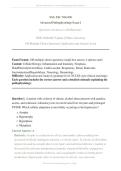
NSG 530 / NSG530 Exam 1 - Advanced Pathophysiology Guide (2026/2027)
NSG 530 / NSG530
Advanced Pathophysiology Exam 1
Questions and Answers with Rationales
NEW 2026/2027 Update | Wilkes University
100 Multiple-Choice Questions | Application and Analysis Level
Exam Format: 100 multiple-choice questions (single best answer, 4 options each)
Content: Cellular Biology, Inflammation and Immunity, Neoplasia,
Fluid/Electrolyte/Acid-Base, Cardiovascular, Respiratory, Renal, Endocrine,
Gastrointestinal/Hepatobiliary, Neurology, Hematology
Difficulty: Application and Analysis (graduate-level, NCLEX-style clinical reasoning)
Each question includes the correct answer and a detailed rationale explaining the
pathophysiology.
Question 1. A patient with a history of chronic alcohol abuse presents with jaundice,
ascites, and confusion. Laboratory tests reveal elevated liver enzymes and prolonged
PT/INR. Which cellular adaptation is most likely occurring in the hepatocytes?
A. Atrophy
B. Hypertrophy
C. Hyperplasia
D. Metaplasia
Correct Answer: A
Rationale: Atrophy is a reduction in cell size and number, often resulting from
decreased workload, inadequate nutrition, or chronic injury. In chronic alcohol abuse,
hepatocytes undergo atrophy due to toxic injury and nutritional deficiency, leading to
decreased liver function manifesting as jaundice (impaired bilirubin conjugation),
ascites (decreased albumin synthesis), and coagulopathy (reduced clotting factor
production). Hypertrophy refers to an increase in cell size, not a decrease.
NSG 530 Advanced Pathophysiology Exam 1 | Page 1
, NSG 530 / NSG530 Exam 1 - Advanced Pathophysiology Guide (2026/2027)
Hyperplasia is an increase in cell number. Metaplasia is the replacement of one cell type
by another.
Question 2. Which of the following is the most common cause of cellular injury from
free radicals?
A. Ionizing radiation
B. Ischemia-reperfusion injury
C. Chemical toxins
D. All of the above
Correct Answer: D
Rationale: Free radicals are highly reactive molecules with unpaired electrons that
can damage cellular components including lipids, proteins, and DNA. All the listed
sources generate free radicals: ionizing radiation directly ionizes water and other
molecules; ischemia-reperfusion injury generates reactive oxygen species (ROS) when
blood flow is restored to ischemic tissue; and many chemical toxins undergo metabolic
activation to produce free radical intermediates. The
NSG 530 Advanced Pathophysiology Exam 1 | Page 2
, NSG 530 / NSG530 Exam 1 - Advanced Pathophysiology Guide (2026/2027)
mitochondrial electron transport chain is also a major endogenous source of free
radicals.
Question 3. A biopsy of the bronchial epithelium from a long-term smoker reveals
ciliated columnar epithelial cells being replaced by stratified squamous epithelium. This
cellular change is best described as:
A. Dysplasia
B. Metaplasia
C. Anaplasia
D. Hyperplasia
Correct Answer: B
Rationale: Metaplasia is the reversible replacement of one mature cell type by another,
typically in response to chronic irritation or stress. In smokers, the chronic irritation
from cigarette smoke causes the normal ciliated columnar epithelium of the respiratory
tract to transform into stratified squamous epithelium, which is better able to withstand
the noxious environment but lacks mucociliary clearance function. Dysplasia refers to
abnormal maturation of cells within a tissue.
Anaplasia describes undifferentiated, pleomorphic cells seen in malignancy.
Hyperplasia is an increase in the number of cells.
Question 4. In cellular injury, which of the following organelles is most susceptible to
ischemic damage?
A. Nucleus
B. Cell membrane
C. Mitochondria
D. Ribosomes
Correct Answer: C
Rationale: Mitochondria are among the most susceptible organelles to ischemic injury
because they depend on a continuous supply of oxygen for oxidative phosphorylation.
During ischemia, the lack of oxygen causes mitochondrial dysfunction, leading to
decreased ATP production, failure of the sodium-potassium pump, cellular swelling,
and ultimately cell death. Mitochondrial damage also triggers the release of cytochrome
c and activation of the apoptotic pathway. While all cellular components are eventually
NSG 530 Advanced Pathophysiology Exam 1 | Page 3
, NSG 530 / NSG530 Exam 1 - Advanced Pathophysiology Guide (2026/2027)
affected by prolonged ischemia, mitochondria are the earliest and most critically
damaged organelles.
Question 5. A patient presents with pain, swelling, and redness in their right calf
following a long-haul flight. Doppler ultrasound confirms a deep vein thrombosis.
Which type of cellular injury is primarily responsible for the tissue damage?
A. Hypoxic injury
B. Chemical injury
C. Immunologic injury
D. Infectious injury
Correct Answer: A
Rationale: Deep vein thrombosis causes hypoxic injury to the downstream tissue by
obstructing venous outflow and impairing arterial inflow. The resulting ischemia leads
to a cascade of cellular events: decreased ATP production, failure of Na+/K+-ATPase
pumps, cellular swelling, influx of calcium, activation of phospholipases and proteases,
and generation of reactive oxygen species. This type of injury is purely
hypoxic/ischemic in origin rather than chemical, immunologic, or infectious.
Prolonged venous stasis during long flights (Virchow triad) predisposes to thrombus
formation.
NSG 530 Advanced Pathophysiology Exam 1 | Page 4
NSG 530 / NSG530
Advanced Pathophysiology Exam 1
Questions and Answers with Rationales
NEW 2026/2027 Update | Wilkes University
100 Multiple-Choice Questions | Application and Analysis Level
Exam Format: 100 multiple-choice questions (single best answer, 4 options each)
Content: Cellular Biology, Inflammation and Immunity, Neoplasia,
Fluid/Electrolyte/Acid-Base, Cardiovascular, Respiratory, Renal, Endocrine,
Gastrointestinal/Hepatobiliary, Neurology, Hematology
Difficulty: Application and Analysis (graduate-level, NCLEX-style clinical reasoning)
Each question includes the correct answer and a detailed rationale explaining the
pathophysiology.
Question 1. A patient with a history of chronic alcohol abuse presents with jaundice,
ascites, and confusion. Laboratory tests reveal elevated liver enzymes and prolonged
PT/INR. Which cellular adaptation is most likely occurring in the hepatocytes?
A. Atrophy
B. Hypertrophy
C. Hyperplasia
D. Metaplasia
Correct Answer: A
Rationale: Atrophy is a reduction in cell size and number, often resulting from
decreased workload, inadequate nutrition, or chronic injury. In chronic alcohol abuse,
hepatocytes undergo atrophy due to toxic injury and nutritional deficiency, leading to
decreased liver function manifesting as jaundice (impaired bilirubin conjugation),
ascites (decreased albumin synthesis), and coagulopathy (reduced clotting factor
production). Hypertrophy refers to an increase in cell size, not a decrease.
NSG 530 Advanced Pathophysiology Exam 1 | Page 1
, NSG 530 / NSG530 Exam 1 - Advanced Pathophysiology Guide (2026/2027)
Hyperplasia is an increase in cell number. Metaplasia is the replacement of one cell type
by another.
Question 2. Which of the following is the most common cause of cellular injury from
free radicals?
A. Ionizing radiation
B. Ischemia-reperfusion injury
C. Chemical toxins
D. All of the above
Correct Answer: D
Rationale: Free radicals are highly reactive molecules with unpaired electrons that
can damage cellular components including lipids, proteins, and DNA. All the listed
sources generate free radicals: ionizing radiation directly ionizes water and other
molecules; ischemia-reperfusion injury generates reactive oxygen species (ROS) when
blood flow is restored to ischemic tissue; and many chemical toxins undergo metabolic
activation to produce free radical intermediates. The
NSG 530 Advanced Pathophysiology Exam 1 | Page 2
, NSG 530 / NSG530 Exam 1 - Advanced Pathophysiology Guide (2026/2027)
mitochondrial electron transport chain is also a major endogenous source of free
radicals.
Question 3. A biopsy of the bronchial epithelium from a long-term smoker reveals
ciliated columnar epithelial cells being replaced by stratified squamous epithelium. This
cellular change is best described as:
A. Dysplasia
B. Metaplasia
C. Anaplasia
D. Hyperplasia
Correct Answer: B
Rationale: Metaplasia is the reversible replacement of one mature cell type by another,
typically in response to chronic irritation or stress. In smokers, the chronic irritation
from cigarette smoke causes the normal ciliated columnar epithelium of the respiratory
tract to transform into stratified squamous epithelium, which is better able to withstand
the noxious environment but lacks mucociliary clearance function. Dysplasia refers to
abnormal maturation of cells within a tissue.
Anaplasia describes undifferentiated, pleomorphic cells seen in malignancy.
Hyperplasia is an increase in the number of cells.
Question 4. In cellular injury, which of the following organelles is most susceptible to
ischemic damage?
A. Nucleus
B. Cell membrane
C. Mitochondria
D. Ribosomes
Correct Answer: C
Rationale: Mitochondria are among the most susceptible organelles to ischemic injury
because they depend on a continuous supply of oxygen for oxidative phosphorylation.
During ischemia, the lack of oxygen causes mitochondrial dysfunction, leading to
decreased ATP production, failure of the sodium-potassium pump, cellular swelling,
and ultimately cell death. Mitochondrial damage also triggers the release of cytochrome
c and activation of the apoptotic pathway. While all cellular components are eventually
NSG 530 Advanced Pathophysiology Exam 1 | Page 3
, NSG 530 / NSG530 Exam 1 - Advanced Pathophysiology Guide (2026/2027)
affected by prolonged ischemia, mitochondria are the earliest and most critically
damaged organelles.
Question 5. A patient presents with pain, swelling, and redness in their right calf
following a long-haul flight. Doppler ultrasound confirms a deep vein thrombosis.
Which type of cellular injury is primarily responsible for the tissue damage?
A. Hypoxic injury
B. Chemical injury
C. Immunologic injury
D. Infectious injury
Correct Answer: A
Rationale: Deep vein thrombosis causes hypoxic injury to the downstream tissue by
obstructing venous outflow and impairing arterial inflow. The resulting ischemia leads
to a cascade of cellular events: decreased ATP production, failure of Na+/K+-ATPase
pumps, cellular swelling, influx of calcium, activation of phospholipases and proteases,
and generation of reactive oxygen species. This type of injury is purely
hypoxic/ischemic in origin rather than chemical, immunologic, or infectious.
Prolonged venous stasis during long flights (Virchow triad) predisposes to thrombus
formation.
NSG 530 Advanced Pathophysiology Exam 1 | Page 4


