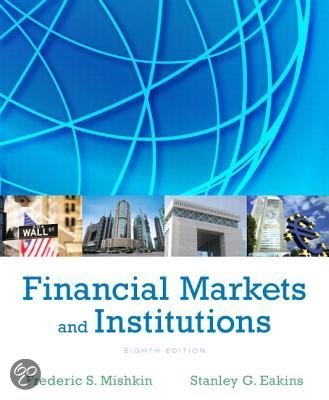
Instructor’s Manual for
Financial Markets and Institutions, 8th
Edition
TE
By Frederic S. Mishkin, Stanley
Eakins,
S
(All Chapters 1-27, 100% Original
TS
Verified, A+ Grade)
This is The Only Original and
O
Complete Instructor’s Manual.
LU
Instant Download.
TI
O
N
, Table of Content
PART 1: INTRODUCTION
Why Study Financial Markets and Institutions?
Overview of the Financial System
PART 2: FUNDAMENTALS OF FINANCIAL MARKETS
What Do Interest Rates Mean and What Is Their Role in Valuation?
Why Do Interest Rates Change?
How Do Risk and Term Structure Affect Interest Rates?
Are Financial Markets Efficient?
TE
PART 3: FUNDAMENTALS OF FINANCIAL INSTITUTIONS
Why Do Financial Institutions Exist?
Why Do Financial Crises Occur and Why Are They So Damaging to the Economy?
PART 4: CENTRAL BANKING AND THE CONDUCT OF MONETARY POLICY
Central Banks and the Federal Reserve System
S
Conduct of Monetary Policy
PART 5: FINANCIAL MARKETS
The Money Markets
TS
The Bond Market
The Stock Market
The Mortgage Markets
The Foreign Exchange Market
The International Financial System
O
PART 6: THE FINANCIAL INSTITUTIONS INDUSTRY
Banking and the Management of Financial Institutions
Financial Regulation
LU
Banking Industry: Structure and Competition
The Mutual Fund Industry
Insurance Companies and Pension Funds
Investment Banks, Security Brokers and Dealers, and Venture Capital Firms
PART 7: THE MANAGEMENT OF FINANCIAL INSTITUTIONS
TI
Risk Management in Financial Institutions
Hedging with Financial Derivatives
CHAPTERS ON THE WEB
O
Financial Crises in Emerging Market Economies W-1
Savings Associations and Credit Unions W-22
Finance Companies
N
, Part I
Introduction
TE
ST
SO
LU
TI
O
N
, Chapter 1
TE
Why Study Financial Markets
and Institutions?
ST
Why Study Financial Markets?
Debt Markets and Interest Rates
The Stock Market
The Foreign Exchange Market
Why Study Financial Institutions?
SO
Structure of the Financial System
Financial Crises
Central Banks and the Conduct of Monetary Policy
The International Financial System
Banks and Other Financial Institutions
Financial Innovation
LU
Managing Risk in Financial Institutions
Applied Managerial Perspective
How We Will Study Financial Markets and Institutions
Exploring the Web
TI
Collecting and Graphing Data
Web Exercise
Concluding Remarks
O
◼ Overview and Teaching Tips
Before embarking on a study of financial markets and institutions, the student must be convinced that this
N
subject is worth studying. Chapter 1 pursues this goal by showing the student that financial markets and
institutions is an exciting field because it focuses on phenomena that affect everyday life. An additional
purpose of Chapter 1 is to provide an overview for the entire book, previewing the topics that will be
covered in later chapters. The chapter also provides the students with a guide as to how they will be studying
financial markets and institutions with a unifying, analytic framework and an applied managerial perspective.
In teaching this chapter, the most important goal should be to get the student excited about the material. I have
found that talking about the data presented in the figures helps achieve this goal by showing the students that
the subject matter of financial markets and institutions has real-world implications that they should care about.
In addition, it is important to emphasize to the students that the course will have an applied managerial
Financial Markets and Institutions, 8th
Edition
TE
By Frederic S. Mishkin, Stanley
Eakins,
S
(All Chapters 1-27, 100% Original
TS
Verified, A+ Grade)
This is The Only Original and
O
Complete Instructor’s Manual.
LU
Instant Download.
TI
O
N
, Table of Content
PART 1: INTRODUCTION
Why Study Financial Markets and Institutions?
Overview of the Financial System
PART 2: FUNDAMENTALS OF FINANCIAL MARKETS
What Do Interest Rates Mean and What Is Their Role in Valuation?
Why Do Interest Rates Change?
How Do Risk and Term Structure Affect Interest Rates?
Are Financial Markets Efficient?
TE
PART 3: FUNDAMENTALS OF FINANCIAL INSTITUTIONS
Why Do Financial Institutions Exist?
Why Do Financial Crises Occur and Why Are They So Damaging to the Economy?
PART 4: CENTRAL BANKING AND THE CONDUCT OF MONETARY POLICY
Central Banks and the Federal Reserve System
S
Conduct of Monetary Policy
PART 5: FINANCIAL MARKETS
The Money Markets
TS
The Bond Market
The Stock Market
The Mortgage Markets
The Foreign Exchange Market
The International Financial System
O
PART 6: THE FINANCIAL INSTITUTIONS INDUSTRY
Banking and the Management of Financial Institutions
Financial Regulation
LU
Banking Industry: Structure and Competition
The Mutual Fund Industry
Insurance Companies and Pension Funds
Investment Banks, Security Brokers and Dealers, and Venture Capital Firms
PART 7: THE MANAGEMENT OF FINANCIAL INSTITUTIONS
TI
Risk Management in Financial Institutions
Hedging with Financial Derivatives
CHAPTERS ON THE WEB
O
Financial Crises in Emerging Market Economies W-1
Savings Associations and Credit Unions W-22
Finance Companies
N
, Part I
Introduction
TE
ST
SO
LU
TI
O
N
, Chapter 1
TE
Why Study Financial Markets
and Institutions?
ST
Why Study Financial Markets?
Debt Markets and Interest Rates
The Stock Market
The Foreign Exchange Market
Why Study Financial Institutions?
SO
Structure of the Financial System
Financial Crises
Central Banks and the Conduct of Monetary Policy
The International Financial System
Banks and Other Financial Institutions
Financial Innovation
LU
Managing Risk in Financial Institutions
Applied Managerial Perspective
How We Will Study Financial Markets and Institutions
Exploring the Web
TI
Collecting and Graphing Data
Web Exercise
Concluding Remarks
O
◼ Overview and Teaching Tips
Before embarking on a study of financial markets and institutions, the student must be convinced that this
N
subject is worth studying. Chapter 1 pursues this goal by showing the student that financial markets and
institutions is an exciting field because it focuses on phenomena that affect everyday life. An additional
purpose of Chapter 1 is to provide an overview for the entire book, previewing the topics that will be
covered in later chapters. The chapter also provides the students with a guide as to how they will be studying
financial markets and institutions with a unifying, analytic framework and an applied managerial perspective.
In teaching this chapter, the most important goal should be to get the student excited about the material. I have
found that talking about the data presented in the figures helps achieve this goal by showing the students that
the subject matter of financial markets and institutions has real-world implications that they should care about.
In addition, it is important to emphasize to the students that the course will have an applied managerial