

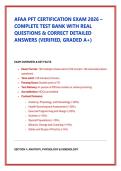
AFAA PFT CERTIFICATION EXAM 2026 –
COMPLETE TEST BANK WITH REAL
QUESTIONS & CORRECT DETAILED
ANSWERS (VERIFIED, GRADED A+)
EXAM OVERVIEW & KEY FACTS
• Exam Format: 120 multiple-choice items (100 scored + 20 unscored pretest
questions)
• Time Limit: 120 minutes (2 hours)
• Passing Score: Scaled score of 70
• Test Delivery: In-person at PSI test centers or online proctoring
• Accreditation: NCCA accredited
• Content Domains:
o Anatomy, Physiology, and Kinesiology (~20%)
o Health Screening and Assessment (~20%)
o Exercise Programming and Design (~25%)
o Nutrition (~10%)
o Special Populations (~10%)
o Behavior Change and Coaching (~10%)
o Safety and Scope of Practice (~5%)
SECTION 1: ANATOMY, PHYSIOLOGY & KINESIOLOGY
,(Questions 1–30)
1. Which of the following describes the anatomical position?
A) Standing, arms crossed, palms facing posterior
B) Standing, arms at sides, palms facing anterior, feet parallel
C) Supine, arms at sides, palms facing down
D) Prone, arms overhead, palms facing down
,,,,answer,,,,: B) Standing, arms at sides, palms facing anterior, feet parallel
Rationale: The anatomical position is standardized: standing upright, facing
forward, arms at the sides, palms facing anterior (forward), and feet parallel. This
position serves as the reference for all directional terms (anterior, posterior,
medial, lateral).
2. What is the primary action of the latissimus dorsi muscle?
A) Shoulder abduction and upward rotation
B) Shoulder adduction, extension, and internal rotation
C) Elbow flexion
D) Scapular protraction
,,,,answer,,,,: B) Shoulder adduction, extension, and internal rotation
Rationale: The latissimus dorsi ("lats") is a large back muscle that adducts,
extends, and internally rotates the humerus. It is a prime mover in pull-ups, rows,
and lat pulldowns.
,3. Which plane of motion divides the body into left and right halves?
A) Frontal (coronal) plane
B) Transverse (horizontal) plane
C) Sagittal plane
D) Oblique plane
,,,,answer,,,,: C) Sagittal plane
Rationale: The sagittal plane divides the body into left and right halves. Movements
in this plane include flexion and extension—such as biceps curls, squats, lunges,
and walking.
4. Which energy system is primarily used during a 10-second all-out sprint?
A) Aerobic system
B) ATP-PC (phosphagen) system
C) Glycolytic system
D) Oxidative system
,,,,answer,,,,: B) ATP-PC (phosphagen) system
Rationale: The ATP-PC system provides immediate energy for short, explosive
efforts lasting up to approximately 10 seconds, such as sprints or heavy lifts. It
rapidly regenerates ATP from creatine phosphate stored in muscle, does not
require oxygen, and produces no lactate.
, 5. What is the primary function of skeletal muscle?
A) Produce hormones
B) Store calcium
C) Produce movement
D) Regulate body temperature only
,,,,answer,,,,: C) Produce movement
Rationale: Skeletal muscles contract to create movement of bones and joints.
While they also contribute to heat production and posture, their primary function is
producing movement.
6. Which joint type is the shoulder joint?
A) Hinge
B) Pivot
C) Ball-and-socket
D) Saddle
,,,,answer,,,,: C) Ball-and-socket
Rationale: The shoulder (glenohumeral) joint is a ball-and-socket joint that allows
multi-planar movement including flexion, extension, abduction, adduction, and
rotation.
7. What type of joint is the knee (tibiofemoral joint)?
COMPLETE TEST BANK WITH REAL
QUESTIONS & CORRECT DETAILED
ANSWERS (VERIFIED, GRADED A+)
EXAM OVERVIEW & KEY FACTS
• Exam Format: 120 multiple-choice items (100 scored + 20 unscored pretest
questions)
• Time Limit: 120 minutes (2 hours)
• Passing Score: Scaled score of 70
• Test Delivery: In-person at PSI test centers or online proctoring
• Accreditation: NCCA accredited
• Content Domains:
o Anatomy, Physiology, and Kinesiology (~20%)
o Health Screening and Assessment (~20%)
o Exercise Programming and Design (~25%)
o Nutrition (~10%)
o Special Populations (~10%)
o Behavior Change and Coaching (~10%)
o Safety and Scope of Practice (~5%)
SECTION 1: ANATOMY, PHYSIOLOGY & KINESIOLOGY
,(Questions 1–30)
1. Which of the following describes the anatomical position?
A) Standing, arms crossed, palms facing posterior
B) Standing, arms at sides, palms facing anterior, feet parallel
C) Supine, arms at sides, palms facing down
D) Prone, arms overhead, palms facing down
,,,,answer,,,,: B) Standing, arms at sides, palms facing anterior, feet parallel
Rationale: The anatomical position is standardized: standing upright, facing
forward, arms at the sides, palms facing anterior (forward), and feet parallel. This
position serves as the reference for all directional terms (anterior, posterior,
medial, lateral).
2. What is the primary action of the latissimus dorsi muscle?
A) Shoulder abduction and upward rotation
B) Shoulder adduction, extension, and internal rotation
C) Elbow flexion
D) Scapular protraction
,,,,answer,,,,: B) Shoulder adduction, extension, and internal rotation
Rationale: The latissimus dorsi ("lats") is a large back muscle that adducts,
extends, and internally rotates the humerus. It is a prime mover in pull-ups, rows,
and lat pulldowns.
,3. Which plane of motion divides the body into left and right halves?
A) Frontal (coronal) plane
B) Transverse (horizontal) plane
C) Sagittal plane
D) Oblique plane
,,,,answer,,,,: C) Sagittal plane
Rationale: The sagittal plane divides the body into left and right halves. Movements
in this plane include flexion and extension—such as biceps curls, squats, lunges,
and walking.
4. Which energy system is primarily used during a 10-second all-out sprint?
A) Aerobic system
B) ATP-PC (phosphagen) system
C) Glycolytic system
D) Oxidative system
,,,,answer,,,,: B) ATP-PC (phosphagen) system
Rationale: The ATP-PC system provides immediate energy for short, explosive
efforts lasting up to approximately 10 seconds, such as sprints or heavy lifts. It
rapidly regenerates ATP from creatine phosphate stored in muscle, does not
require oxygen, and produces no lactate.
, 5. What is the primary function of skeletal muscle?
A) Produce hormones
B) Store calcium
C) Produce movement
D) Regulate body temperature only
,,,,answer,,,,: C) Produce movement
Rationale: Skeletal muscles contract to create movement of bones and joints.
While they also contribute to heat production and posture, their primary function is
producing movement.
6. Which joint type is the shoulder joint?
A) Hinge
B) Pivot
C) Ball-and-socket
D) Saddle
,,,,answer,,,,: C) Ball-and-socket
Rationale: The shoulder (glenohumeral) joint is a ball-and-socket joint that allows
multi-planar movement including flexion, extension, abduction, adduction, and
rotation.
7. What type of joint is the knee (tibiofemoral joint)?


