

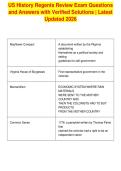
US History Regents Review Exam Questions
and Answers with Verified Solutions | Latest
Updated 2026
Mayflower Compact A document written by the Pilgrims
establishing
themselves as a political society and
setting
guidelines for self-government
Virginia House of Burgesses First representative government in the
colonies
Mercantilism ECONOMIC SYSTEM WHERE RAW
MATERIALS
WERE SENT TO THE MOTHER
COUNTRY AND
THEN THE COLONISTS HAD TO BUY
PRODUCTS
FROM THE MOTHER COUNTRY
Common Sense 1776: a pamphlet written by Thomas Paine
that
claimed the colonies had a right to be an
independent nation
,John Locke 1632 to 1704:believed that people had
natural
rights to liberty, life and property
(Liberalism)
(Naturalism) (Social Contract)
Declaration of Independence 1776 statement, issued by the Second
Continental
Congress, explaining why the colonies
wanted
independence from Britain.
Articles of Confederation 1st Constitution of the U.S. 1781-1788
(weaknesses-
no executive, no judicial, no power to tax,
no
power to regulate trade)
U.S. Constitution A document written by delegates at the
Constitutional Convention that established
a
national government in the United States.
Bicameral Legislature a lawmaking body with 2 houses - the
Senate and
the House of Representatives
Virginia Plan - the idea that representation in both
houses of a
bicameral Congress should be based on
population but naturally giving the larger
states an
advantage
, New Jersey Plan "Small state plan" at the Constitutional
Convention
in which each state was represented
equally in the
legislature.
Great Compromise Created the House and Senate while
resolving the
dispute between the large and small
states. -
Roger Sherman
3/5 Compromise -each slave would count for 3/5 of a
person for
taxation and representation purposes
Legislative branch Branch of government that makes the laws
Executive Branch Branch of government that enforces the
laws
Judicial Branch Branch of government that decides if laws
are
carried out fairly.
Federalists A term used to describe supporters of the
Constitution during ratification debates in
state
legislatures.
AntiFederalists People who opposed the constitution
and Answers with Verified Solutions | Latest
Updated 2026
Mayflower Compact A document written by the Pilgrims
establishing
themselves as a political society and
setting
guidelines for self-government
Virginia House of Burgesses First representative government in the
colonies
Mercantilism ECONOMIC SYSTEM WHERE RAW
MATERIALS
WERE SENT TO THE MOTHER
COUNTRY AND
THEN THE COLONISTS HAD TO BUY
PRODUCTS
FROM THE MOTHER COUNTRY
Common Sense 1776: a pamphlet written by Thomas Paine
that
claimed the colonies had a right to be an
independent nation
,John Locke 1632 to 1704:believed that people had
natural
rights to liberty, life and property
(Liberalism)
(Naturalism) (Social Contract)
Declaration of Independence 1776 statement, issued by the Second
Continental
Congress, explaining why the colonies
wanted
independence from Britain.
Articles of Confederation 1st Constitution of the U.S. 1781-1788
(weaknesses-
no executive, no judicial, no power to tax,
no
power to regulate trade)
U.S. Constitution A document written by delegates at the
Constitutional Convention that established
a
national government in the United States.
Bicameral Legislature a lawmaking body with 2 houses - the
Senate and
the House of Representatives
Virginia Plan - the idea that representation in both
houses of a
bicameral Congress should be based on
population but naturally giving the larger
states an
advantage
, New Jersey Plan "Small state plan" at the Constitutional
Convention
in which each state was represented
equally in the
legislature.
Great Compromise Created the House and Senate while
resolving the
dispute between the large and small
states. -
Roger Sherman
3/5 Compromise -each slave would count for 3/5 of a
person for
taxation and representation purposes
Legislative branch Branch of government that makes the laws
Executive Branch Branch of government that enforces the
laws
Judicial Branch Branch of government that decides if laws
are
carried out fairly.
Federalists A term used to describe supporters of the
Constitution during ratification debates in
state
legislatures.
AntiFederalists People who opposed the constitution


