

Lecture 1 - M122 - Brief history of
microbiology Exam Questions and Answers
with Verified Solutions | Latest Updated 2026
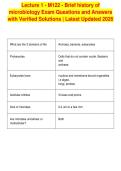
What are the 3 domains of life Archaea, bacteria, eukaryotes
Prokaryotes Cells that do not contain nuclei. Bacteria
and
archaea
Eukaryotes have nucleus and membrane bound organelles
i.e algae,
fungi, protists
Acellular entities Viruses and prions
Size of microbes 0.2 um to a few mm
Are microbes unicellular or Both
multicellular?
, Robert Hooke (1665) The first to observe distinct units of living
material
using a compound microscope, but he
never
observed single-celled bacteria because
his crude
lenses achieved at best 30-fold power.
Antonie van Leeuwenhoek (1674) The first to observe bacteria (single-celled
microbes) with single lens.
Francisco Redi (1660s) showed that maggots in decaying meat
were the
offspring of flies.
Meat in sealed containers didn't produce
flies. This
experiment argued against spontaneous
generation for macroscopic organisms.
However
the meat was still putrefried, producing
microbes
that seemed to arise without parents.
Lazzaro Spallanzani (1760s) showed that a sealed flask of meat broth
sterilized
by boiling failed to grow microbes.
Noticed that microbes appeared in pairs →
demonstrated cell fission → showed that
microbes
arise from preexisting microbes and
demonstrated
that heat sterilization can prevent microbial
growth
microbiology Exam Questions and Answers
with Verified Solutions | Latest Updated 2026
What are the 3 domains of life Archaea, bacteria, eukaryotes
Prokaryotes Cells that do not contain nuclei. Bacteria
and
archaea
Eukaryotes have nucleus and membrane bound organelles
i.e algae,
fungi, protists
Acellular entities Viruses and prions
Size of microbes 0.2 um to a few mm
Are microbes unicellular or Both
multicellular?
, Robert Hooke (1665) The first to observe distinct units of living
material
using a compound microscope, but he
never
observed single-celled bacteria because
his crude
lenses achieved at best 30-fold power.
Antonie van Leeuwenhoek (1674) The first to observe bacteria (single-celled
microbes) with single lens.
Francisco Redi (1660s) showed that maggots in decaying meat
were the
offspring of flies.
Meat in sealed containers didn't produce
flies. This
experiment argued against spontaneous
generation for macroscopic organisms.
However
the meat was still putrefried, producing
microbes
that seemed to arise without parents.
Lazzaro Spallanzani (1760s) showed that a sealed flask of meat broth
sterilized
by boiling failed to grow microbes.
Noticed that microbes appeared in pairs →
demonstrated cell fission → showed that
microbes
arise from preexisting microbes and
demonstrated
that heat sterilization can prevent microbial
growth


