

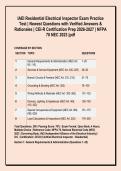
IAEI Residential Electrical Inspector Exam Practice
Test | Newest Questions with Verified Answers &
Rationales | CEI-R Certification Prep 2026-2027 | NFPA
70 NEC 2023 |pdf
COVERAGE BY SECTION
SECTION TOPIC QUESTIONS
1 General Requirements & Administration (NEC Art. 1–25
90, 110)
2 Services & Service Equipment (NEC Art. 230, 225) 26–50
3 Branch Circuits & Feeders (NEC Art. 210, 215) 51–75
4 Grounding & Bonding (NEC Art. 250) 76–100
5 Wiring Methods & Materials (NEC Art. 300–362) 101–125
6 Devices, Lighting, & Appliances (NEC Art. 406, 126–150
410, 422)
7 Special Occupancies & Equipment (NEC Art. 680, 151–175
690, 625)
8 Load Calculations & Inspections (NEC Art. 220) 176–200
Total Questions: 200 | Passing Score: 70% | Exam Format: Open Book, 4 Hours,
Multiple-Choice | Reference Code: NFPA 70, National Electrical Code (NEC)
2023 | Governing Body: IAEI (Independent Alliance of the Electrical Industry) /
ICC | Certification: CEI-R (Certified Electrical Inspector - Residential)
Section 1: General Requirements & Administration (Questions 1–25)
,1. According to the IAEI Code of Ethics for electrical inspectors, what is the most
important professional obligation of an inspector?
a) Favoring contractors who complete projects on time
b) Providing design advice to contractors during inspections
c) Maintaining impartial judgment and confidentiality
d) Ignoring minor infractions to expedite project completion
Inspectors must remain unbiased, avoid conflicts of interest, and protect client information.
A primary obligation is to ensure safety through independent, fair, and professional
judgment.
2. What authority does the Authority Having Jurisdiction (AHJ) possess regarding a
residential electrical inspection?
a) Only to issue construction permits
b) Sole responsibility for utility billing and service connections
c) Ability to approve designs without reviewing code compliance
d) Right of entry and ability to issue stop-work orders
The AHJ has the authority to enter premises for inspection purposes and can halt work
when violations are found to ensure safety and code compliance.
,3. According to NEC 110.26, what is the minimum required working clearance in front
of a residential electrical panelboard?
a) 24 inches wide, 30 inches deep
b) 30 inches wide, 36 inches deep
c) 30 inches wide, 36 inches high
d) 36 inches wide, 30 inches deep
NEC 110.26 requires a minimum working space of 30 inches in width by 36 inches in depth
in front of electrical equipment. This clearance ensures safe access for maintenance and
emergency response.
4. What is the primary purpose of an electrical inspection in a residential setting?
a) To verify that the contractor followed the plans exactly
b) To ensure the installation meets the minimum safety requirements of the NEC
c) To determine if the homeowner's appliances are energy efficient
d) To check the electrical bill for accuracy
The fundamental goal of electrical inspection is safety. The inspector verifies that the
installation complies with the NEC to prevent fire and shock hazards.
, 5. Which of the following is NOT a duty of the electrical inspector?
a) Reviewing approved plans and specifications
b) Issuing correction notices for code violations
c) Maintaining inspection reports and data
d) Designing modifications to the electrical system
Inspectors enforce the code; they do not design or modify systems. Design is the
responsibility of the electrical engineer or contractor.
6. According to ICC/IAEI standards, what does the E1 certification exam cover?
a) Residential Electrical Inspection based on the IRC and NEC
b) Commercial Electrical Inspection
c) Plans Examination for all building types
d) Fire Alarm and Suppression Systems
The E1 exam specifically tests knowledge of residential electrical inspections, referencing
both the International Residential Code (IRC) and the NEC.
7. What does the acronym AHJ stand for in the context of electrical inspections?
Test | Newest Questions with Verified Answers &
Rationales | CEI-R Certification Prep 2026-2027 | NFPA
70 NEC 2023 |pdf
COVERAGE BY SECTION
SECTION TOPIC QUESTIONS
1 General Requirements & Administration (NEC Art. 1–25
90, 110)
2 Services & Service Equipment (NEC Art. 230, 225) 26–50
3 Branch Circuits & Feeders (NEC Art. 210, 215) 51–75
4 Grounding & Bonding (NEC Art. 250) 76–100
5 Wiring Methods & Materials (NEC Art. 300–362) 101–125
6 Devices, Lighting, & Appliances (NEC Art. 406, 126–150
410, 422)
7 Special Occupancies & Equipment (NEC Art. 680, 151–175
690, 625)
8 Load Calculations & Inspections (NEC Art. 220) 176–200
Total Questions: 200 | Passing Score: 70% | Exam Format: Open Book, 4 Hours,
Multiple-Choice | Reference Code: NFPA 70, National Electrical Code (NEC)
2023 | Governing Body: IAEI (Independent Alliance of the Electrical Industry) /
ICC | Certification: CEI-R (Certified Electrical Inspector - Residential)
Section 1: General Requirements & Administration (Questions 1–25)
,1. According to the IAEI Code of Ethics for electrical inspectors, what is the most
important professional obligation of an inspector?
a) Favoring contractors who complete projects on time
b) Providing design advice to contractors during inspections
c) Maintaining impartial judgment and confidentiality
d) Ignoring minor infractions to expedite project completion
Inspectors must remain unbiased, avoid conflicts of interest, and protect client information.
A primary obligation is to ensure safety through independent, fair, and professional
judgment.
2. What authority does the Authority Having Jurisdiction (AHJ) possess regarding a
residential electrical inspection?
a) Only to issue construction permits
b) Sole responsibility for utility billing and service connections
c) Ability to approve designs without reviewing code compliance
d) Right of entry and ability to issue stop-work orders
The AHJ has the authority to enter premises for inspection purposes and can halt work
when violations are found to ensure safety and code compliance.
,3. According to NEC 110.26, what is the minimum required working clearance in front
of a residential electrical panelboard?
a) 24 inches wide, 30 inches deep
b) 30 inches wide, 36 inches deep
c) 30 inches wide, 36 inches high
d) 36 inches wide, 30 inches deep
NEC 110.26 requires a minimum working space of 30 inches in width by 36 inches in depth
in front of electrical equipment. This clearance ensures safe access for maintenance and
emergency response.
4. What is the primary purpose of an electrical inspection in a residential setting?
a) To verify that the contractor followed the plans exactly
b) To ensure the installation meets the minimum safety requirements of the NEC
c) To determine if the homeowner's appliances are energy efficient
d) To check the electrical bill for accuracy
The fundamental goal of electrical inspection is safety. The inspector verifies that the
installation complies with the NEC to prevent fire and shock hazards.
, 5. Which of the following is NOT a duty of the electrical inspector?
a) Reviewing approved plans and specifications
b) Issuing correction notices for code violations
c) Maintaining inspection reports and data
d) Designing modifications to the electrical system
Inspectors enforce the code; they do not design or modify systems. Design is the
responsibility of the electrical engineer or contractor.
6. According to ICC/IAEI standards, what does the E1 certification exam cover?
a) Residential Electrical Inspection based on the IRC and NEC
b) Commercial Electrical Inspection
c) Plans Examination for all building types
d) Fire Alarm and Suppression Systems
The E1 exam specifically tests knowledge of residential electrical inspections, referencing
both the International Residential Code (IRC) and the NEC.
7. What does the acronym AHJ stand for in the context of electrical inspections?


