

NR 569 DIFFERENTIAL DIAGNOSIS IN ACUTE CARE MIDTERM QUESTIONS & ANSWER… EXAM
P R O F E S S I O N A L P R A C T I C E M AT E R I A L S
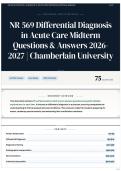
NR 569 Differential Diagnosis
in Acute Care Midterm
Questions & Answers 2026-
2027 | Chamberlain University
Verified Answers Exam Ready With Rationales
75 QUESTIONS
DOCUMENT OVERVIEW
This document contains 75 verified questions with correct answers provided, along with detailed
explanations for each item. It focuses on differential diagnosis in acute care, ensuring comprehensive
understanding of clinical assessments and conditions. This resource is ideal for students preparing for
exams, reviewing course material, and enhancing their certification readiness.
CONTENTS
Patient Assessment Q1–Q8
Differential Diagnosis Q9–Q16
Diagnostic Testing Q17–Q28
Radiographic Interpretation Q29–Q35
Skin Conditions Q36–Q59
Infective Endocarditis Q60–Q62
Page 1
,Respiratory Conditions Q63–Q75
E XA M Q U EST I O N S
Q1 QUESTION 1 OF 75
Comprehensive Patient Assessment
CORRECT ANSWER
- Appropriate for new patients in the office or hospital.
- Provides fundamental and personalized knowledge about patient.
- Strengthens the clinician-patient relationship.
- Helps identify or rule out physical causes related to patient concerns.
- Provides a baseline for future assessments.
- Creates a platform for health promotion through education and counseling.
- Develops proficiency in the skills of physical assessment.
Q2 QUESTION 2 OF 75
Focused Patient Assessment
CORRECT ANSWER
- Appropriate for established patients, especially during routine or urgent care visits.
- Addresses focused concerns or symptoms.
- Assesses symptoms restricted to a specific body system.
- Applies examination methods relevant to assessing the concern or problem as thoroughly and carefully as possible.
Q3 QUESTION 3 OF 75
Subjective Information
CORRECT ANSWER
- The clinical record from the Chief Complaint (CC) through the Review of Systems (ROS) is considered SUBJECTIVE
information.
- Includes symptoms which are health concerns the patient tells the provider.
- Includes feelings, perceptions, and concerns obtained from the clinical interview.
- Examples: complaints of sore throat, headache, or pain.
Page 2
, Q4 QUESTION 4 OF 75
Objective Information
CORRECT ANSWER
- All physical examination, laboratory information and test data are objective data.
Q5 QUESTION 5 OF 75
Components of Comprehensive Adult Health History
CORRECT ANSWER
- Initial information (Identifying patient information/source/reliability)
- Chief Complaint(s)
- History of Present Illness
- Past Medical History
- Family History
- Personal/Social History
- Review of Systems (ROS)
Q6 QUESTION 6 OF 75
SNAPPS method
CORRECT ANSWER
- Summarize the history and findings.
- Narrow the differential diagnosis to two to three possibilities.
- Analyze the differential by comparing and contrasting the possibilities.
- Probe the preceptor by asking questions about alternative approaches or uncertainties.
- Plan the management of the patient's health issues.
- Select an issue from the case for self-directed learning.
Q7 QUESTION 7 OF 75
Page 3
P R O F E S S I O N A L P R A C T I C E M AT E R I A L S
NR 569 Differential Diagnosis
in Acute Care Midterm
Questions & Answers 2026-
2027 | Chamberlain University
Verified Answers Exam Ready With Rationales
75 QUESTIONS
DOCUMENT OVERVIEW
This document contains 75 verified questions with correct answers provided, along with detailed
explanations for each item. It focuses on differential diagnosis in acute care, ensuring comprehensive
understanding of clinical assessments and conditions. This resource is ideal for students preparing for
exams, reviewing course material, and enhancing their certification readiness.
CONTENTS
Patient Assessment Q1–Q8
Differential Diagnosis Q9–Q16
Diagnostic Testing Q17–Q28
Radiographic Interpretation Q29–Q35
Skin Conditions Q36–Q59
Infective Endocarditis Q60–Q62
Page 1
,Respiratory Conditions Q63–Q75
E XA M Q U EST I O N S
Q1 QUESTION 1 OF 75
Comprehensive Patient Assessment
CORRECT ANSWER
- Appropriate for new patients in the office or hospital.
- Provides fundamental and personalized knowledge about patient.
- Strengthens the clinician-patient relationship.
- Helps identify or rule out physical causes related to patient concerns.
- Provides a baseline for future assessments.
- Creates a platform for health promotion through education and counseling.
- Develops proficiency in the skills of physical assessment.
Q2 QUESTION 2 OF 75
Focused Patient Assessment
CORRECT ANSWER
- Appropriate for established patients, especially during routine or urgent care visits.
- Addresses focused concerns or symptoms.
- Assesses symptoms restricted to a specific body system.
- Applies examination methods relevant to assessing the concern or problem as thoroughly and carefully as possible.
Q3 QUESTION 3 OF 75
Subjective Information
CORRECT ANSWER
- The clinical record from the Chief Complaint (CC) through the Review of Systems (ROS) is considered SUBJECTIVE
information.
- Includes symptoms which are health concerns the patient tells the provider.
- Includes feelings, perceptions, and concerns obtained from the clinical interview.
- Examples: complaints of sore throat, headache, or pain.
Page 2
, Q4 QUESTION 4 OF 75
Objective Information
CORRECT ANSWER
- All physical examination, laboratory information and test data are objective data.
Q5 QUESTION 5 OF 75
Components of Comprehensive Adult Health History
CORRECT ANSWER
- Initial information (Identifying patient information/source/reliability)
- Chief Complaint(s)
- History of Present Illness
- Past Medical History
- Family History
- Personal/Social History
- Review of Systems (ROS)
Q6 QUESTION 6 OF 75
SNAPPS method
CORRECT ANSWER
- Summarize the history and findings.
- Narrow the differential diagnosis to two to three possibilities.
- Analyze the differential by comparing and contrasting the possibilities.
- Probe the preceptor by asking questions about alternative approaches or uncertainties.
- Plan the management of the patient's health issues.
- Select an issue from the case for self-directed learning.
Q7 QUESTION 7 OF 75
Page 3


