

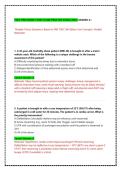
TNCC PRECOURSE STUDY GUIDE PRACTICE EXAM (2026) GRADED A+
Multiple-Choice Questions | Based on ENA TNCC 9th Edition Core Concepts | Verified
Rationales
1. A 45-year-old morbidly obese patient (BMI 48) is brought in after a motor
vehicle crash. Which of the following is a unique challenge in the trauma
assessment of this patient?
A) Difficulty visualizing the airway due to redundant tissue
B) Inaccurate blood pressure readings with a standard cuff
C) Delayed identification of intra-abdominal injuries due to thick abdominal wall
D) All of the above
Correct Answer: D
Rationale: Obese trauma patients present unique challenges: airway management is
difficult (redundant tissue, small mouth opening), blood pressure may be falsely elevated
with a standard cuff (requiring a large adult or thigh cuff), and physical exam/FAST may
be limited by thick adipose tissue, masking intra-abdominal injuries.
2. A patient is brought in with a core temperature of 32°C (89.6°F) after being
submerged in cold water for 20 minutes. The patient is in cardiac arrest. What is
the priority intervention?
A) Defibrillation (shockable rhythms may be refractory until rewarmed)
B) Active rewarming (e.g., warm IV fluids, Bair Hugger, warm bladder lavage)
C) CPR with consideration of prolonged resuscitation until the patient is rewarmed to
34°C
D) All of the above
Correct Answer: D
Rationale: Hypothermic cardiac arrest requires prolonged CPR and rewarming.
Defibrillation may be ineffective at core temperatures < 30°C (86°F); one shock is given if
VF/VT, then rewarming is prioritized. Active internal rewarming (warm IV, warm saline
lavage, ECMO if available) is critical.
,3. A patient with a crush injury to the left leg has a compartment pressure of 28
mmHg. The patient's diastolic blood pressure is 80 mmHg. What is the delta
pressure (ΔP), and what does it indicate?
A) ΔP = 52 mmHg; this is normal and does not require fasciotomy
B) ΔP = 28 mmHg; this indicates compartment syndrome and requires fasciotomy
C) ΔP = 80 mmHg; this is normal
D) ΔP = 108 mmHg; this is normal
Correct Answer: A
Rationale: Delta pressure (ΔP) = Diastolic BP – Compartment pressure. 80 – 28 = 52
mmHg. A ΔP < 30 mmHg indicates compartment syndrome and requires fasciotomy. A
ΔP > 30 mmHg is generally considered safe, but clinical signs (pain, pallor, paresthesia,
paralysis, pulselessness) must also be monitored.
4. A patient presents with a gunshot wound to the right upper quadrant of the
abdomen. The patient is hemodynamically unstable. Which of the following is the
most appropriate next step?
A) CT scan of the abdomen with IV contrast
B) FAST exam followed by immediate laparotomy if positive
C) Observation and serial abdominal exams
D) Diagnostic peritoneal lavage (DPL)
Correct Answer: B
Rationale: In an unstable patient with a penetrating abdominal injury, a FAST exam is
performed to detect free fluid. If positive (or even if negative but the patient remains
unstable), immediate laparotomy is indicated. CT is contraindicated in unstable patients.
DPL is rarely used.
5. A patient with a suspected acute subdural hematoma is being prepared for
surgery. Which of the following is the most critical pre-operative intervention?
A) Administer mannitol to reduce ICP
B) Correct any coagulopathy (e.g., reverse warfarin with vitamin K and PCC)
,C) Maintain normocapnia (PaCO2 35–40 mmHg)
D) All of the above
Correct Answer: D
Rationale: Subdural hematoma requires urgent surgical evacuation. Pre-operatively, ICP
should be reduced (mannitol), coagulopathy corrected (if present), and normocapnia
maintained to prevent hypercapnia (increases ICP) or hypocapnia (cerebral ischemia).
6. A trauma patient has a suspected aortic injury. Which of the following is a sign
of aortic transection on chest X-ray?
A) Widened mediastinum (> 8 cm)
B) Loss of the aortic knob contour
C) Left hemothorax
D) All of the above
Correct Answer: D
Rationale: Chest X-ray findings suspicious for aortic injury include a widened mediastinum
(> 8 cm), loss of the aortic knob, left hemothorax, depression of the left mainstem
bronchus, and deviation of the nasogastric tube to the right.
7. A 16-year-old patient is involved in a motor vehicle crash and has a Glasgow
Coma Scale (GCS) of 14. The patient is complaining of a headache and has vomited
once. Which of the following is the most appropriate management?
A) Discharge home with head injury instructions
B) Admit for observation and perform a head CT
C) Perform a CT scan of the head and discharge if normal
D) Observe for 4 hours in the ED and discharge
Correct Answer: B
Rationale: A GCS of 14 with vomiting in a pediatric/adolescent patient warrants a head CT
and admission for observation. Even if the CT is normal, patients with a GCS < 15 can
deteriorate. Observation and serial neurological exams are essential.
, 8. A patient with a suspected spinal cord injury is receiving high-dose
methylprednisolone. Which of the following is a major complication of this
therapy?
A) Hyperglycemia
B) Gastrointestinal bleeding
C) Infection
D) All of the above
Correct Answer: D
Rationale: High-dose methylprednisolone (no longer routinely recommended) is associated
with significant complications: hyperglycemia, gastrointestinal bleeding,
immunosuppression/infection, and wound complications. Current guidelines do not
support its routine use in acute SCI.
9. A trauma patient is in severe pain from multiple rib fractures. The patient is
given IV morphine and becomes hypotensive. What is the most likely cause?
A) Anaphylaxis to morphine
B) Histamine release causing vasodilation
C) Hypovolemia unmasked by decreased sympathetic tone from pain relief
D) Respiratory depression
Correct Answer: C
Rationale: Morphine can cause vasodilation and decrease sympathetic tone. In a
hypovolemic patient, pain relief can unmask underlying hypovolemia, leading to
hypotension. The priority is to assess for ongoing hemorrhage and administer IV fluids.
10. A patient with a suspected basilar skull fracture has clear fluid draining from
the nose. What is the appropriate test to confirm the fluid is cerebrospinal fluid
(CSF)?
A) Beta-2 transferrin test
B) Glucose test (CSF glucose is low)
C) Halo sign (ring around blood on filter paper)
D) Nitrazine test (turns blue for CSF)
Multiple-Choice Questions | Based on ENA TNCC 9th Edition Core Concepts | Verified
Rationales
1. A 45-year-old morbidly obese patient (BMI 48) is brought in after a motor
vehicle crash. Which of the following is a unique challenge in the trauma
assessment of this patient?
A) Difficulty visualizing the airway due to redundant tissue
B) Inaccurate blood pressure readings with a standard cuff
C) Delayed identification of intra-abdominal injuries due to thick abdominal wall
D) All of the above
Correct Answer: D
Rationale: Obese trauma patients present unique challenges: airway management is
difficult (redundant tissue, small mouth opening), blood pressure may be falsely elevated
with a standard cuff (requiring a large adult or thigh cuff), and physical exam/FAST may
be limited by thick adipose tissue, masking intra-abdominal injuries.
2. A patient is brought in with a core temperature of 32°C (89.6°F) after being
submerged in cold water for 20 minutes. The patient is in cardiac arrest. What is
the priority intervention?
A) Defibrillation (shockable rhythms may be refractory until rewarmed)
B) Active rewarming (e.g., warm IV fluids, Bair Hugger, warm bladder lavage)
C) CPR with consideration of prolonged resuscitation until the patient is rewarmed to
34°C
D) All of the above
Correct Answer: D
Rationale: Hypothermic cardiac arrest requires prolonged CPR and rewarming.
Defibrillation may be ineffective at core temperatures < 30°C (86°F); one shock is given if
VF/VT, then rewarming is prioritized. Active internal rewarming (warm IV, warm saline
lavage, ECMO if available) is critical.
,3. A patient with a crush injury to the left leg has a compartment pressure of 28
mmHg. The patient's diastolic blood pressure is 80 mmHg. What is the delta
pressure (ΔP), and what does it indicate?
A) ΔP = 52 mmHg; this is normal and does not require fasciotomy
B) ΔP = 28 mmHg; this indicates compartment syndrome and requires fasciotomy
C) ΔP = 80 mmHg; this is normal
D) ΔP = 108 mmHg; this is normal
Correct Answer: A
Rationale: Delta pressure (ΔP) = Diastolic BP – Compartment pressure. 80 – 28 = 52
mmHg. A ΔP < 30 mmHg indicates compartment syndrome and requires fasciotomy. A
ΔP > 30 mmHg is generally considered safe, but clinical signs (pain, pallor, paresthesia,
paralysis, pulselessness) must also be monitored.
4. A patient presents with a gunshot wound to the right upper quadrant of the
abdomen. The patient is hemodynamically unstable. Which of the following is the
most appropriate next step?
A) CT scan of the abdomen with IV contrast
B) FAST exam followed by immediate laparotomy if positive
C) Observation and serial abdominal exams
D) Diagnostic peritoneal lavage (DPL)
Correct Answer: B
Rationale: In an unstable patient with a penetrating abdominal injury, a FAST exam is
performed to detect free fluid. If positive (or even if negative but the patient remains
unstable), immediate laparotomy is indicated. CT is contraindicated in unstable patients.
DPL is rarely used.
5. A patient with a suspected acute subdural hematoma is being prepared for
surgery. Which of the following is the most critical pre-operative intervention?
A) Administer mannitol to reduce ICP
B) Correct any coagulopathy (e.g., reverse warfarin with vitamin K and PCC)
,C) Maintain normocapnia (PaCO2 35–40 mmHg)
D) All of the above
Correct Answer: D
Rationale: Subdural hematoma requires urgent surgical evacuation. Pre-operatively, ICP
should be reduced (mannitol), coagulopathy corrected (if present), and normocapnia
maintained to prevent hypercapnia (increases ICP) or hypocapnia (cerebral ischemia).
6. A trauma patient has a suspected aortic injury. Which of the following is a sign
of aortic transection on chest X-ray?
A) Widened mediastinum (> 8 cm)
B) Loss of the aortic knob contour
C) Left hemothorax
D) All of the above
Correct Answer: D
Rationale: Chest X-ray findings suspicious for aortic injury include a widened mediastinum
(> 8 cm), loss of the aortic knob, left hemothorax, depression of the left mainstem
bronchus, and deviation of the nasogastric tube to the right.
7. A 16-year-old patient is involved in a motor vehicle crash and has a Glasgow
Coma Scale (GCS) of 14. The patient is complaining of a headache and has vomited
once. Which of the following is the most appropriate management?
A) Discharge home with head injury instructions
B) Admit for observation and perform a head CT
C) Perform a CT scan of the head and discharge if normal
D) Observe for 4 hours in the ED and discharge
Correct Answer: B
Rationale: A GCS of 14 with vomiting in a pediatric/adolescent patient warrants a head CT
and admission for observation. Even if the CT is normal, patients with a GCS < 15 can
deteriorate. Observation and serial neurological exams are essential.
, 8. A patient with a suspected spinal cord injury is receiving high-dose
methylprednisolone. Which of the following is a major complication of this
therapy?
A) Hyperglycemia
B) Gastrointestinal bleeding
C) Infection
D) All of the above
Correct Answer: D
Rationale: High-dose methylprednisolone (no longer routinely recommended) is associated
with significant complications: hyperglycemia, gastrointestinal bleeding,
immunosuppression/infection, and wound complications. Current guidelines do not
support its routine use in acute SCI.
9. A trauma patient is in severe pain from multiple rib fractures. The patient is
given IV morphine and becomes hypotensive. What is the most likely cause?
A) Anaphylaxis to morphine
B) Histamine release causing vasodilation
C) Hypovolemia unmasked by decreased sympathetic tone from pain relief
D) Respiratory depression
Correct Answer: C
Rationale: Morphine can cause vasodilation and decrease sympathetic tone. In a
hypovolemic patient, pain relief can unmask underlying hypovolemia, leading to
hypotension. The priority is to assess for ongoing hemorrhage and administer IV fluids.
10. A patient with a suspected basilar skull fracture has clear fluid draining from
the nose. What is the appropriate test to confirm the fluid is cerebrospinal fluid
(CSF)?
A) Beta-2 transferrin test
B) Glucose test (CSF glucose is low)
C) Halo sign (ring around blood on filter paper)
D) Nitrazine test (turns blue for CSF)


