

USMLE Pulmonary and critical care
Study online at https://quizlet.com/_jsi521
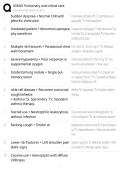
1. Sudden dyspnea + Normal CXR with Pulmonary embolism ’Ix: CT pulmonary an-
pleuritic chest pain giography ’Tx: Anticoagulation.
2. Intubated patient + Abnormal capnogra- Suspected esophageal ET tube placement ’Ix:
phy waveform End-tidal CO₂ (Capnography) ’Tx: Reposition
endotracheal tube.
3. Multiple rib fractures + Paradoxical chest Flail chest ’Ix: Chest X-ray/CT ’Tx: Adequate
wall movement analgesia + Respiratory support.
4. Severe hypoxemia + Poor response to Pulmonary edema ’Ix: Chest X-ray ’Tx: Posi-
supplemental oxygen tive-pressure ventilation + Treat cause.
5. Incidental lung nodule + Single pul- Solitary pulmonary nodule ’Ix: Compare pri-
monary lesion or imaging ’Chest CT ’Tx: Surveillance/Biopsy
based on malignancy risk.
6. ickle cell disease + Recurrent nocturnal Asthma ’Ix: Spirometry ’Tx: Standard asthma
cough/wheeze therapy.
= Asthma ’ Ix: Spirometry ’ Tx: Standard
asthma therapy.
7. Steroid use + Neutrophilic leukocytosis Glucocorticoid-induced demargination ’Ix:
without infection Clinical diagnosis ’Tx: No treatment required.
8. Barking cough + Stridor at Moderate-to-severe croup ’Ix: Clinical diagno-
sis ’Tx: Dexamethasone + Nebulized epineph-
rine.
9. Lower rib fractures + Left shoulder pain Splenic injury ’Ix: CT abdomen (stable) / FAST
(Kehr sign) (unstable) ’Tx: Manage splenic injury.
10. Cocaine use + Hemoptysis with diffuse
infiltrates
, USMLE Pulmonary and critical care
Study online at https://quizlet.com/_jsi521
Diffuse alveolar hemorrhage ’Ix: Bron-
choscopy/BAL ’Tx: Supportive care + Stop co-
caine.
11. Seizures + History of theophylline use Theophylline toxicity ’Ix: Serum theophylline
level ’Tx: Activated charcoal ± Hemodialysis
(severe).
12. Persistent pneumonia symptoms + Hilar Primary pulmonary tuberculosis ’Ix: Sputum
adenopathy with pleural effusion AFB smear/culture ’Tx: RIPE therapy.
13. Shoulder pain + Horner syndrome/Arm Pancoast tumor ’Ix: Chest CT ’Biopsy ’Tx:
weakness Chemoradiation ± Surgery.
14. Pregnancy + Mild dyspnea with normal Physiologic dyspnea of pregnancy ’Ix: Clinical
exam diagnosis ’Tx: Reassurance.
15. Premature infant + Apnea with bradycar- Apnea of prematurity ’Ix: Clinical diagnosis ’Tx:
dia Caffeine + Respiratory support.
16. Acute allergic reaction + Respiratory Anaphylaxis ’Ix: Clinical diagnosis ’Tx: IM epi-
compromise nephrine immediately.
17. Asthma + Typical GERD symptoms GERD worsening asthma ’Ix: Clinical diagnosis
’Tx: Proton pump inhibitor.
18. Hemoptysis + Sinus disease + Glomeru- Granulomatosis with polyangiitis (GPA) ’Ix:
lonephritis ANCA + Tissue biopsy ’Tx: Immunosuppres-
sion.
19. Aspiration after anesthesia + Symptoms Aspiration pneumonitis ’Ix: Clinical diagnosis ’
within 1-2 days Tx: Supportive care (No antibiotics initially).
20. Asbestos exposure + Smoker
, USMLE Pulmonary and critical care
Study online at https://quizlet.com/_jsi521
Asbestos-related lung cancer risk ’Ix: Chest
imaging as indicated ’Tx: Smoking cessa-
tion/Risk reduction.
21. Near-drowning victim + Initially asymp- Delayed pulmonary edema after drowning ’Ix:
tomatic Observation with pulse oximetry ’Tx: Observe
for e
8 hours.
22. Acute cough + Wheezing in patient with Acute bronchitis ’Ix: Clinical diagnosis ’Tx: Sup-
asthma portive care + Albuterol if wheezing (No antibi-
= Acute otics).
23. Septic shock + Persistent hypotension Septic shock ’Ix: Clinical diagnosis ’Tx: IV crys-
talloids first ’Vasopressors if needed.
24. Multiple rib fractures + Hypoxemia with Flail chest ’Ix: Chest imaging ’Tx: Adequate
paradoxical chest movement analgesia + Respiratory support.
25. Severe hypoxemia + Bilateral infiltrates ARDS ’Ix: Clinical diagnosis ’Tx: Lung-protective
without heart failure mechanical ventilation.
26. Elderly on quetiapine + New pneumonia Aspiration pneumonia due to atypical antipsy-
chotic ’Ix: Chest X-ray ’Tx: Appropriate antibi-
otics.
27. Persistent dry cough + ACE inhibitor use ACE inhibitor-induced cough ’Ix: Clinical diag-
nosis ’Tx: Stop ACE inhibitor (Switch to ARB).
28. Child with pneumonia + No improve- Parapneumonic effusion ’Ix: Chest X-ray ’Tx:
ment after 48-72 hours Drain if large/symptomatic.
29. Asthma/Cystic fibrosis + High IgE with Allergic bronchopulmonary aspergillosis
recurrent infiltrates (ABPA) ’Ix: Total IgE ± Aspergillus testing ’Tx:
Corticosteroids.
Study online at https://quizlet.com/_jsi521
1. Sudden dyspnea + Normal CXR with Pulmonary embolism ’Ix: CT pulmonary an-
pleuritic chest pain giography ’Tx: Anticoagulation.
2. Intubated patient + Abnormal capnogra- Suspected esophageal ET tube placement ’Ix:
phy waveform End-tidal CO₂ (Capnography) ’Tx: Reposition
endotracheal tube.
3. Multiple rib fractures + Paradoxical chest Flail chest ’Ix: Chest X-ray/CT ’Tx: Adequate
wall movement analgesia + Respiratory support.
4. Severe hypoxemia + Poor response to Pulmonary edema ’Ix: Chest X-ray ’Tx: Posi-
supplemental oxygen tive-pressure ventilation + Treat cause.
5. Incidental lung nodule + Single pul- Solitary pulmonary nodule ’Ix: Compare pri-
monary lesion or imaging ’Chest CT ’Tx: Surveillance/Biopsy
based on malignancy risk.
6. ickle cell disease + Recurrent nocturnal Asthma ’Ix: Spirometry ’Tx: Standard asthma
cough/wheeze therapy.
= Asthma ’ Ix: Spirometry ’ Tx: Standard
asthma therapy.
7. Steroid use + Neutrophilic leukocytosis Glucocorticoid-induced demargination ’Ix:
without infection Clinical diagnosis ’Tx: No treatment required.
8. Barking cough + Stridor at Moderate-to-severe croup ’Ix: Clinical diagno-
sis ’Tx: Dexamethasone + Nebulized epineph-
rine.
9. Lower rib fractures + Left shoulder pain Splenic injury ’Ix: CT abdomen (stable) / FAST
(Kehr sign) (unstable) ’Tx: Manage splenic injury.
10. Cocaine use + Hemoptysis with diffuse
infiltrates
, USMLE Pulmonary and critical care
Study online at https://quizlet.com/_jsi521
Diffuse alveolar hemorrhage ’Ix: Bron-
choscopy/BAL ’Tx: Supportive care + Stop co-
caine.
11. Seizures + History of theophylline use Theophylline toxicity ’Ix: Serum theophylline
level ’Tx: Activated charcoal ± Hemodialysis
(severe).
12. Persistent pneumonia symptoms + Hilar Primary pulmonary tuberculosis ’Ix: Sputum
adenopathy with pleural effusion AFB smear/culture ’Tx: RIPE therapy.
13. Shoulder pain + Horner syndrome/Arm Pancoast tumor ’Ix: Chest CT ’Biopsy ’Tx:
weakness Chemoradiation ± Surgery.
14. Pregnancy + Mild dyspnea with normal Physiologic dyspnea of pregnancy ’Ix: Clinical
exam diagnosis ’Tx: Reassurance.
15. Premature infant + Apnea with bradycar- Apnea of prematurity ’Ix: Clinical diagnosis ’Tx:
dia Caffeine + Respiratory support.
16. Acute allergic reaction + Respiratory Anaphylaxis ’Ix: Clinical diagnosis ’Tx: IM epi-
compromise nephrine immediately.
17. Asthma + Typical GERD symptoms GERD worsening asthma ’Ix: Clinical diagnosis
’Tx: Proton pump inhibitor.
18. Hemoptysis + Sinus disease + Glomeru- Granulomatosis with polyangiitis (GPA) ’Ix:
lonephritis ANCA + Tissue biopsy ’Tx: Immunosuppres-
sion.
19. Aspiration after anesthesia + Symptoms Aspiration pneumonitis ’Ix: Clinical diagnosis ’
within 1-2 days Tx: Supportive care (No antibiotics initially).
20. Asbestos exposure + Smoker
, USMLE Pulmonary and critical care
Study online at https://quizlet.com/_jsi521
Asbestos-related lung cancer risk ’Ix: Chest
imaging as indicated ’Tx: Smoking cessa-
tion/Risk reduction.
21. Near-drowning victim + Initially asymp- Delayed pulmonary edema after drowning ’Ix:
tomatic Observation with pulse oximetry ’Tx: Observe
for e
8 hours.
22. Acute cough + Wheezing in patient with Acute bronchitis ’Ix: Clinical diagnosis ’Tx: Sup-
asthma portive care + Albuterol if wheezing (No antibi-
= Acute otics).
23. Septic shock + Persistent hypotension Septic shock ’Ix: Clinical diagnosis ’Tx: IV crys-
talloids first ’Vasopressors if needed.
24. Multiple rib fractures + Hypoxemia with Flail chest ’Ix: Chest imaging ’Tx: Adequate
paradoxical chest movement analgesia + Respiratory support.
25. Severe hypoxemia + Bilateral infiltrates ARDS ’Ix: Clinical diagnosis ’Tx: Lung-protective
without heart failure mechanical ventilation.
26. Elderly on quetiapine + New pneumonia Aspiration pneumonia due to atypical antipsy-
chotic ’Ix: Chest X-ray ’Tx: Appropriate antibi-
otics.
27. Persistent dry cough + ACE inhibitor use ACE inhibitor-induced cough ’Ix: Clinical diag-
nosis ’Tx: Stop ACE inhibitor (Switch to ARB).
28. Child with pneumonia + No improve- Parapneumonic effusion ’Ix: Chest X-ray ’Tx:
ment after 48-72 hours Drain if large/symptomatic.
29. Asthma/Cystic fibrosis + High IgE with Allergic bronchopulmonary aspergillosis
recurrent infiltrates (ABPA) ’Ix: Total IgE ± Aspergillus testing ’Tx:
Corticosteroids.


