

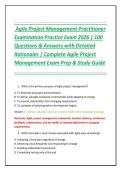
Agile Project Management Practitioner
Examination Practice Exam 2026 | 100
Questions & Answers with Detailed
Rationales | Complete Agile Project
Management Exam Prep & Study Guide
1. What is the primary purpose of Agile project management?
A. To eliminate all project documentation
B. To deliver valuable outcomes incrementally while adapting to change
C. To prevent stakeholders from changing requirements
D. To complete all planning before development begins
Answer: To deliver valuable outcomes incrementally while adapting to change
Rationale: Agile project management emphasizes iterative delivery, continuous
feedback, collaboration, and the ability to respond effectively to changing
requirements.
2. Which principle is most closely associated with Agile ways of working?
A. Following a fixed plan regardless of change
B. Delivering value frequently and responding to change
C. Avoiding stakeholder involvement
D. Completing testing only at the end
,Answer: Delivering value frequently and responding to change
Rationale: Agile approaches prioritize frequent delivery of valuable outcomes
and use feedback to adjust plans and priorities.
3. What is an Agile iteration?
A. A project closure activity
B. A fixed period during which a team develops and reviews a defined increment
of work
C. A contract negotiation
D. A financial audit
Answer: A fixed period during which a team develops and reviews a defined
increment of work
Rationale: An iteration provides a structured timebox for planning,
development, review, and learning.
4. Which role is primarily responsible for maximizing product value?
A. Scrum Master
B. Product Owner
C. Project Accountant
D. Technical Auditor
Answer: Product Owner
Rationale: The Product Owner represents value interests and is responsible for
prioritizing the product backlog to maximize value.
5. What is the main purpose of a product backlog?
A. To record employee attendance
B. To contain and prioritize work that may be needed to deliver the product
C. To replace all project documentation
D. To track only completed work
,Answer: To contain and prioritize work that may be needed to deliver the
product
Rationale: A product backlog provides a dynamic, ordered list of requirements,
enhancements, fixes, and other work needed for the product.
6. What does timeboxing mean in Agile project management?
A. Allowing activities to continue until they are completely finished
B. Allocating a fixed amount of time to an activity or event
C. Delaying decisions until project closure
D. Eliminating deadlines
Answer: Allocating a fixed amount of time to an activity or event
Rationale: Timeboxing establishes clear boundaries that encourage focus,
prioritization, and timely decision-making.
7. Which characteristic best describes an effective Agile team?
A. Highly centralized decision-making
B. Self-organizing and collaborative behavior
C. Strict separation of all skills
D. Dependence on detailed managerial instructions
Answer: Self-organizing and collaborative behavior
Rationale: Agile teams are generally empowered to organize their work and
collaborate closely to achieve agreed objectives.
8. What is the primary purpose of an Agile product vision?
A. To define every task for the entire project
B. To describe the desired future product and its intended value
C. To replace iteration planning
D. To establish employee salaries
Answer: To describe the desired future product and its intended value
, Rationale: A clear product vision aligns stakeholders and provides direction for
prioritization and delivery.
9. Which approach is most appropriate when requirements are likely to
change?
A. Predictive planning only
B. Iterative and incremental development
C. No planning at all
D. Delaying stakeholder feedback until completion
Answer: Iterative and incremental development
Rationale: Iterative and incremental delivery allows the team to learn from
feedback and adjust requirements as circumstances change.
10.What is an MVP?
A. Maximum Value Plan
B. Minimum Viable Product
C. Managed Verification Process
D. Minimum Validation Procedure
Answer: Minimum Viable Product
Rationale: An MVP contains the minimum set of capabilities needed to test
assumptions, provide value, and gather meaningful feedback.
11.What is the purpose of a Definition of Done?
A. To establish when work can be considered complete
B. To determine project funding
C. To identify stakeholders only
D. To replace acceptance criteria
Answer: To establish when work can be considered complete
Examination Practice Exam 2026 | 100
Questions & Answers with Detailed
Rationales | Complete Agile Project
Management Exam Prep & Study Guide
1. What is the primary purpose of Agile project management?
A. To eliminate all project documentation
B. To deliver valuable outcomes incrementally while adapting to change
C. To prevent stakeholders from changing requirements
D. To complete all planning before development begins
Answer: To deliver valuable outcomes incrementally while adapting to change
Rationale: Agile project management emphasizes iterative delivery, continuous
feedback, collaboration, and the ability to respond effectively to changing
requirements.
2. Which principle is most closely associated with Agile ways of working?
A. Following a fixed plan regardless of change
B. Delivering value frequently and responding to change
C. Avoiding stakeholder involvement
D. Completing testing only at the end
,Answer: Delivering value frequently and responding to change
Rationale: Agile approaches prioritize frequent delivery of valuable outcomes
and use feedback to adjust plans and priorities.
3. What is an Agile iteration?
A. A project closure activity
B. A fixed period during which a team develops and reviews a defined increment
of work
C. A contract negotiation
D. A financial audit
Answer: A fixed period during which a team develops and reviews a defined
increment of work
Rationale: An iteration provides a structured timebox for planning,
development, review, and learning.
4. Which role is primarily responsible for maximizing product value?
A. Scrum Master
B. Product Owner
C. Project Accountant
D. Technical Auditor
Answer: Product Owner
Rationale: The Product Owner represents value interests and is responsible for
prioritizing the product backlog to maximize value.
5. What is the main purpose of a product backlog?
A. To record employee attendance
B. To contain and prioritize work that may be needed to deliver the product
C. To replace all project documentation
D. To track only completed work
,Answer: To contain and prioritize work that may be needed to deliver the
product
Rationale: A product backlog provides a dynamic, ordered list of requirements,
enhancements, fixes, and other work needed for the product.
6. What does timeboxing mean in Agile project management?
A. Allowing activities to continue until they are completely finished
B. Allocating a fixed amount of time to an activity or event
C. Delaying decisions until project closure
D. Eliminating deadlines
Answer: Allocating a fixed amount of time to an activity or event
Rationale: Timeboxing establishes clear boundaries that encourage focus,
prioritization, and timely decision-making.
7. Which characteristic best describes an effective Agile team?
A. Highly centralized decision-making
B. Self-organizing and collaborative behavior
C. Strict separation of all skills
D. Dependence on detailed managerial instructions
Answer: Self-organizing and collaborative behavior
Rationale: Agile teams are generally empowered to organize their work and
collaborate closely to achieve agreed objectives.
8. What is the primary purpose of an Agile product vision?
A. To define every task for the entire project
B. To describe the desired future product and its intended value
C. To replace iteration planning
D. To establish employee salaries
Answer: To describe the desired future product and its intended value
, Rationale: A clear product vision aligns stakeholders and provides direction for
prioritization and delivery.
9. Which approach is most appropriate when requirements are likely to
change?
A. Predictive planning only
B. Iterative and incremental development
C. No planning at all
D. Delaying stakeholder feedback until completion
Answer: Iterative and incremental development
Rationale: Iterative and incremental delivery allows the team to learn from
feedback and adjust requirements as circumstances change.
10.What is an MVP?
A. Maximum Value Plan
B. Minimum Viable Product
C. Managed Verification Process
D. Minimum Validation Procedure
Answer: Minimum Viable Product
Rationale: An MVP contains the minimum set of capabilities needed to test
assumptions, provide value, and gather meaningful feedback.
11.What is the purpose of a Definition of Done?
A. To establish when work can be considered complete
B. To determine project funding
C. To identify stakeholders only
D. To replace acceptance criteria
Answer: To establish when work can be considered complete


