
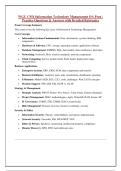
Exam Coverage Summary
This exam covers the following key areas of Information Technology Management:
Core Concepts
Information Systems Fundamentals: Data, information, systems thinking, MIS
components
Hardware & Software: CPU, storage, operating systems, application software
Database Management: RDBMS, SQL, data models, data warehouses, data lakes
Networking: Protocols, IPv6, wireless standards, network components
Cloud Computing: Service models (IaaS, PaaS, SaaS), deployment types,
characteristics
Business Applications
Enterprise Systems: ERP, CRM, SCM, their components and benefits
Business Intelligence: Analytics types, data visualization, dashboards, reporting
E-Business: Models (B2B, B2C, C2C), tools, challenges, Web 2.0/3.0 concepts
Decision Support: TPS, DSS, EIS, OLTP vs. OLAP
Strategy & Management
Strategic Analysis: SWOT, Porter's Five Forces, Value Chain, Generic Strategies
Project Management: SDLC methodologies, Agile, Waterfall, RAD, Scrum, XP
IT Governance: COBIT, ITIL, CMMI, ISACA frameworks
Risk Management: Disaster recovery, business continuity, security
Security & Ethics
Information Security: Threats, vulnerabilities, encryption, authentication
Network Security: Firewalls, IDS, WPA/WEP, VPN
Ethics & Privacy: Epolicies, monitoring, intellectual property, compliance
Disaster Recovery: RPO, RTO, hot/cold/warm sites
,Q1
A manufacturing company implements an ERP system to integrate its supply chain and
financial operations. The project manager needs to document all activities required to
complete the project successfully. Which document formally authorizes the project and
provides the project manager with authority to apply organizational resources?
A. Project charter
B. Business case
C. Project scope statement
D. Work breakdown structure
Correct Answer: A
Rationale: A project charter formally authorizes the project, identifies the project manager,
and provides authority to apply resources. The business case justifies the project, scope
statement defines deliverables, and WBS decomposes work into manageable components.
Q2
A retail chain wants to analyze customer purchasing patterns to recommend complementary
products during checkout. The data analyst needs to identify associations between items
frequently purchased together. Which data mining technique should be applied?
A. Market basket analysis
B. Cluster analysis
C. Regression analysis
D. Classification analysis
Correct Answer: A
Rationale: Market basket analysis identifies affinities among customer choices by analyzing
items purchased together. Cluster analysis groups similar items, regression predicts values,
and classification categorizes data into groups.
Q3
An organization is migrating its legacy systems to a service-oriented architecture. The IT
,director needs to ensure different applications can communicate regardless of their
underlying platforms. Which technology enables this interoperability?
A. Web services
B. FTP
C. DNS
D. SMTP
Correct Answer: A
Rationale: Web services use open standards like XML and SOAP to enable interoperability
between different systems. FTP is for file transfers, DNS resolves domain names, and SMTP
handles email delivery.
Q4
A hospital needs to ensure patient records remain accessible even during a regional disaster.
The IT team must determine the maximum acceptable data loss measured in hours. What
metric should they define?
A. Recovery Point Objective (RPO)
B. Recovery Time Objective (RTO)
C. Service Level Agreement (SLA)
D. Mean Time Between Failures (MTBF)
Correct Answer: A
Rationale: RPO defines the maximum acceptable data loss in time units (hours/days). RTO is
restoration time, SLA defines service expectations, and MTBF measures reliability.
Q5
An e-commerce platform experiences slowdowns during flash sales. The systems architect
recommends distributing incoming traffic across multiple server instances. Which component
should be implemented?
A. Load balancer
B. Firewall
, C. Network switch
D. Database index
Correct Answer: A
Rationale: A load balancer distributes traffic across servers for high availability and
performance. Firewalls secure networks, switches connect devices, and indexes speed
queries.
Q6
A software development team adopts an agile methodology that emphasizes extensive user
involvement and rapid construction of working prototypes. Which methodology are they
using?
A. Rapid Application Development (RAD)
B. Waterfall
C. Extreme Programming (XP)
D. Rational Unified Process (RUP)
Correct Answer: A
Rationale: RAD emphasizes user involvement and rapid prototyping. Waterfall is sequential,
XP focuses on coding practices, and RUP uses four phases with iterative development.
Q7
A company wants to implement a system that tracks employee payroll, benefits,
compensation, and performance assessments while ensuring compliance with legal
requirements. Which ERP component handles these functions?
A. Human resources management
B. Accounting and finance
C. Production and materials management
D. Supply chain management
Correct Answer: A
This exam covers the following key areas of Information Technology Management:
Core Concepts
Information Systems Fundamentals: Data, information, systems thinking, MIS
components
Hardware & Software: CPU, storage, operating systems, application software
Database Management: RDBMS, SQL, data models, data warehouses, data lakes
Networking: Protocols, IPv6, wireless standards, network components
Cloud Computing: Service models (IaaS, PaaS, SaaS), deployment types,
characteristics
Business Applications
Enterprise Systems: ERP, CRM, SCM, their components and benefits
Business Intelligence: Analytics types, data visualization, dashboards, reporting
E-Business: Models (B2B, B2C, C2C), tools, challenges, Web 2.0/3.0 concepts
Decision Support: TPS, DSS, EIS, OLTP vs. OLAP
Strategy & Management
Strategic Analysis: SWOT, Porter's Five Forces, Value Chain, Generic Strategies
Project Management: SDLC methodologies, Agile, Waterfall, RAD, Scrum, XP
IT Governance: COBIT, ITIL, CMMI, ISACA frameworks
Risk Management: Disaster recovery, business continuity, security
Security & Ethics
Information Security: Threats, vulnerabilities, encryption, authentication
Network Security: Firewalls, IDS, WPA/WEP, VPN
Ethics & Privacy: Epolicies, monitoring, intellectual property, compliance
Disaster Recovery: RPO, RTO, hot/cold/warm sites
,Q1
A manufacturing company implements an ERP system to integrate its supply chain and
financial operations. The project manager needs to document all activities required to
complete the project successfully. Which document formally authorizes the project and
provides the project manager with authority to apply organizational resources?
A. Project charter
B. Business case
C. Project scope statement
D. Work breakdown structure
Correct Answer: A
Rationale: A project charter formally authorizes the project, identifies the project manager,
and provides authority to apply resources. The business case justifies the project, scope
statement defines deliverables, and WBS decomposes work into manageable components.
Q2
A retail chain wants to analyze customer purchasing patterns to recommend complementary
products during checkout. The data analyst needs to identify associations between items
frequently purchased together. Which data mining technique should be applied?
A. Market basket analysis
B. Cluster analysis
C. Regression analysis
D. Classification analysis
Correct Answer: A
Rationale: Market basket analysis identifies affinities among customer choices by analyzing
items purchased together. Cluster analysis groups similar items, regression predicts values,
and classification categorizes data into groups.
Q3
An organization is migrating its legacy systems to a service-oriented architecture. The IT
,director needs to ensure different applications can communicate regardless of their
underlying platforms. Which technology enables this interoperability?
A. Web services
B. FTP
C. DNS
D. SMTP
Correct Answer: A
Rationale: Web services use open standards like XML and SOAP to enable interoperability
between different systems. FTP is for file transfers, DNS resolves domain names, and SMTP
handles email delivery.
Q4
A hospital needs to ensure patient records remain accessible even during a regional disaster.
The IT team must determine the maximum acceptable data loss measured in hours. What
metric should they define?
A. Recovery Point Objective (RPO)
B. Recovery Time Objective (RTO)
C. Service Level Agreement (SLA)
D. Mean Time Between Failures (MTBF)
Correct Answer: A
Rationale: RPO defines the maximum acceptable data loss in time units (hours/days). RTO is
restoration time, SLA defines service expectations, and MTBF measures reliability.
Q5
An e-commerce platform experiences slowdowns during flash sales. The systems architect
recommends distributing incoming traffic across multiple server instances. Which component
should be implemented?
A. Load balancer
B. Firewall
, C. Network switch
D. Database index
Correct Answer: A
Rationale: A load balancer distributes traffic across servers for high availability and
performance. Firewalls secure networks, switches connect devices, and indexes speed
queries.
Q6
A software development team adopts an agile methodology that emphasizes extensive user
involvement and rapid construction of working prototypes. Which methodology are they
using?
A. Rapid Application Development (RAD)
B. Waterfall
C. Extreme Programming (XP)
D. Rational Unified Process (RUP)
Correct Answer: A
Rationale: RAD emphasizes user involvement and rapid prototyping. Waterfall is sequential,
XP focuses on coding practices, and RUP uses four phases with iterative development.
Q7
A company wants to implement a system that tracks employee payroll, benefits,
compensation, and performance assessments while ensuring compliance with legal
requirements. Which ERP component handles these functions?
A. Human resources management
B. Accounting and finance
C. Production and materials management
D. Supply chain management
Correct Answer: A


