

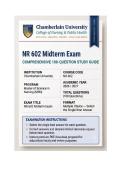
,NR 602 Midterm Exam – Childbearing & Childrearing
Practicum – Q&A (2026) PDF | Chamberlain
1. Presumptive signs of pregnancy include which of the following?
A) Amenorrhea and breast tenderness
B) Goodell sign and positive pregnancy test
C) Fetal heart tones
D) Ultrasound visualization of fetus
Correct Answer: A) Amenorrhea and breast tenderness
Rationale: Presumptive signs are subjective symptoms experienced by the patient, such as
amenorrhea, breast changes, nausea, fatigue, and urinary frequency. Goodell sign and
positive pregnancy test are probable signs; fetal heart tones and ultrasound visualization are
positive, definitive signs.
2. When examining a toddler during a well-child visit, which body part should be examined
last?
A) Heart
B) Ears and throat
C) Abdomen
D) Extremities
Correct Answer: B) Ears and throat
Rationale: The ears and throat are the most invasive and distressing parts of the examination
for a toddler. Performing these assessments last minimizes anxiety and allows the child to
cooperate for the remainder of the exam.
,3. A 10-year-old presents with vesicles and honey-colored crusted lesions on the face after a
scratch. The most likely diagnosis is:
A) Herpes simplex
B) Varicella
C) Impetigo
D) Cellulitis
Correct Answer: C) Impetigo
Rationale: Impetigo is a superficial bacterial skin infection, commonly caused by
Staphylococcus aureus or Streptococcus pyogenes, presenting with vesicles that rupture and
form honey-colored crusts. It often follows a break in the skin.
4. A nurse practitioner is using Nägele’s rule to calculate the due date for a pregnant patient
whose last menstrual period began on January 10. The estimated date of delivery is:
A) September 3
B) October 10
C) November 10
D) October 17
Correct Answer: D) October 17
Rationale: Nägele’s rule: subtract 3 months from the LMP, add 7 days, and add 1 year.
January 10 minus 3 months = October 10; plus 7 days = October 17. The due date is October
17 of the same year.
5. Which of the following is a contraindication to combined hormonal contraceptives?
A) Acne
B) History of venous thromboembolism
, C) Dysmenorrhea
D) Endometriosis
Correct Answer: B) History of venous thromboembolism
Rationale: Combined hormonal contraceptives increase the risk of thromboembolic events
and are contraindicated in women with a history of VTE. Acne, dysmenorrhea, and
endometriosis are often improved by combined hormonal contraceptives.
6. A 12-year-old asthmatic presents with acute wheezing and shortness of breath. The nurse
practitioner’s first-line treatment is:
A) Oral prednisone
B) Inhaled corticosteroid
C) Short-acting beta agonist (albuterol)
D) Montelukast
Correct Answer: C) Short-acting beta agonist (albuterol)
Rationale: Acute asthma exacerbations are managed with inhaled short-acting beta agonists
to achieve rapid bronchodilation. Inhaled corticosteroids and montelukast are controller
medications; oral prednisone may be added for moderate-to-severe exacerbations.
7. The fundal height at 20 weeks’ gestation is palpated at the:
A) Symphysis pubis
B) Midway between symphysis and umbilicus
C) Xiphoid process
D) Umbilicus
Correct Answer: D) Umbilicus
Practicum – Q&A (2026) PDF | Chamberlain
1. Presumptive signs of pregnancy include which of the following?
A) Amenorrhea and breast tenderness
B) Goodell sign and positive pregnancy test
C) Fetal heart tones
D) Ultrasound visualization of fetus
Correct Answer: A) Amenorrhea and breast tenderness
Rationale: Presumptive signs are subjective symptoms experienced by the patient, such as
amenorrhea, breast changes, nausea, fatigue, and urinary frequency. Goodell sign and
positive pregnancy test are probable signs; fetal heart tones and ultrasound visualization are
positive, definitive signs.
2. When examining a toddler during a well-child visit, which body part should be examined
last?
A) Heart
B) Ears and throat
C) Abdomen
D) Extremities
Correct Answer: B) Ears and throat
Rationale: The ears and throat are the most invasive and distressing parts of the examination
for a toddler. Performing these assessments last minimizes anxiety and allows the child to
cooperate for the remainder of the exam.
,3. A 10-year-old presents with vesicles and honey-colored crusted lesions on the face after a
scratch. The most likely diagnosis is:
A) Herpes simplex
B) Varicella
C) Impetigo
D) Cellulitis
Correct Answer: C) Impetigo
Rationale: Impetigo is a superficial bacterial skin infection, commonly caused by
Staphylococcus aureus or Streptococcus pyogenes, presenting with vesicles that rupture and
form honey-colored crusts. It often follows a break in the skin.
4. A nurse practitioner is using Nägele’s rule to calculate the due date for a pregnant patient
whose last menstrual period began on January 10. The estimated date of delivery is:
A) September 3
B) October 10
C) November 10
D) October 17
Correct Answer: D) October 17
Rationale: Nägele’s rule: subtract 3 months from the LMP, add 7 days, and add 1 year.
January 10 minus 3 months = October 10; plus 7 days = October 17. The due date is October
17 of the same year.
5. Which of the following is a contraindication to combined hormonal contraceptives?
A) Acne
B) History of venous thromboembolism
, C) Dysmenorrhea
D) Endometriosis
Correct Answer: B) History of venous thromboembolism
Rationale: Combined hormonal contraceptives increase the risk of thromboembolic events
and are contraindicated in women with a history of VTE. Acne, dysmenorrhea, and
endometriosis are often improved by combined hormonal contraceptives.
6. A 12-year-old asthmatic presents with acute wheezing and shortness of breath. The nurse
practitioner’s first-line treatment is:
A) Oral prednisone
B) Inhaled corticosteroid
C) Short-acting beta agonist (albuterol)
D) Montelukast
Correct Answer: C) Short-acting beta agonist (albuterol)
Rationale: Acute asthma exacerbations are managed with inhaled short-acting beta agonists
to achieve rapid bronchodilation. Inhaled corticosteroids and montelukast are controller
medications; oral prednisone may be added for moderate-to-severe exacerbations.
7. The fundal height at 20 weeks’ gestation is palpated at the:
A) Symphysis pubis
B) Midway between symphysis and umbilicus
C) Xiphoid process
D) Umbilicus
Correct Answer: D) Umbilicus


