

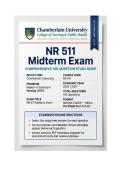
,NR 511 Midterm Exam – Differential Diagnosis & Primary Care
Practicum – Q&A (2026) PDF | Chamberlain
1. The nurse practitioner is evaluating a patient with a rash. Which question would be
included in the History of Present Illness using the OLDCARTS mnemonic?
A) "Do you have any allergies?"
B) "What makes the pain worse?"
C) "Have you ever been hospitalized?"
D) "What is your occupation?"
Correct Answer: B) "What makes the pain worse?"
Rationale: OLDCARTS includes Aggravating factors—what worsens the symptom. Allergies,
past hospitalizations, and occupation belong to other history sections. The HPI focuses on the
chief complaint's characteristics, onset, location, duration, and factors that influence it.
2. A 28-year-old female presents with a 3-day history of purulent rhinorrhea, facial pressure,
and nasal congestion. The nurse practitioner diagnoses acute bacterial sinusitis. Which sinus
is most commonly affected?
A) Ethmoid
B) Maxillary
C) Frontal
D) Sphenoid
Correct Answer: B) Maxillary
Rationale: The maxillary sinuses are the largest and most frequently involved in acute
bacterial sinusitis due to their drainage position. Symptoms include facial pain, pressure, and
purulent discharge. The ethmoid and frontal sinuses may also be affected but less often as
isolated sites.
,3. A patient with Alzheimer's disease is started on a cholinesterase inhibitor. What is the
primary purpose of this medication class?
A) Cure the disease
B) Slow cognitive decline and improve function
C) Prevent neurofibrillary tangles
D) Reverse memory loss
Correct Answer: B) Slow cognitive decline and improve function
Rationale: Cholinesterase inhibitors (donepezil, rivastigmine, galantamine) increase
acetylcholine levels, providing modest symptomatic benefit and potentially delaying
progression. They do not cure or reverse Alzheimer's pathology. Treatment is recommended
at diagnosis.
4. A 24-year-old woman develops a rash that began on her face and spread downward. She
reports low-grade fever, headache, and sore throat 2 days before the rash. The nurse
practitioner suspects:
A) Measles (rubeola)
B) Rubella (German measles)
C) Scarlet fever
D) Fifth disease
Correct Answer: B) Rubella (German measles)
Rationale: Rubella presents with a rose-pink maculopapular rash starting on the head and
spreading caudally, preceded by prodromal symptoms. Measles has Koplik spots and a more
severe prodrome. Scarlet fever has a sandpaper rash and strawberry tongue.
, 5. A patient with GERD has persistent symptoms despite lifestyle changes and H2 blockers.
The nurse practitioner prescribes:
A) Antacids only
B) Metoclopramide
C) Proton pump inhibitor (e.g., omeprazole)
D) Sucralfate
Correct Answer: C) Proton pump inhibitor (e.g., omeprazole)
Rationale: PPIs provide superior acid suppression and healing of esophagitis compared to H2
blockers and are first-line when H2 blockers fail. Antacids are for mild, intermittent
symptoms. Metoclopramide is a prokinetic with limited use due to side effects.
6. Which antibiotic is the treatment of choice for group A beta-hemolytic streptococcal
pharyngitis in a non-allergic patient?
A) Azithromycin
B) Ciprofloxacin
C) Penicillin V or amoxicillin
D) Cephalexin
Correct Answer: C) Penicillin V or amoxicillin
Rationale: Penicillin or amoxicillin is first-line for GABHS pharyngitis to prevent rheumatic
fever. Macrolides (azithromycin) are reserved for penicillin-allergic patients.
Fluoroquinolones and cephalexin are not primary choices.
7. The nurse practitioner documents the patient's report of fatigue and weight loss in which
part of the SOAP note?
A) Objective
Practicum – Q&A (2026) PDF | Chamberlain
1. The nurse practitioner is evaluating a patient with a rash. Which question would be
included in the History of Present Illness using the OLDCARTS mnemonic?
A) "Do you have any allergies?"
B) "What makes the pain worse?"
C) "Have you ever been hospitalized?"
D) "What is your occupation?"
Correct Answer: B) "What makes the pain worse?"
Rationale: OLDCARTS includes Aggravating factors—what worsens the symptom. Allergies,
past hospitalizations, and occupation belong to other history sections. The HPI focuses on the
chief complaint's characteristics, onset, location, duration, and factors that influence it.
2. A 28-year-old female presents with a 3-day history of purulent rhinorrhea, facial pressure,
and nasal congestion. The nurse practitioner diagnoses acute bacterial sinusitis. Which sinus
is most commonly affected?
A) Ethmoid
B) Maxillary
C) Frontal
D) Sphenoid
Correct Answer: B) Maxillary
Rationale: The maxillary sinuses are the largest and most frequently involved in acute
bacterial sinusitis due to their drainage position. Symptoms include facial pain, pressure, and
purulent discharge. The ethmoid and frontal sinuses may also be affected but less often as
isolated sites.
,3. A patient with Alzheimer's disease is started on a cholinesterase inhibitor. What is the
primary purpose of this medication class?
A) Cure the disease
B) Slow cognitive decline and improve function
C) Prevent neurofibrillary tangles
D) Reverse memory loss
Correct Answer: B) Slow cognitive decline and improve function
Rationale: Cholinesterase inhibitors (donepezil, rivastigmine, galantamine) increase
acetylcholine levels, providing modest symptomatic benefit and potentially delaying
progression. They do not cure or reverse Alzheimer's pathology. Treatment is recommended
at diagnosis.
4. A 24-year-old woman develops a rash that began on her face and spread downward. She
reports low-grade fever, headache, and sore throat 2 days before the rash. The nurse
practitioner suspects:
A) Measles (rubeola)
B) Rubella (German measles)
C) Scarlet fever
D) Fifth disease
Correct Answer: B) Rubella (German measles)
Rationale: Rubella presents with a rose-pink maculopapular rash starting on the head and
spreading caudally, preceded by prodromal symptoms. Measles has Koplik spots and a more
severe prodrome. Scarlet fever has a sandpaper rash and strawberry tongue.
, 5. A patient with GERD has persistent symptoms despite lifestyle changes and H2 blockers.
The nurse practitioner prescribes:
A) Antacids only
B) Metoclopramide
C) Proton pump inhibitor (e.g., omeprazole)
D) Sucralfate
Correct Answer: C) Proton pump inhibitor (e.g., omeprazole)
Rationale: PPIs provide superior acid suppression and healing of esophagitis compared to H2
blockers and are first-line when H2 blockers fail. Antacids are for mild, intermittent
symptoms. Metoclopramide is a prokinetic with limited use due to side effects.
6. Which antibiotic is the treatment of choice for group A beta-hemolytic streptococcal
pharyngitis in a non-allergic patient?
A) Azithromycin
B) Ciprofloxacin
C) Penicillin V or amoxicillin
D) Cephalexin
Correct Answer: C) Penicillin V or amoxicillin
Rationale: Penicillin or amoxicillin is first-line for GABHS pharyngitis to prevent rheumatic
fever. Macrolides (azithromycin) are reserved for penicillin-allergic patients.
Fluoroquinolones and cephalexin are not primary choices.
7. The nurse practitioner documents the patient's report of fatigue and weight loss in which
part of the SOAP note?
A) Objective


