

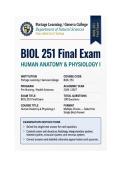
,BIOL 251 Final Exam | Human Anatomy &
Physiology I w/Lab Exam Q&A | Portage Learning
1. The study of the structure of the human body is known as:
A) Anatomy
B) Physiology
C) Histology
D) Cytology
Correct Answer: A) Anatomy
Rationale: Anatomy is the study of the body's structures and their relationships.
Physiology studies functions; histology studies tissues; cytology studies cells.
These are complementary but distinct disciplines.
2. The standard reference position for describing anatomical structures is:
A) Supine with arms at sides
B) Body standing erect, feet parallel, palms facing forward
C) Sitting with legs extended
D) Prone with head turned to the side
Correct Answer: B) Body standing erect, feet parallel, palms facing forward
Rationale: The anatomical position is the universally accepted starting point for
directional terms and body planes. The body is upright, face forward, feet
parallel, and palms facing anteriorly.
,3. A plane that divides the body into superior and inferior parts is called:
A) Frontal (coronal)
B) Sagittal
C) Transverse (horizontal)
D) Midsagittal
Correct Answer: C) Transverse (horizontal)
Rationale: The transverse plane cuts across the body horizontally, producing top
and bottom sections. The frontal plane divides anterior/posterior; sagittal
divides right/left; midsagittal is directly on the midline.
4. The heart is located within the:
A) Thoracic cavity
B) Abdominopelvic cavity
C) Cranial cavity
D) Dorsal cavity
Correct Answer: A) Thoracic cavity
Rationale: The thoracic cavity, a subdivision of the ventral cavity, contains the
heart (within the pericardial cavity) and lungs. The abdominopelvic cavity is
inferior; the cranial cavity houses the brain.
5. The serous membrane covering the lungs is the:
, A) Pleura
B) Pericardium
C) Peritoneum
D) Meninges
Correct Answer: A) Pleura
Rationale: The pleura is a double‑layered serous membrane; the visceral pleura
adheres to the lungs, the parietal pleura lines the thoracic cavity, and serous
fluid between them reduces friction during breathing.
6. Which of the following levels of organization is directly above the cellular
level?
A) Tissue
B) Chemical
C) Organ
D) Organ system
Correct Answer: A) Tissue
Rationale: The hierarchy progresses from chemical → cellular → tissue → organ
→ organ system → organism. Tissues are groups of similar cells performing a
common function.
7. When body temperature rises, sweating and vasodilation help cool the body.
This is an example of:
Physiology I w/Lab Exam Q&A | Portage Learning
1. The study of the structure of the human body is known as:
A) Anatomy
B) Physiology
C) Histology
D) Cytology
Correct Answer: A) Anatomy
Rationale: Anatomy is the study of the body's structures and their relationships.
Physiology studies functions; histology studies tissues; cytology studies cells.
These are complementary but distinct disciplines.
2. The standard reference position for describing anatomical structures is:
A) Supine with arms at sides
B) Body standing erect, feet parallel, palms facing forward
C) Sitting with legs extended
D) Prone with head turned to the side
Correct Answer: B) Body standing erect, feet parallel, palms facing forward
Rationale: The anatomical position is the universally accepted starting point for
directional terms and body planes. The body is upright, face forward, feet
parallel, and palms facing anteriorly.
,3. A plane that divides the body into superior and inferior parts is called:
A) Frontal (coronal)
B) Sagittal
C) Transverse (horizontal)
D) Midsagittal
Correct Answer: C) Transverse (horizontal)
Rationale: The transverse plane cuts across the body horizontally, producing top
and bottom sections. The frontal plane divides anterior/posterior; sagittal
divides right/left; midsagittal is directly on the midline.
4. The heart is located within the:
A) Thoracic cavity
B) Abdominopelvic cavity
C) Cranial cavity
D) Dorsal cavity
Correct Answer: A) Thoracic cavity
Rationale: The thoracic cavity, a subdivision of the ventral cavity, contains the
heart (within the pericardial cavity) and lungs. The abdominopelvic cavity is
inferior; the cranial cavity houses the brain.
5. The serous membrane covering the lungs is the:
, A) Pleura
B) Pericardium
C) Peritoneum
D) Meninges
Correct Answer: A) Pleura
Rationale: The pleura is a double‑layered serous membrane; the visceral pleura
adheres to the lungs, the parietal pleura lines the thoracic cavity, and serous
fluid between them reduces friction during breathing.
6. Which of the following levels of organization is directly above the cellular
level?
A) Tissue
B) Chemical
C) Organ
D) Organ system
Correct Answer: A) Tissue
Rationale: The hierarchy progresses from chemical → cellular → tissue → organ
→ organ system → organism. Tissues are groups of similar cells performing a
common function.
7. When body temperature rises, sweating and vasodilation help cool the body.
This is an example of:


