

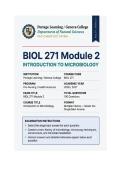
,BIOL 271 Module 2 Exam | Microbiology w/Lab
Q&A | Portage Learning
1. The sum of all chemical reactions occurring within a living organism is called:
A) Metabolism
B) Catabolism
C) Anabolism
D) Homeostasis
Correct Answer: A) Metabolism
Rationale: Metabolism encompasses both the breakdown (catabolism) and
synthesis (anabolism) of molecules to sustain life. It occurs in all living
organisms, not just motile ones.
2. The metabolic process that breaks down large molecules into smaller ones
and releases energy is:
A) Anabolism
B) Catabolism
C) Biosynthesis
D) Photosynthesis
Correct Answer: B) Catabolism
Rationale: Catabolism is exergonic; it provides the energy and building blocks
for anabolism. Examples include the breakdown of glucose and proteins into
amino acids.
,3. The biosynthesis of complex molecules from simpler ones, requiring energy
input, is termed:
A) Catabolism
B) Metabolism
C) Anabolism
D) Oxidation
Correct Answer: C) Anabolism
Rationale: Anabolic reactions are endergonic; they build macromolecules like
proteins and nucleic acids, essential for growth, repair, and reproduction.
Catabolism fuels these processes.
4. The energy currency of the cell, which donates a phosphate group to power
endergonic reactions, is:
A) Glucose
B) NADH
C) DNA
D) ATP
Correct Answer: D) ATP
Rationale: Adenosine triphosphate (ATP) stores energy in its high‑energy
phosphate bonds. Dephosphorylation to ADP + Pi releases energy for cellular
work.
, 5. When ATP loses a phosphate group to become ADP, this reaction is called:
A) Dephosphorylation
B) Phosphorylation
C) Reduction
D) Oxidation
Correct Answer: A) Dephosphorylation
Rationale: ATP → ADP + Pi is dephosphorylation, releasing energy.
Phosphorylation is the reverse, where ADP gains a phosphate to form ATP.
6. Enzymes function as biological catalysts by:
A) Being consumed in reactions
B) Speeding up chemical reactions
C) Increasing activation energy
D) Altering the equilibrium
Correct Answer: B) Speeding up chemical reactions
Rationale: Enzymes lower activation energy, allowing reactions to proceed
faster without being consumed. They are highly specific and work under mild
conditions.
7. The loss of electrons from a molecule is known as:
A) Reduction
Q&A | Portage Learning
1. The sum of all chemical reactions occurring within a living organism is called:
A) Metabolism
B) Catabolism
C) Anabolism
D) Homeostasis
Correct Answer: A) Metabolism
Rationale: Metabolism encompasses both the breakdown (catabolism) and
synthesis (anabolism) of molecules to sustain life. It occurs in all living
organisms, not just motile ones.
2. The metabolic process that breaks down large molecules into smaller ones
and releases energy is:
A) Anabolism
B) Catabolism
C) Biosynthesis
D) Photosynthesis
Correct Answer: B) Catabolism
Rationale: Catabolism is exergonic; it provides the energy and building blocks
for anabolism. Examples include the breakdown of glucose and proteins into
amino acids.
,3. The biosynthesis of complex molecules from simpler ones, requiring energy
input, is termed:
A) Catabolism
B) Metabolism
C) Anabolism
D) Oxidation
Correct Answer: C) Anabolism
Rationale: Anabolic reactions are endergonic; they build macromolecules like
proteins and nucleic acids, essential for growth, repair, and reproduction.
Catabolism fuels these processes.
4. The energy currency of the cell, which donates a phosphate group to power
endergonic reactions, is:
A) Glucose
B) NADH
C) DNA
D) ATP
Correct Answer: D) ATP
Rationale: Adenosine triphosphate (ATP) stores energy in its high‑energy
phosphate bonds. Dephosphorylation to ADP + Pi releases energy for cellular
work.
, 5. When ATP loses a phosphate group to become ADP, this reaction is called:
A) Dephosphorylation
B) Phosphorylation
C) Reduction
D) Oxidation
Correct Answer: A) Dephosphorylation
Rationale: ATP → ADP + Pi is dephosphorylation, releasing energy.
Phosphorylation is the reverse, where ADP gains a phosphate to form ATP.
6. Enzymes function as biological catalysts by:
A) Being consumed in reactions
B) Speeding up chemical reactions
C) Increasing activation energy
D) Altering the equilibrium
Correct Answer: B) Speeding up chemical reactions
Rationale: Enzymes lower activation energy, allowing reactions to proceed
faster without being consumed. They are highly specific and work under mild
conditions.
7. The loss of electrons from a molecule is known as:
A) Reduction


