
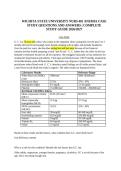
WICHITA STATE UNIVERSITY NURS 401 ANEMIA CASE
STUDY QUESTIONS AND ANSWERS | COMPLETE
STUDY GUIDE 2026/2027
Case Study
G. C. is a 78-year-old widow who comes to the outpatient clinic saying that over the past 2 to 3
months she has felt increasingly tired, despite sleeping well at night, and periodic headaches.
Over the past few years, she describes eating less and less meat because of her financial
situation and has trouble preparing a meal “just for me”. G. C. relates how she relies on her late
husband’s retirement income for all her expenses. She struggles financially to buy medicines for
treating her hypertension and arthritis. Vital signs are blood pressure 136/76 mmHg, respirations
16 breaths/minute, pulse 80 beats/minute. She denies any dyspnea or palpitations. The nurse
practitioner orders blood work. G. C.’s chemistry panel findings are all within normal limits, and
a stool fecal occult blood test result is negative. Her other results are displayed below:
Laboratory Results Reference Range
White blood cell (WBC) 7600/mm3 5000-10,000/mm3
count
Hematocrit (Hct) 27.3% 37% - 47%
Hemoglobin (Hgb) 8.3 mg/dL 12-16 mg/dL
Platelets 151,000/mm3 150,000 – 450,000/mm3
Red Blood Cell (RBC) Indices
Mean corpuscular volume 65 FL (65 mm3) 80-95 FL
(MCV)
Mean corpuscular 31.6 pg 27-31 pg
hemoglobin (MCH)
MCH concentration 35.1% 32% - 36%
(MCHC)
Iron, total 30 mcg/dL 60-160 mcg/dL
Iron-binding capacity 422 mcg/dL 250-460 mcg/dL
Ferritin 8 mg/dL 10-150 mg/dL
Vitamin B12 414 pg/mL 160-950 pg/mL
Folate 22 ng/mL 5-25 ng/mL
Based on these results and her history, what condition does G.C. most likely have?
Iron deficiency anemia
Who is at risk for this condition? Identify the risk factors that G.C. has.
Older adults, vegetarians, younger females, pregnancy, alcoholics. GC is at risk because of her
age, she is not eating enough iron.
STUDY QUESTIONS AND ANSWERS | COMPLETE
STUDY GUIDE 2026/2027
Case Study
G. C. is a 78-year-old widow who comes to the outpatient clinic saying that over the past 2 to 3
months she has felt increasingly tired, despite sleeping well at night, and periodic headaches.
Over the past few years, she describes eating less and less meat because of her financial
situation and has trouble preparing a meal “just for me”. G. C. relates how she relies on her late
husband’s retirement income for all her expenses. She struggles financially to buy medicines for
treating her hypertension and arthritis. Vital signs are blood pressure 136/76 mmHg, respirations
16 breaths/minute, pulse 80 beats/minute. She denies any dyspnea or palpitations. The nurse
practitioner orders blood work. G. C.’s chemistry panel findings are all within normal limits, and
a stool fecal occult blood test result is negative. Her other results are displayed below:
Laboratory Results Reference Range
White blood cell (WBC) 7600/mm3 5000-10,000/mm3
count
Hematocrit (Hct) 27.3% 37% - 47%
Hemoglobin (Hgb) 8.3 mg/dL 12-16 mg/dL
Platelets 151,000/mm3 150,000 – 450,000/mm3
Red Blood Cell (RBC) Indices
Mean corpuscular volume 65 FL (65 mm3) 80-95 FL
(MCV)
Mean corpuscular 31.6 pg 27-31 pg
hemoglobin (MCH)
MCH concentration 35.1% 32% - 36%
(MCHC)
Iron, total 30 mcg/dL 60-160 mcg/dL
Iron-binding capacity 422 mcg/dL 250-460 mcg/dL
Ferritin 8 mg/dL 10-150 mg/dL
Vitamin B12 414 pg/mL 160-950 pg/mL
Folate 22 ng/mL 5-25 ng/mL
Based on these results and her history, what condition does G.C. most likely have?
Iron deficiency anemia
Who is at risk for this condition? Identify the risk factors that G.C. has.
Older adults, vegetarians, younger females, pregnancy, alcoholics. GC is at risk because of her
age, she is not eating enough iron.


