

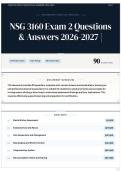
NSG 3160 EXAM 2 QUESTIONS & ANSWERS 2026-2027 | EXAM
P R O F E S S I O N A L P R A C T I C E M AT E R I A L S
NSG 3160 Exam 2 Questions
& Answers 2026-2027 |
Verified Answers Exam Ready With Rationales
90 QUESTIONS
DOCUMENT OVERVIEW
This document provides 90 questions, complete with correct answers and explanations, focusing on
comprehensive physical assessment. It is suitable for students to study and review key concepts for
nursing exams, offering a direct way to understand assessment findings and their implications. This
resource effectively supports learning and preparation for certification.
CONTENTS
01 Mental Status Assessment Q1–Q20
02 Substance Use and Abuse Q21–Q30
03 Pain Assessment and Management Q31–Q40
04 Neurological and Motor Function Q41–Q50
05 Integumentary System Q51–Q60
06 Sensory System: Vision and Hearing Q61–Q80
Page 1
, 07 Head, Neck, and Oral Cavity Q81–Q90
E XA M Q U EST I O N S
Q1 QUESTION 1 OF 90
A full mental status examination should be completed if the patient
a. develops dysphagia.
b. has a new diagnosis of type 2 diabetes mellitus.
c. complains of insomnia.
d. has a change in behavior and the family is concerned.
CORRECT ANSWER
d. has a change in behavior and the family is concerned.
A full mental status examination is indicated if there is any abnormality in affect or behavior and in the
following situations: family members concerned about a person's behavioral changes; brain lesions; aphasia; or
symptoms of psychiatric mental illness, especially with acute onset. A full mental status examination is not
indicated for dysphagia or difficulty with swallowing. A full mental status examination is not indicated for a
medical problem such as type 2 diabetes mellitus. A full mental status examination is not indicated for a
symptom such as insomnia.
Q2 QUESTION 2 OF 90
Aphasia is best described as
a. a disturbance in executive functioning (planning, organizing, sequencing, abstracting).
b. a language disturbance in speaking, writing, or understanding.
c. the impaired ability to recognize or identify objects despite intact sensory function.
d. the impaired ability to carry out motor activities despite intact motor function.
CORRECT ANSWER
b. a language disturbance in speaking, writing, or understanding.
Aphasia is a language disturbance. Apraxia is an impaired ability to carry out motor activities despite intact
motor function. Agnosia is an impaired ability to identify objects correctly despite intact sensory function. A
disturbance in executive functioning is a cognitive disturbance. Dementia is the development of multiple
cognitive deficits with both memory impairment and a cognitive disturbance.
Q3 QUESTION 3 OF 90
Page 2
,A patient in whom a seizure disorder was recently diagnosed plans to continue a career as a pilot. At this time
in the interview, the nurse begins to question the patient's
a. thought process.
b. intellect.
c. judgment.
d. perception.
CORRECT ANSWER
c. judgment.
To assess judgment in the interview, the nurse should notice what the person says about job plans, social or
family obligations, and plans for the future. Job and future plans should be realistic and should take into
account the person's health situation. Thought processes should be consistent, coherent, relevant, and logical.
Perceptions should be congruent; the person should be consistently aware of reality. Intellectual functioning is
measured by problem-solving and reasoning abilities.
Q4 QUESTION 4 OF 90
A major characteristic of dementia is
a. hallucinations.
b. sudden onset of symptoms.
c. cognitive deficits that are substance-induced.
d. impaired short-term and long-term memory.
CORRECT ANSWER
d. impaired short-term and long-term memory.
Dementia is the presence of cognitive deficits; the deficits include memory impairment (impaired ability to
learn new information or to recall previously learned information). Hallucinations are a form of delirium.
Delirium is a disturbance that develops over a short period of time. Delirium may be substance-induced.
Q5 QUESTION 5 OF 90
Mental status assessment documents
a. schizophrenia and other mental health disorders.
b. artistic or writing ability in the mentally ill person.
Page 3
, c. emotional and cognitive functioning.
d. intelligence and educational level.
CORRECT ANSWER
c. emotional and cognitive functioning.
Mental status assessment is a systematic check of emotional and cognitive functioning. Intelligence testing
measures problem-solving and reasoning abilities; results of intelligence testing should be assessed
considering educational and cultural background. Mental status assessment evaluates appearance, behavior,
cognition, and thought processes, not artistic or writing ability. Abnormalities in mood and affect may indicate
schizophrenia and other mental health disorders.
Q6 QUESTION 6 OF 90
Although a full mental status examination may not be required for every patient, the health care provider
must address the four main components during a health history and physical examination. The four
components are
a. language, orientation, attention, and abstract reasoning.
b. mood, affect, consciousness, and orientation.
c. appearance, behavior, cognition, and thought processes.
d. memory, attention, thought content, and perceptions.
CORRECT ANSWER
c. appearance, behavior, cognition, and thought processes.
The four main components of a full mental status examination are appearance, behavior, cognition, and
thought processes. Select behaviors that are assessed with a mental status examination include memory,
attention, thought content, and perceptions. Select behaviors that are assessed with a mental status
examination include language, orientation, attention, and abstract reasoning. Select behaviors that are
assessed with a mental status examination include mood, affect, consciousness, and orientation.
Q7 QUESTION 7 OF 90
An older adult
a. has a slower response time.
b. has diminished recent and remote memory recall.
Page 4
P R O F E S S I O N A L P R A C T I C E M AT E R I A L S
NSG 3160 Exam 2 Questions
& Answers 2026-2027 |
Verified Answers Exam Ready With Rationales
90 QUESTIONS
DOCUMENT OVERVIEW
This document provides 90 questions, complete with correct answers and explanations, focusing on
comprehensive physical assessment. It is suitable for students to study and review key concepts for
nursing exams, offering a direct way to understand assessment findings and their implications. This
resource effectively supports learning and preparation for certification.
CONTENTS
01 Mental Status Assessment Q1–Q20
02 Substance Use and Abuse Q21–Q30
03 Pain Assessment and Management Q31–Q40
04 Neurological and Motor Function Q41–Q50
05 Integumentary System Q51–Q60
06 Sensory System: Vision and Hearing Q61–Q80
Page 1
, 07 Head, Neck, and Oral Cavity Q81–Q90
E XA M Q U EST I O N S
Q1 QUESTION 1 OF 90
A full mental status examination should be completed if the patient
a. develops dysphagia.
b. has a new diagnosis of type 2 diabetes mellitus.
c. complains of insomnia.
d. has a change in behavior and the family is concerned.
CORRECT ANSWER
d. has a change in behavior and the family is concerned.
A full mental status examination is indicated if there is any abnormality in affect or behavior and in the
following situations: family members concerned about a person's behavioral changes; brain lesions; aphasia; or
symptoms of psychiatric mental illness, especially with acute onset. A full mental status examination is not
indicated for dysphagia or difficulty with swallowing. A full mental status examination is not indicated for a
medical problem such as type 2 diabetes mellitus. A full mental status examination is not indicated for a
symptom such as insomnia.
Q2 QUESTION 2 OF 90
Aphasia is best described as
a. a disturbance in executive functioning (planning, organizing, sequencing, abstracting).
b. a language disturbance in speaking, writing, or understanding.
c. the impaired ability to recognize or identify objects despite intact sensory function.
d. the impaired ability to carry out motor activities despite intact motor function.
CORRECT ANSWER
b. a language disturbance in speaking, writing, or understanding.
Aphasia is a language disturbance. Apraxia is an impaired ability to carry out motor activities despite intact
motor function. Agnosia is an impaired ability to identify objects correctly despite intact sensory function. A
disturbance in executive functioning is a cognitive disturbance. Dementia is the development of multiple
cognitive deficits with both memory impairment and a cognitive disturbance.
Q3 QUESTION 3 OF 90
Page 2
,A patient in whom a seizure disorder was recently diagnosed plans to continue a career as a pilot. At this time
in the interview, the nurse begins to question the patient's
a. thought process.
b. intellect.
c. judgment.
d. perception.
CORRECT ANSWER
c. judgment.
To assess judgment in the interview, the nurse should notice what the person says about job plans, social or
family obligations, and plans for the future. Job and future plans should be realistic and should take into
account the person's health situation. Thought processes should be consistent, coherent, relevant, and logical.
Perceptions should be congruent; the person should be consistently aware of reality. Intellectual functioning is
measured by problem-solving and reasoning abilities.
Q4 QUESTION 4 OF 90
A major characteristic of dementia is
a. hallucinations.
b. sudden onset of symptoms.
c. cognitive deficits that are substance-induced.
d. impaired short-term and long-term memory.
CORRECT ANSWER
d. impaired short-term and long-term memory.
Dementia is the presence of cognitive deficits; the deficits include memory impairment (impaired ability to
learn new information or to recall previously learned information). Hallucinations are a form of delirium.
Delirium is a disturbance that develops over a short period of time. Delirium may be substance-induced.
Q5 QUESTION 5 OF 90
Mental status assessment documents
a. schizophrenia and other mental health disorders.
b. artistic or writing ability in the mentally ill person.
Page 3
, c. emotional and cognitive functioning.
d. intelligence and educational level.
CORRECT ANSWER
c. emotional and cognitive functioning.
Mental status assessment is a systematic check of emotional and cognitive functioning. Intelligence testing
measures problem-solving and reasoning abilities; results of intelligence testing should be assessed
considering educational and cultural background. Mental status assessment evaluates appearance, behavior,
cognition, and thought processes, not artistic or writing ability. Abnormalities in mood and affect may indicate
schizophrenia and other mental health disorders.
Q6 QUESTION 6 OF 90
Although a full mental status examination may not be required for every patient, the health care provider
must address the four main components during a health history and physical examination. The four
components are
a. language, orientation, attention, and abstract reasoning.
b. mood, affect, consciousness, and orientation.
c. appearance, behavior, cognition, and thought processes.
d. memory, attention, thought content, and perceptions.
CORRECT ANSWER
c. appearance, behavior, cognition, and thought processes.
The four main components of a full mental status examination are appearance, behavior, cognition, and
thought processes. Select behaviors that are assessed with a mental status examination include memory,
attention, thought content, and perceptions. Select behaviors that are assessed with a mental status
examination include language, orientation, attention, and abstract reasoning. Select behaviors that are
assessed with a mental status examination include mood, affect, consciousness, and orientation.
Q7 QUESTION 7 OF 90
An older adult
a. has a slower response time.
b. has diminished recent and remote memory recall.
Page 4


