

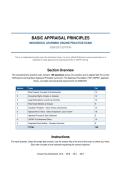
BASIC APPRAISAL PRINCIPLES
MCKISSOCK LEARNING ONLINE PRACTICE EXAM
2026/2027 EDITION
This is an independent practice exam for educational study; it is not an official McKissock Learning examination or a
substitute for state appraisal licensing requirements or USPAP training.
Section Overview
This comprehensive practice exam contains 100 questions across nine sections and is aligned with the current
McKissock Learning Basic Appraisal Principles curriculum, The Appraisal Foundation (TAF) USPAP, appraisal
theory, and state licensing board requirements for 2026/2027.
Section Topic Qs
1 Real Property Concepts & Characteristics 13
2 Ownership Rights, Estates, & Interests 10
3 Legal Descriptions & Land Use Controls 10
4 Real Estate Markets & Analysis 9
5 Valuation Principles - Value Theory & Economics 13
6 Approaches to Value - Sales Comparison, Cost, Income 18
7 Appraisal Process & Data Collection 9
8 USPAP & Professional Ethics 10
9 Integrated Case Studies - Complex Scenarios 8
TOTAL 100
Instructions
For each question, select the single best answer. Use the answer key at the end of the exam to check your work.
Each item includes a brief rationale explaining the correct response.
Answer Key Distribution: 25 A · 25 B · 25 C · 25 D
, Section 1: Real Property Concepts & Characteristics
Q1: Real property, as opposed to real estate, is best defined as:
A. The physical land and anything permanently attached to it
B. The physical land plus the bundle of rights associated with ownership [CORRECT]
C. Only the buildings on the land
D. Any movable personal asset owned by the owner
Correct Answer: B
Rationale: Real estate is the physical land and permanent improvements, while real property adds the legal rights (bundle of
rights) of ownership. Buildings alone and movable assets are incorrect.
Q2: The physical characteristic of land described as 'indestructible' means:
A. Land is permanent and does not wear out [CORRECT]
B. Land can never be removed from its location
C. Land is impossible to sell
D. Land increases in value automatically
Correct Answer: A
Rationale: Indestructibility refers to land's permanence and durability. Immobility refers to its fixed location. Land does not
automatically appreciate, and it can be bought and sold.
Q3: The physical characteristic that prevents land from being moved or relocated is known as:
A. Nonhomogeneity
B. Indestructibility
C. Situs
D. Immobility [CORRECT]
Correct Answer: D
Rationale: Immobility means the land and buildings are fixed in place and cannot be moved. Nonhomogeneity refers to
uniqueness, indestructibility to permanence, and situs is an economic concept.
Q4: The concept that no two parcels of land are exactly alike is referred to as:
A. Scarcity
B. Transferability
C. Nonhomogeneity (uniqueness) [CORRECT]
D. Externalities
Correct Answer: C
Rationale: Nonhomogeneity means each parcel is unique due to its specific location and characteristics. Scarcity,
transferability, and externalities are economic concepts, not physical uniqueness.
Q5: An economic characteristic of real estate that reflects the limited supply of land is called:
A. Scarcity [CORRECT]
B. Situs
C. Fixity
D. Nonhomogeneity
Correct Answer: A
Rationale: Scarcity is the economic characteristic reflecting limited supply of land relative to demand. Situs is locational
preference, fixity is capital immobility, and nonhomogeneity is physical uniqueness.
Q6: The economic concept that location preferences influence the value of property is known as:
A. Indestructibility
B. Situs [CORRECT]
C. Transferability
D. Permanence
Correct Answer: B
Basic Appraisal Principles (McKissock Learning) - 2026/2027 Practice Page 2
, Rationale: Situs refers to the economic preference of people for a particular location, which strongly influences value. The
other terms are physical characteristics or general economic concepts.
Q7: Land itself is generally classified in appraisal as:
A. A wasting asset that depreciates over time
B. Personal property
C. A form of intangible value
D. A non-depreciable, non-wasting asset [CORRECT]
Correct Answer: D
Rationale: Land is considered a non-depreciable, non-wasting asset in appraisal. Improvements (buildings) may depreciate,
but land does not. Land is real property, not personal property or intangible value.
Q8: An example of an improvement to real property is:
A. A house or commercial building permanently attached to the land [CORRECT]
B. A portable lawnmower
C. Cash in a bank account
D. A rented car
Correct Answer: A
Rationale: An improvement is a man-made addition to land, such as a building, that is permanently attached. Movable items
and personal assets are not improvements to real property.
Q9: For appraisal purposes, personal property is defined as:
A. Anything not permanently attached to the land, which is movable [CORRECT]
B. Land itself
C. Only agricultural real estate
D. An ownership interest in a building
Correct Answer: A
Rationale: Personal property consists of movable items that are not permanently attached to real estate. Land and buildings
are real property; personal property is defined by its movability.
Q10: A fixture is most accurately described as:
A. A type of easement
B. A zoning regulation
C. Personal property that has become permanently attached to real property [CORRECT]
D. A legal description of a parcel
Correct Answer: C
Rationale: A fixture is personal property (e.g., a built-in appliance) that becomes real property once permanently affixed to land
or a building. It is not an easement, zoning rule, or legal description.
Q11: The four general classes of property used in appraisal include:
A. New, used, leased, and vacant
B. Urban, suburban, rural, and coastal
C. Single-family, multi-family, retail, and office
D. Residential, commercial, industrial, and agricultural [CORRECT]
Correct Answer: D
Rationale: The four broad property classes are residential, commercial, industrial, and agricultural. The other groupings mix
specific types or use classes rather than the general classification.
Q12: Which statement best reflects the economic characteristic of 'fixity'?
A. Land is sold frequently at auction
B. Property always appreciates
C. Location has no effect on value
D. Capital and real estate improvements are immobile and tied to a location [CORRECT]
Correct Answer: D
Basic Appraisal Principles (McKissock Learning) - 2026/2027 Practice Page 3
MCKISSOCK LEARNING ONLINE PRACTICE EXAM
2026/2027 EDITION
This is an independent practice exam for educational study; it is not an official McKissock Learning examination or a
substitute for state appraisal licensing requirements or USPAP training.
Section Overview
This comprehensive practice exam contains 100 questions across nine sections and is aligned with the current
McKissock Learning Basic Appraisal Principles curriculum, The Appraisal Foundation (TAF) USPAP, appraisal
theory, and state licensing board requirements for 2026/2027.
Section Topic Qs
1 Real Property Concepts & Characteristics 13
2 Ownership Rights, Estates, & Interests 10
3 Legal Descriptions & Land Use Controls 10
4 Real Estate Markets & Analysis 9
5 Valuation Principles - Value Theory & Economics 13
6 Approaches to Value - Sales Comparison, Cost, Income 18
7 Appraisal Process & Data Collection 9
8 USPAP & Professional Ethics 10
9 Integrated Case Studies - Complex Scenarios 8
TOTAL 100
Instructions
For each question, select the single best answer. Use the answer key at the end of the exam to check your work.
Each item includes a brief rationale explaining the correct response.
Answer Key Distribution: 25 A · 25 B · 25 C · 25 D
, Section 1: Real Property Concepts & Characteristics
Q1: Real property, as opposed to real estate, is best defined as:
A. The physical land and anything permanently attached to it
B. The physical land plus the bundle of rights associated with ownership [CORRECT]
C. Only the buildings on the land
D. Any movable personal asset owned by the owner
Correct Answer: B
Rationale: Real estate is the physical land and permanent improvements, while real property adds the legal rights (bundle of
rights) of ownership. Buildings alone and movable assets are incorrect.
Q2: The physical characteristic of land described as 'indestructible' means:
A. Land is permanent and does not wear out [CORRECT]
B. Land can never be removed from its location
C. Land is impossible to sell
D. Land increases in value automatically
Correct Answer: A
Rationale: Indestructibility refers to land's permanence and durability. Immobility refers to its fixed location. Land does not
automatically appreciate, and it can be bought and sold.
Q3: The physical characteristic that prevents land from being moved or relocated is known as:
A. Nonhomogeneity
B. Indestructibility
C. Situs
D. Immobility [CORRECT]
Correct Answer: D
Rationale: Immobility means the land and buildings are fixed in place and cannot be moved. Nonhomogeneity refers to
uniqueness, indestructibility to permanence, and situs is an economic concept.
Q4: The concept that no two parcels of land are exactly alike is referred to as:
A. Scarcity
B. Transferability
C. Nonhomogeneity (uniqueness) [CORRECT]
D. Externalities
Correct Answer: C
Rationale: Nonhomogeneity means each parcel is unique due to its specific location and characteristics. Scarcity,
transferability, and externalities are economic concepts, not physical uniqueness.
Q5: An economic characteristic of real estate that reflects the limited supply of land is called:
A. Scarcity [CORRECT]
B. Situs
C. Fixity
D. Nonhomogeneity
Correct Answer: A
Rationale: Scarcity is the economic characteristic reflecting limited supply of land relative to demand. Situs is locational
preference, fixity is capital immobility, and nonhomogeneity is physical uniqueness.
Q6: The economic concept that location preferences influence the value of property is known as:
A. Indestructibility
B. Situs [CORRECT]
C. Transferability
D. Permanence
Correct Answer: B
Basic Appraisal Principles (McKissock Learning) - 2026/2027 Practice Page 2
, Rationale: Situs refers to the economic preference of people for a particular location, which strongly influences value. The
other terms are physical characteristics or general economic concepts.
Q7: Land itself is generally classified in appraisal as:
A. A wasting asset that depreciates over time
B. Personal property
C. A form of intangible value
D. A non-depreciable, non-wasting asset [CORRECT]
Correct Answer: D
Rationale: Land is considered a non-depreciable, non-wasting asset in appraisal. Improvements (buildings) may depreciate,
but land does not. Land is real property, not personal property or intangible value.
Q8: An example of an improvement to real property is:
A. A house or commercial building permanently attached to the land [CORRECT]
B. A portable lawnmower
C. Cash in a bank account
D. A rented car
Correct Answer: A
Rationale: An improvement is a man-made addition to land, such as a building, that is permanently attached. Movable items
and personal assets are not improvements to real property.
Q9: For appraisal purposes, personal property is defined as:
A. Anything not permanently attached to the land, which is movable [CORRECT]
B. Land itself
C. Only agricultural real estate
D. An ownership interest in a building
Correct Answer: A
Rationale: Personal property consists of movable items that are not permanently attached to real estate. Land and buildings
are real property; personal property is defined by its movability.
Q10: A fixture is most accurately described as:
A. A type of easement
B. A zoning regulation
C. Personal property that has become permanently attached to real property [CORRECT]
D. A legal description of a parcel
Correct Answer: C
Rationale: A fixture is personal property (e.g., a built-in appliance) that becomes real property once permanently affixed to land
or a building. It is not an easement, zoning rule, or legal description.
Q11: The four general classes of property used in appraisal include:
A. New, used, leased, and vacant
B. Urban, suburban, rural, and coastal
C. Single-family, multi-family, retail, and office
D. Residential, commercial, industrial, and agricultural [CORRECT]
Correct Answer: D
Rationale: The four broad property classes are residential, commercial, industrial, and agricultural. The other groupings mix
specific types or use classes rather than the general classification.
Q12: Which statement best reflects the economic characteristic of 'fixity'?
A. Land is sold frequently at auction
B. Property always appreciates
C. Location has no effect on value
D. Capital and real estate improvements are immobile and tied to a location [CORRECT]
Correct Answer: D
Basic Appraisal Principles (McKissock Learning) - 2026/2027 Practice Page 3


