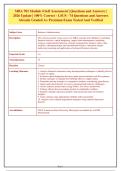
MBA 701 Module 4 Self Assessment | Questions and Answers |
2026 Update | 100% Correct - LSUS - 74 Questions and Answers
Already Graded A+ Premium Exam Tested And Verified
Subject Area Business Administration
Description This self-assessment exam covers core MBA concepts from Module 4, including
financial analysis, capital budgeting, supply chain management, marketing
strategy, organizational behavior, strategic management, business ethics, data
analytics, entrepreneurship, and international business. Questions require
multi-step reasoning and application of advanced business theories.
Expected Grade A+
Total Questions 74
Duration 2 hours
Learning Outcomes 1. Analyze financial statements using decomposition techniques to identify drivers
of return on equity.
2. Evaluate capital budgeting decisions under unconventional cash flow patterns.
3. Design strategies to mitigate the bullwhip effect in supply chains.
4. Formulate pricing strategies in competitive markets considering game theory.
5. Apply motivation theories to resolve organizational behavior challenges.
6. Assess industry attractiveness using Porter's five forces framework.
7. Critique ethical decision-making models in stakeholder conflicts.
8. Interpret multiple regression models with interaction terms for business
insights.
9. Value startups using appropriate methods under uncertainty.
10. Analyze cross-cultural negotiation strategies using cultural dimension
theories.
Accreditation LSUS (Louisiana State University Shreveport) accredited by AACSB
International.
Page 1
,1. A company's return on equity (ROE) increased from 15% to 20% while its equity
multiplier decreased. Which DuPont component most likely drove the increase?
Answer: Increase in profit margin
Since the equity multiplier decreased, leverage (C) is not the driver. ROE = Profit
Margin × Asset Turnover × Equity Multiplier. With equity multiplier down, profit
margin must have increased significantly to offset and raise ROE, making B correct. A
would reduce ROE, and D is captured in profit margin but is not a DuPont component.
2. A project has unconventional cash flows: -100, +50, +50, -20, +80. Which capital
budgeting method is most reliable for ranking mutually exclusive projects?
Answer: Net Present Value (NPV)
With unconventional cash flows (sign changes), IRR may yield multiple values or be
misleading. NPV is always reliable for ranking mutually exclusive projects as it
assumes reinvestment at the cost of capital. PI is useful but can be scale-sensitive.
Payback ignores time value and cash flows after cutoff.
3. To reduce the bullwhip effect in a supply chain, which strategy directly addresses
demand signal processing?
Answer: Implement vendor-managed inventory (VMI) with shared demand data
Demand signal processing amplifies order variability as each echelon overreacts to
demand changes. Sharing point-of-sale data via VMI reduces information distortion,
directly mitigating this cause. B and C worsen the effect, and D addresses lead time, not
signal processing.
4. Two firms compete in a market with differentiated products. If one firm lowers
price, the other must match to maintain market share. This describes which
competitive pricing scenario?
Answer: Kinked demand curve model
The kinked demand curve model assumes rivals match price decreases but not
increases, leading to price rigidity. This matches the description. Bertrand with
homogeneous goods would lead to price war to marginal cost. Cournot involves
quantity competition. Stackelberg has a leader-follower structure.
Page 2
, 5. A manager believes employees are inherently lazy and need constant supervision.
This manager's style aligns with which motivational theory?
Answer: Theory X
Theory X assumes workers are lazy, avoid responsibility, and require coercion. Theory
Y assumes self-direction. Expectancy theory focuses on effort-performance-outcome
links, and equity theory on fairness perceptions. The belief described directly matches
Theory X.
6. In Porter's five forces, which condition most increases the threat of substitutes?
Answer: Low price-performance trade-off for alternatives
Substitutes threaten when they offer a similar benefit at a competitive
price-performance ratio. Low switching costs (A) would increase threat, not high; high
switching costs decrease threat. High concentration (C) reduces rivalry. Strong brand
loyalty (D) reduces substitute threat. B directly increases substitute threat.
7. A pharmaceutical company prices a life-saving drug high in developed countries
but low in developing nations. Which ethical framework best supports this
differential pricing?
Answer: Stakeholder theory balancing interests of all parties
Stakeholder theory considers multiple groups, including patients in poor countries, and
justifies differential pricing to balance profit and access. Shareholder theory would
prioritize profit, possibly ignoring access. Virtue ethics is less specific. Deontological
ethics would require a universal rule, which differential pricing violates.
8. In a regression model, log(sales) = 3.2 + 0.5*log(advertising) +
0.3*price_promotion + 0.1*log(advertising)*price_promotion, where
price_promotion is a dummy (1 = promotion active). What is the percentage change
in sales when advertising increases by 10% during a promotion?
Answer: 6%
The elasticity of sales with respect to advertising is 0.5 + 0.1*price_promotion = 0.6
during promotion. A 10% increase in advertising leads to a 6% increase in sales
(elasticity * % change). Option A is without promotion, C is incorrect addition, D is
false because interaction is given.
Page 3
2026 Update | 100% Correct - LSUS - 74 Questions and Answers
Already Graded A+ Premium Exam Tested And Verified
Subject Area Business Administration
Description This self-assessment exam covers core MBA concepts from Module 4, including
financial analysis, capital budgeting, supply chain management, marketing
strategy, organizational behavior, strategic management, business ethics, data
analytics, entrepreneurship, and international business. Questions require
multi-step reasoning and application of advanced business theories.
Expected Grade A+
Total Questions 74
Duration 2 hours
Learning Outcomes 1. Analyze financial statements using decomposition techniques to identify drivers
of return on equity.
2. Evaluate capital budgeting decisions under unconventional cash flow patterns.
3. Design strategies to mitigate the bullwhip effect in supply chains.
4. Formulate pricing strategies in competitive markets considering game theory.
5. Apply motivation theories to resolve organizational behavior challenges.
6. Assess industry attractiveness using Porter's five forces framework.
7. Critique ethical decision-making models in stakeholder conflicts.
8. Interpret multiple regression models with interaction terms for business
insights.
9. Value startups using appropriate methods under uncertainty.
10. Analyze cross-cultural negotiation strategies using cultural dimension
theories.
Accreditation LSUS (Louisiana State University Shreveport) accredited by AACSB
International.
Page 1
,1. A company's return on equity (ROE) increased from 15% to 20% while its equity
multiplier decreased. Which DuPont component most likely drove the increase?
Answer: Increase in profit margin
Since the equity multiplier decreased, leverage (C) is not the driver. ROE = Profit
Margin × Asset Turnover × Equity Multiplier. With equity multiplier down, profit
margin must have increased significantly to offset and raise ROE, making B correct. A
would reduce ROE, and D is captured in profit margin but is not a DuPont component.
2. A project has unconventional cash flows: -100, +50, +50, -20, +80. Which capital
budgeting method is most reliable for ranking mutually exclusive projects?
Answer: Net Present Value (NPV)
With unconventional cash flows (sign changes), IRR may yield multiple values or be
misleading. NPV is always reliable for ranking mutually exclusive projects as it
assumes reinvestment at the cost of capital. PI is useful but can be scale-sensitive.
Payback ignores time value and cash flows after cutoff.
3. To reduce the bullwhip effect in a supply chain, which strategy directly addresses
demand signal processing?
Answer: Implement vendor-managed inventory (VMI) with shared demand data
Demand signal processing amplifies order variability as each echelon overreacts to
demand changes. Sharing point-of-sale data via VMI reduces information distortion,
directly mitigating this cause. B and C worsen the effect, and D addresses lead time, not
signal processing.
4. Two firms compete in a market with differentiated products. If one firm lowers
price, the other must match to maintain market share. This describes which
competitive pricing scenario?
Answer: Kinked demand curve model
The kinked demand curve model assumes rivals match price decreases but not
increases, leading to price rigidity. This matches the description. Bertrand with
homogeneous goods would lead to price war to marginal cost. Cournot involves
quantity competition. Stackelberg has a leader-follower structure.
Page 2
, 5. A manager believes employees are inherently lazy and need constant supervision.
This manager's style aligns with which motivational theory?
Answer: Theory X
Theory X assumes workers are lazy, avoid responsibility, and require coercion. Theory
Y assumes self-direction. Expectancy theory focuses on effort-performance-outcome
links, and equity theory on fairness perceptions. The belief described directly matches
Theory X.
6. In Porter's five forces, which condition most increases the threat of substitutes?
Answer: Low price-performance trade-off for alternatives
Substitutes threaten when they offer a similar benefit at a competitive
price-performance ratio. Low switching costs (A) would increase threat, not high; high
switching costs decrease threat. High concentration (C) reduces rivalry. Strong brand
loyalty (D) reduces substitute threat. B directly increases substitute threat.
7. A pharmaceutical company prices a life-saving drug high in developed countries
but low in developing nations. Which ethical framework best supports this
differential pricing?
Answer: Stakeholder theory balancing interests of all parties
Stakeholder theory considers multiple groups, including patients in poor countries, and
justifies differential pricing to balance profit and access. Shareholder theory would
prioritize profit, possibly ignoring access. Virtue ethics is less specific. Deontological
ethics would require a universal rule, which differential pricing violates.
8. In a regression model, log(sales) = 3.2 + 0.5*log(advertising) +
0.3*price_promotion + 0.1*log(advertising)*price_promotion, where
price_promotion is a dummy (1 = promotion active). What is the percentage change
in sales when advertising increases by 10% during a promotion?
Answer: 6%
The elasticity of sales with respect to advertising is 0.5 + 0.1*price_promotion = 0.6
during promotion. A 10% increase in advertising leads to a 6% increase in sales
(elasticity * % change). Option A is without promotion, C is incorrect addition, D is
false because interaction is given.
Page 3