

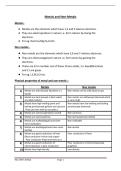
Metals and Non-Metals
Metals:-
● Metals are the elements which have 1,2 and 3 valence electrons.
● They are electropositive in nature i.e. form cations by losing the
electrons.
● For eg. Na,K,Ca,Mg,Fe,Al etc.
Non metals:-
● Non metals are the elements which have 5,6 and 7 valence electrons.
● They are electronegativein nature i.e. form anion by gaining the
electrons.
● These are 22 in number out of these 10 are solids, 1 is liquid(Bromine)
and 11 are gases.
● For eg. I,S,N,S,Cl etc.
Physical properties of metal and non metals :-
Metals Non metals
1) Metals are solid (except Hg which is a Non metals can be solid liquid or gas
liquid)
2) Metals are hard (except Li,Na,K which Non metals are soft(except diamond which
are alkali metals ) is very hard)
3) Metals have high melting point and Non metals have low melting and boiling
boiling point(except gallium and caesium point(except diamond)
.They can even melt at our palm.)
4) Metals are sonorous(produce sound) Non sonorous
5) Metals are lustrous(shiny) Non lustrous(except iodine)
6) Metals are malleable(gold and silver Non malleable
most malleable)
7) Metals are ductile(gold and silver most Non ductile
ductile)
8) Metals are good conductors of heat Poor conductors of heat
(Best conductor→silver and copper
Poor conductor→lead and mercury )
9) Metals are good conductors of Poor conductors of electricity(except
electricity(silver is best conductor) graphite)
10) Metals have high density. Low density
Mrs.JYOTI AHUJA Page 1
, Malleability: The property due to which metals can be converted into thin
sheets on hammering.
Ductility: The property due to which metals are drawn into wires on stretching.
Alkali metals: The metals having only 1 electron in valence shell. (eg. Li,Na,K)
Chemical properties of metals
1. Reaction of metal with oxygen
2. Reaction of metal with water
3. Reaction of metal with acids
4. Reaction of metal with other metal salts
5. Reaction of metal with non metal
● Reaction of metal with oxygen :
Metal + oxygen → Metal oxides(basic)
For eg. Na + O2 → Na2O
K + O2→ K2O
Mg + O2 →Mgo
Activity : Take Mg ribbon ,heat it in presence of oxygen . Mgo will be formed.
Put in water . Mg(OH)2 will be formed. Go for litmus test. Red changes blue
which shows metallic oxides are basic in nature .
Amphoteric oxides:- The metal oxides which have acidic as well as basic
character i.e. they react with both acids as well as bases . For eg. Al 2O3 and
ZnO.
Al2O3 + Hcl → Alcl3 + H2O
Al2O3 + NaOH → NaAlO2 + H2O
(Sodium Aluminate)
How the metals react with O2 ?
K → react vigorously with O2 and catch fire (thus kept in kerosene oil )
Na → react vigorously with O2 and catch fire (thus kept in kerosene oil )
Ca
Mg
Al
Zn → Forms a protective layer of oxide
Mrs.JYOTI AHUJA Page 2
Metals:-
● Metals are the elements which have 1,2 and 3 valence electrons.
● They are electropositive in nature i.e. form cations by losing the
electrons.
● For eg. Na,K,Ca,Mg,Fe,Al etc.
Non metals:-
● Non metals are the elements which have 5,6 and 7 valence electrons.
● They are electronegativein nature i.e. form anion by gaining the
electrons.
● These are 22 in number out of these 10 are solids, 1 is liquid(Bromine)
and 11 are gases.
● For eg. I,S,N,S,Cl etc.
Physical properties of metal and non metals :-
Metals Non metals
1) Metals are solid (except Hg which is a Non metals can be solid liquid or gas
liquid)
2) Metals are hard (except Li,Na,K which Non metals are soft(except diamond which
are alkali metals ) is very hard)
3) Metals have high melting point and Non metals have low melting and boiling
boiling point(except gallium and caesium point(except diamond)
.They can even melt at our palm.)
4) Metals are sonorous(produce sound) Non sonorous
5) Metals are lustrous(shiny) Non lustrous(except iodine)
6) Metals are malleable(gold and silver Non malleable
most malleable)
7) Metals are ductile(gold and silver most Non ductile
ductile)
8) Metals are good conductors of heat Poor conductors of heat
(Best conductor→silver and copper
Poor conductor→lead and mercury )
9) Metals are good conductors of Poor conductors of electricity(except
electricity(silver is best conductor) graphite)
10) Metals have high density. Low density
Mrs.JYOTI AHUJA Page 1
, Malleability: The property due to which metals can be converted into thin
sheets on hammering.
Ductility: The property due to which metals are drawn into wires on stretching.
Alkali metals: The metals having only 1 electron in valence shell. (eg. Li,Na,K)
Chemical properties of metals
1. Reaction of metal with oxygen
2. Reaction of metal with water
3. Reaction of metal with acids
4. Reaction of metal with other metal salts
5. Reaction of metal with non metal
● Reaction of metal with oxygen :
Metal + oxygen → Metal oxides(basic)
For eg. Na + O2 → Na2O
K + O2→ K2O
Mg + O2 →Mgo
Activity : Take Mg ribbon ,heat it in presence of oxygen . Mgo will be formed.
Put in water . Mg(OH)2 will be formed. Go for litmus test. Red changes blue
which shows metallic oxides are basic in nature .
Amphoteric oxides:- The metal oxides which have acidic as well as basic
character i.e. they react with both acids as well as bases . For eg. Al 2O3 and
ZnO.
Al2O3 + Hcl → Alcl3 + H2O
Al2O3 + NaOH → NaAlO2 + H2O
(Sodium Aluminate)
How the metals react with O2 ?
K → react vigorously with O2 and catch fire (thus kept in kerosene oil )
Na → react vigorously with O2 and catch fire (thus kept in kerosene oil )
Ca
Mg
Al
Zn → Forms a protective layer of oxide
Mrs.JYOTI AHUJA Page 2


