
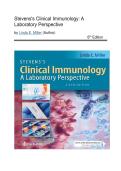
Stevens's Clinical Immunology: A
Laboratory Perspective
by Linda E. Miller (Author)
6th Edition
,TABLE OF CONTENTS
I. Nature of the Immune System
1. Introduction to Immunity and the Immune System
2. Innate Immunity
3. Nature of Antigens and the Major Histocompatibility Complex
4. Adaptive Immunity
5. Antibody Structure and Function
6. Cytokines
7. The Complement System
II. Basic Immunological Procedures
8. Safety and Quality Management
9. Principles of Serological Testing
10. Precipitation and Agglutination Reactions
11. Labeled Immunoassays
12. Molecular Diagnostic Techniques
13. Flow Cytometry and Laboratory Automation
III. Immune Disorders
14. Hypersensitivity
15. Autoimmunity
16. Transplantation Immunology
17. Tumor Immunology
18. Immunoproliferative Diseases
19. Immunodeficiency Diseases
IV. Serological and Molecular Diagnosis of Infectious Disease
20. Serological and Molecular Detection of Bacterial Infections
21. Spirochete Diseases
22. Serological and Molecular Diagnosis of Parasitic and Fungal Infections
23. Serology and Molecular Detection of Viral Infections
24. Laboratory Diagnosis of HIV Infection
,25. Immunization and Vaccines
Test Bank: Stevens's Clinical Immunology: A Laboratory Perspective, 6th
Edition (Miller, 2026)
Multiple Choice Questions
CHAPTER 1: Introduction to the Immune System
1. Which of the following BEST describes innate immunity?
A) It is antigen-specific and has memory
B) It is the first line of defense and is nonspecific
C) It relies on B and T lymphocytes exclusively
D) It requires prior exposure to an antigen
Answer: B
Rationale: Innate immunity is the body's first line of defense and responds to pathogens in a nonspecific
manner, without requiring prior exposure or developing immunological memory.
2. Which cells are considered the primary mediators of adaptive immunity?
A) Neutrophils and macrophages
B) Natural killer (NK) cells and mast cells
C) B lymphocytes and T lymphocytes
D) Basophils and eosinophils
Answer: C
Rationale: Adaptive immunity is mediated primarily by B and T lymphocytes, which provide antigen-
specific responses and immunological memory.
3. Which of the following is a characteristic of adaptive immunity but NOT innate immunity?
, A) Rapid response within minutes to hours
B) Immunological memory
C) Use of phagocytic cells
D) Complement activation
Answer: B
Rationale: Immunological memory is a hallmark of adaptive immunity, allowing a faster and stronger
response upon re-exposure to the same antigen.
4. The term "immunogen" refers to:
A) Any molecule that can react with an antibody
B) A substance that can induce an immune response
C) A small molecule that requires a carrier protein
D) A self-antigen that causes autoimmunity
Answer: B
Rationale: An immunogen is a substance capable of inducing an immune response, whereas an antigen
simply refers to any molecule that can be recognized by antibody or T-cell receptors.
5. Which of the following is NOT a physical barrier of innate immunity?
A) Skin
B) Mucous membranes
C) Cilia in the respiratory tract
D) Complement proteins
Answer: D
Rationale: Complement proteins are soluble mediators of innate immunity, not physical barriers. Skin,
mucous membranes, and cilia act as mechanical barriers.
6. Haptens differ from complete antigens in that haptens:


