

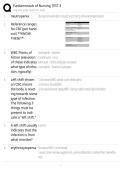
Fundamentals of Nursing TEST 3
Study online at https://quizlet.com/_4nc9fv
1. neutropenia decreased neutrophils (results in pt. being immunocompromised)
2. Reference ranges
for CBC (per hand-
out) **KNOW
THESE**
3. WBC Points of Neutrophils - bacteria
Action (elevation Lymphocytes - virus
of these indicates Monocyte - debris (indicates recovery)
what type of infec- Eosinophils - Parasites & allergies
tion, typically)
4. Left shift shown 1) Increased WBC overall count (leukocytes)
on CBC means 2) Increase Neutrophils
the body is react- 3) Increased bands (baby WBC's being made to help fight infection)
ing towards some
type of infection.
The following 3
things must be
present to indi-
cate a "left shift."
5. A left shift usually bacteria
indicates that the
infection is from
what microbe?
6. erythrocytopenia decreased RBC's in the blood
Causes: bone marrow suppression, anemia, blood loss, malnutrition, hemodilu-
tion
, Fundamentals of Nursing TEST 3
Study online at https://quizlet.com/_4nc9fv
7. Anemia signs & Fatigue, tachycardia, pallor, SOB
symptoms
8. polycythemia Increased RBC's in the blood
Tx: Pt. may have to be "bled" d/t viscous blood
9. Dehydration may RBC's & creatinine
cause increased:
10. Low levels of he- anemia, hemodilution, blood loss
moglobin in the
blood could indi-
cate what disor-
ders?
11. Pernicious ane- Lack of intrinsic factor which results in decreased Vit B12 in body (S/Sx: beefy red
mia tongue, paresteshia)
12. Thrombocytope- Low platelet count in the blood
nia *Assess pt w/ low platelets for the following S/Sx: pallor, decreased LOC, change
in mental status (confusion), hypotension, bleeding (ecchymosis under skin)*
13. When the spontaneous bleeding
platelets fall un-
der 50,000, the
patient may have:
14. Precautions for no razors for shaving, protect pt from injury, avoid giving injections unless
patients on absolutely necessary
Coumadin/He-
parin, or those
with LOW
platelets are:
, Fundamentals of Nursing TEST 3
Study online at https://quizlet.com/_4nc9fv
15. Urinalysis (UA) Describes the characteristics of the urine and detects substances in it. A quick
urinalysis can be done with the dipstick test or the urine specimen can be sent
to the laboratory for a full analysis.
16. Urinalysis (UA) Color: pale/yellow
NORMAL results: Clarity: clear
**KNOW** Odor: not strong/nutty
Specific gravity: 1.015 to 1.030
pH: 5-7
17. The following 1) Pyridium (urinary tract analgesic) - orange
things can cause 2) Blood in urine - tea brown
urine color to 3) Dehydration - dark yellow, amber colored
change: 4) Foods (beets turn it red-brown)
18. ABNORMAL find- 1) Blood (caused by infection, or cancer)
ings in urinalysis: 2) Cloudy/turbulent/Sediment (caused by bacteria, blood, sperm, crystals, mu-
cous)
3) Foul odor (caused by bacterial infection)
4) Sweet/fruity odor (caused by diabetes, starvation)
5) Specific gravity & pH outside of normal range
6) Protein (caused by fever, hard exercise, pregnancy, kidney disease)
7) Glucose (uncontrolled diabetes, or kidney disease)
8) Nitrites (bacteria changes nitrates to nitrites; indicates UTI)
9) Pyuria (pus in urine)
10) WBC's
11) Ketones from fat breakdown (caused by starvation, diabetic ketoacidosis,
Atkin's diet)
12) Bilirubin (liver disorders, cirrhosis, hepatitis, obstructed bile duct)
19. Urine culture & Diagnostic test that is used to confirm suspected infections, identify organisms,
sensitivity *C&S* determine antimicrobial therapy
, Fundamentals of Nursing TEST 3
Study online at https://quizlet.com/_4nc9fv
20. Basic Metabol-
ic Panel lab
ranges ***know
all labs***
21. Hemoglobin AIC Test reflects the last 120 days of blood sugar levels
Normal range: < 7%
22. Serum Albumin is 3.6 - 5.0
the BEST indica-
tor for nutrition-
al sufficiency. Nor-
mal range is:
23. PT - prothrombin Measures the time it takes for the plasma of the blood to clot
time **KNOW ALL Normal range: 12 - 15 seconds
LABS**
24. PTT - par- Measures how long it takes the blood to clot
tial thrombo- Normal range: 30 - 45 seconds
plastin time
**KNOW**
25. INR normal range 0.8 - 1.2
**KNOW**
26. A PT/INR above 3.5
___________ should
alert the nurse im-
mediately:
27. Blood Culture
Study online at https://quizlet.com/_4nc9fv
1. neutropenia decreased neutrophils (results in pt. being immunocompromised)
2. Reference ranges
for CBC (per hand-
out) **KNOW
THESE**
3. WBC Points of Neutrophils - bacteria
Action (elevation Lymphocytes - virus
of these indicates Monocyte - debris (indicates recovery)
what type of infec- Eosinophils - Parasites & allergies
tion, typically)
4. Left shift shown 1) Increased WBC overall count (leukocytes)
on CBC means 2) Increase Neutrophils
the body is react- 3) Increased bands (baby WBC's being made to help fight infection)
ing towards some
type of infection.
The following 3
things must be
present to indi-
cate a "left shift."
5. A left shift usually bacteria
indicates that the
infection is from
what microbe?
6. erythrocytopenia decreased RBC's in the blood
Causes: bone marrow suppression, anemia, blood loss, malnutrition, hemodilu-
tion
, Fundamentals of Nursing TEST 3
Study online at https://quizlet.com/_4nc9fv
7. Anemia signs & Fatigue, tachycardia, pallor, SOB
symptoms
8. polycythemia Increased RBC's in the blood
Tx: Pt. may have to be "bled" d/t viscous blood
9. Dehydration may RBC's & creatinine
cause increased:
10. Low levels of he- anemia, hemodilution, blood loss
moglobin in the
blood could indi-
cate what disor-
ders?
11. Pernicious ane- Lack of intrinsic factor which results in decreased Vit B12 in body (S/Sx: beefy red
mia tongue, paresteshia)
12. Thrombocytope- Low platelet count in the blood
nia *Assess pt w/ low platelets for the following S/Sx: pallor, decreased LOC, change
in mental status (confusion), hypotension, bleeding (ecchymosis under skin)*
13. When the spontaneous bleeding
platelets fall un-
der 50,000, the
patient may have:
14. Precautions for no razors for shaving, protect pt from injury, avoid giving injections unless
patients on absolutely necessary
Coumadin/He-
parin, or those
with LOW
platelets are:
, Fundamentals of Nursing TEST 3
Study online at https://quizlet.com/_4nc9fv
15. Urinalysis (UA) Describes the characteristics of the urine and detects substances in it. A quick
urinalysis can be done with the dipstick test or the urine specimen can be sent
to the laboratory for a full analysis.
16. Urinalysis (UA) Color: pale/yellow
NORMAL results: Clarity: clear
**KNOW** Odor: not strong/nutty
Specific gravity: 1.015 to 1.030
pH: 5-7
17. The following 1) Pyridium (urinary tract analgesic) - orange
things can cause 2) Blood in urine - tea brown
urine color to 3) Dehydration - dark yellow, amber colored
change: 4) Foods (beets turn it red-brown)
18. ABNORMAL find- 1) Blood (caused by infection, or cancer)
ings in urinalysis: 2) Cloudy/turbulent/Sediment (caused by bacteria, blood, sperm, crystals, mu-
cous)
3) Foul odor (caused by bacterial infection)
4) Sweet/fruity odor (caused by diabetes, starvation)
5) Specific gravity & pH outside of normal range
6) Protein (caused by fever, hard exercise, pregnancy, kidney disease)
7) Glucose (uncontrolled diabetes, or kidney disease)
8) Nitrites (bacteria changes nitrates to nitrites; indicates UTI)
9) Pyuria (pus in urine)
10) WBC's
11) Ketones from fat breakdown (caused by starvation, diabetic ketoacidosis,
Atkin's diet)
12) Bilirubin (liver disorders, cirrhosis, hepatitis, obstructed bile duct)
19. Urine culture & Diagnostic test that is used to confirm suspected infections, identify organisms,
sensitivity *C&S* determine antimicrobial therapy
, Fundamentals of Nursing TEST 3
Study online at https://quizlet.com/_4nc9fv
20. Basic Metabol-
ic Panel lab
ranges ***know
all labs***
21. Hemoglobin AIC Test reflects the last 120 days of blood sugar levels
Normal range: < 7%
22. Serum Albumin is 3.6 - 5.0
the BEST indica-
tor for nutrition-
al sufficiency. Nor-
mal range is:
23. PT - prothrombin Measures the time it takes for the plasma of the blood to clot
time **KNOW ALL Normal range: 12 - 15 seconds
LABS**
24. PTT - par- Measures how long it takes the blood to clot
tial thrombo- Normal range: 30 - 45 seconds
plastin time
**KNOW**
25. INR normal range 0.8 - 1.2
**KNOW**
26. A PT/INR above 3.5
___________ should
alert the nurse im-
mediately:
27. Blood Culture


