

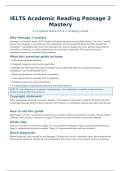
IELTS Academic Reading Passage 2
Mastery
A Complete Band 6.5-8.5 Strategy Guide
Why Passage 2 matters
Passage 2 is the point where IELTS Academic Reading becomes meaningfully harder. The text is usually
denser than Passage 1, the ideas are less predictable, and the questions demand better paraphrase
recognition. Candidates often lose time because they read too deeply too early, become distracted by
unfamiliar vocabulary, or select answers that are only partly supported. This guide gives you a
repeatable system for handling those problems.
What this premium guide includes
• A 20-minute passage workflow
• Paragraph mapping and structure prediction
• Strategies for Matching Information, Multiple Choice, Matching Features, Sentence/Summary
Completion, and True/False/Not Given
• Advanced paraphrase and distractor recognition
• A full original practice passage with 13 questions
• Complete answer key with explanations
• A 7-day Passage 2 improvement plan and exam-day checklist
EXAM TIP: Your objective is not perfect comprehension. Your objective is controlled, evidence-based
decision-making under time pressure.
Copyright statement
Every explanation, passage, example, question, and answer in this guide is original. No IELTS test item,
Cambridge passage, British Council exercise, IDP material, or proprietary question has been reproduced.
How to use this guide
Read Pages 2-7 first. Complete the practice set on Page 8 without checking the answers. Review Page 9
carefully, then use the 7-day plan on Page 10. Revisit your error log after every timed attempt.
Guide map
Pages 2-3: structure and timing | Pages 4-7: core question strategies | Page 8: original timed practice |
Page 9: explanations and error analysis | Page 10: improvement plan and final checklist.
Quick diagnostic
Before studying, time yourself on one Passage 2. Record your score, completion time, and the questions
that required guessing. Repeat the same diagnostic after seven days and compare all three measures.
, IELTS Academic Reading Passage 2 Mastery Page 2 of 10
1. Understanding Passage 2
Passage 2 normally sits between the relatively accessible first passage and the most demanding final
passage. It often contains factual material, but the writer may also compare explanations, describe
research, evaluate a system, or contrast older and newer ideas. The challenge is therefore not only
finding information, but understanding how ideas relate.
Typical Passage 2 characteristics
Feature
Feature What ititmeans
What meansforfor
youyou
Length
Length Usually substantial
Usually enough enough
substantial to punish slow reading; avoid
to punish slow line-by-line
reading; reading
avoidat the start.
line-by-line reading at the start.
Structure
Structure Often clear
Often but more
clear but analytical: cause-effect, comparison,
more analytical: development
cause-effect, over time, or
comparison, problem-solution.over time, or problem-solu
development
Vocabulary
Vocabulary More academic
More academic and
and less less repetitive
repetitive than Passage than Passage
1. Expect 1. changes
word-family Expectand
word-family changes and conceptual pa
conceptual paraphrases.
Question
Question order
order Some sets
Some sets follow
follow passage
passage order;
order; Matching Matching
Information Information
and Matching Featuresand
may Matching
not. Features may not.
Difficulty
Difficulty Moderate.
Moderate. Aim The aim
for about 20is approximately
minutes, 20time
leaving sufficient minutes, leaving
for Passage 3. sufficient time for Passage 3.
The hidden skill: paragraph function
A paragraph does more than contain facts. It performs a function. It may introduce a debate, explain a
cause, present evidence, challenge a claim, describe a limitation, or offer a solution. When you identify
this function, later questions become easier because you know where each kind of information is likely
to appear.
Example paragraph map
Paragraph One-line map
A Introduces the problem and explains why it matters
B Describes the traditional explanation
C Presents newer evidence against that explanation
D Explains a practical application
E Discusses limits and remaining uncertainty
EXAM TIP: Write only 2-5 words beside each paragraph. A fast map such as “old theory,” “new evidence,”
and “limitations” is enough.
COMMON TRAP: Do not confuse the topic of a paragraph with its main function. A paragraph may mention
costs, but its true purpose may be to compare two systems.
Mastery
A Complete Band 6.5-8.5 Strategy Guide
Why Passage 2 matters
Passage 2 is the point where IELTS Academic Reading becomes meaningfully harder. The text is usually
denser than Passage 1, the ideas are less predictable, and the questions demand better paraphrase
recognition. Candidates often lose time because they read too deeply too early, become distracted by
unfamiliar vocabulary, or select answers that are only partly supported. This guide gives you a
repeatable system for handling those problems.
What this premium guide includes
• A 20-minute passage workflow
• Paragraph mapping and structure prediction
• Strategies for Matching Information, Multiple Choice, Matching Features, Sentence/Summary
Completion, and True/False/Not Given
• Advanced paraphrase and distractor recognition
• A full original practice passage with 13 questions
• Complete answer key with explanations
• A 7-day Passage 2 improvement plan and exam-day checklist
EXAM TIP: Your objective is not perfect comprehension. Your objective is controlled, evidence-based
decision-making under time pressure.
Copyright statement
Every explanation, passage, example, question, and answer in this guide is original. No IELTS test item,
Cambridge passage, British Council exercise, IDP material, or proprietary question has been reproduced.
How to use this guide
Read Pages 2-7 first. Complete the practice set on Page 8 without checking the answers. Review Page 9
carefully, then use the 7-day plan on Page 10. Revisit your error log after every timed attempt.
Guide map
Pages 2-3: structure and timing | Pages 4-7: core question strategies | Page 8: original timed practice |
Page 9: explanations and error analysis | Page 10: improvement plan and final checklist.
Quick diagnostic
Before studying, time yourself on one Passage 2. Record your score, completion time, and the questions
that required guessing. Repeat the same diagnostic after seven days and compare all three measures.
, IELTS Academic Reading Passage 2 Mastery Page 2 of 10
1. Understanding Passage 2
Passage 2 normally sits between the relatively accessible first passage and the most demanding final
passage. It often contains factual material, but the writer may also compare explanations, describe
research, evaluate a system, or contrast older and newer ideas. The challenge is therefore not only
finding information, but understanding how ideas relate.
Typical Passage 2 characteristics
Feature
Feature What ititmeans
What meansforfor
youyou
Length
Length Usually substantial
Usually enough enough
substantial to punish slow reading; avoid
to punish slow line-by-line
reading; reading
avoidat the start.
line-by-line reading at the start.
Structure
Structure Often clear
Often but more
clear but analytical: cause-effect, comparison,
more analytical: development
cause-effect, over time, or
comparison, problem-solution.over time, or problem-solu
development
Vocabulary
Vocabulary More academic
More academic and
and less less repetitive
repetitive than Passage than Passage
1. Expect 1. changes
word-family Expectand
word-family changes and conceptual pa
conceptual paraphrases.
Question
Question order
order Some sets
Some sets follow
follow passage
passage order;
order; Matching Matching
Information Information
and Matching Featuresand
may Matching
not. Features may not.
Difficulty
Difficulty Moderate.
Moderate. Aim The aim
for about 20is approximately
minutes, 20time
leaving sufficient minutes, leaving
for Passage 3. sufficient time for Passage 3.
The hidden skill: paragraph function
A paragraph does more than contain facts. It performs a function. It may introduce a debate, explain a
cause, present evidence, challenge a claim, describe a limitation, or offer a solution. When you identify
this function, later questions become easier because you know where each kind of information is likely
to appear.
Example paragraph map
Paragraph One-line map
A Introduces the problem and explains why it matters
B Describes the traditional explanation
C Presents newer evidence against that explanation
D Explains a practical application
E Discusses limits and remaining uncertainty
EXAM TIP: Write only 2-5 words beside each paragraph. A fast map such as “old theory,” “new evidence,”
and “limitations” is enough.
COMMON TRAP: Do not confuse the topic of a paragraph with its main function. A paragraph may mention
costs, but its true purpose may be to compare two systems.


