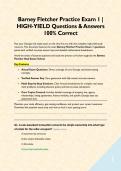
Barney Fletcher Practice Exam 1 |
HIGH-YIELD Questions & Answers
100% Correct
Pass your Georgia real estate exam on the very first try with this complete, high-yield study
resource. This document features the exact Barney Fletcher Practice Exam 1 questions
paired with verified, accurate answer keys and detailed mathematical breakdowns.
Avoid the stress of surprise questions and study the precise curriculum taught by the Barney
Fletcher Real Estate School.
Key Features
• Actual Exam Questions: Direct coverage of core Georgia real estate testing
concepts.
• Verified Answer Key: Zero guesswork with fully vetted, accurate answers.
• Math Step-by-Step Solutions: Clear formula breakdowns for complex real estate
math problems, including discount points and loan-to-value calculations.
• Core Topics Covered: Includes detailed coverage of property law, agency
relationships, listing agreements, finance modules, and specific Georgia state tax
assessment laws.
Maximize your study efficiency, gain testing confidence, and protect your career investment.
Download this essential exam prep tool now to lock in your passing score!
Q1. A sale‑leaseback transaction converts fee simple ownership into what type
of estate for the seller-occupant? [Multiple Choice]
A) easement by necessity
B) fee simple defeasible estate
C) life estate
D) less than freehold estate
1
, Answer: less than freehold estate
Explanation: In a sale‑leaseback the owner sells the fee simple interest and then leases the
property back as tenant; the seller‑occupant becomes a lessee holding a less‑than‑freehold
estate (leasehold). An easement by necessity is a right over another's land, not a lease; a fee
simple defeasible is an ownership subject to conditions; a life estate grants ownership for
someone's life. Thus the correct classification is a less‑than‑freehold estate.
Q2. Which best describes a buy‑down loan? [Multiple Choice]
A) when the buyer obtains a second mortgage to lower the amount of the first mortgage
B) the buyer pays a front end payment to lower the interest rate on the loan in order
to qualify
C) the buyer submits a large earnest deposit to encourage the seller to accept a lower
offer
D) it lowers the interest rate between the 6th and 10th years
Answer: the buyer pays a front end payment to lower the interest rate on the loan in
order to qualify
Explanation: A buy‑down involves paying points or an upfront payment to reduce the mortgage
interest rate (often temporarily) so the borrower can qualify for the loan or have lower initial
payments. Obtaining a second mortgage to reduce the first is a different financing structure, a
large earnest deposit is not a buy‑down, and specifying an interest reduction only between
certain years is not the standard definition of a buy‑down.
Q3. In the cost approach, which procedure best describes how estimated
property value is found? [Multiple Choice]
A) subtract land value from building cost
B) use gross income and subtract operating expenses
C) add land value to building (rebuilding) cost, then subtract depreciation
D) apply reproduction cost without subtracting depreciation
Answer: add land value to building (rebuilding) cost, then subtract depreciation
Explanation: The cost approach estimates value by determining the cost to reproduce or replace
the improvements, subtracting accrued depreciation (functional, physical, etc.), and then adding
the land value. This yields the total estimated property value. Distractors explained: using gross
income and operating expenses describes the income (capitalization) approach, not the cost
approach; applying reproduction cost without subtracting depreciation would overstate value
2
, because accrued depreciation must be removed; subtracting land value from building cost is not
part of any standard valuation method and would produce an incorrect result.
Q4. Under which ownership category would a cooperative take title to property?
[Multiple Choice]
A) tenants in common
B) severalty
C) tenancy by the entireties
D) joint tenancy
Answer: severalty
Explanation: A cooperative corporation holds legal title to the property in severalty (i.e., title in
the name of the corporation as a single entity), and shareholders hold proprietary leases or stock
interests rather than individual fee simple title. Tenants in common, joint tenancy, and tenancy
by the entirety are forms of direct ownership by individuals and do not describe how a
cooperative corporation holds title.
Q5. Which of the following results in a transfer of real estate through court
action? [Multiple Choice]
A) deed recordation
B) eminent domain
C) police power
D) constructive notice
Answer: eminent domain
Explanation: Eminent domain is the legal power of the government to take private property for
public use, typically through court proceedings and with just compensation. Police power is
government regulation of property use (zoning, health and safety) and does not itself transfer
title. Constructive notice and deed recordation are methods of giving public notice about
ownership interests but do not effect a transfer by court action.
Q6. When a lender packages a number of loans to sell to investors, what interim
financing term describes that activity? [Multiple Choice]
A) discount financing
B) warehouse financing
C) blanket financing
3
, D) package financing
Answer: warehouse financing
Explanation: Warehouse financing is interim funding that lenders use to originate and hold loans
briefly before packaging and selling them to investors. Blanket financing covers multiple
properties with one loan; package financing refers to financing both real and personal property
in one loan; discount financing is not the standard term used for the described securitization
step. The source identifies the packaged‑loan sale to investors as warehouse financing.
Q7. Under an installment land contract, what type of title does the seller retain
until the contract is fully performed? [Multiple Choice]
A) tenancy in common
B) equitable
C) legal
D) joint tenancy
Answer: legal
Explanation: In an installment (land) contract, the buyer typically receives equitable title (the
right to obtain full ownership upon performance), while the seller retains legal title until the
contract is fully performed and final payment is made. The distractors: 'equitable' is the buyer's
interest, not what the seller retains; joint tenancy and tenancy in common are forms of
concurrent ownership and do not describe the seller's retained title in an installment land
contract.
Q8. Which instrument can guarantee against encroachments and defects in
title? [Multiple Choice]
A) title insurance policy
B) assumption package
C) termite inspection
D) survey
Answer: title insurance policy
Explanation: A title insurance policy protects the insured against losses from previously unknown
defects in title or recorded matters (subject to policy terms), and it can provide assurance
regarding encroachments or title defects discovered after purchase. A survey identifies
boundaries and encroachments but does not guarantee title; an assumption package relates to
loan assumption; a termite inspection addresses wood-destroying organisms, not title matters.
4
HIGH-YIELD Questions & Answers
100% Correct
Pass your Georgia real estate exam on the very first try with this complete, high-yield study
resource. This document features the exact Barney Fletcher Practice Exam 1 questions
paired with verified, accurate answer keys and detailed mathematical breakdowns.
Avoid the stress of surprise questions and study the precise curriculum taught by the Barney
Fletcher Real Estate School.
Key Features
• Actual Exam Questions: Direct coverage of core Georgia real estate testing
concepts.
• Verified Answer Key: Zero guesswork with fully vetted, accurate answers.
• Math Step-by-Step Solutions: Clear formula breakdowns for complex real estate
math problems, including discount points and loan-to-value calculations.
• Core Topics Covered: Includes detailed coverage of property law, agency
relationships, listing agreements, finance modules, and specific Georgia state tax
assessment laws.
Maximize your study efficiency, gain testing confidence, and protect your career investment.
Download this essential exam prep tool now to lock in your passing score!
Q1. A sale‑leaseback transaction converts fee simple ownership into what type
of estate for the seller-occupant? [Multiple Choice]
A) easement by necessity
B) fee simple defeasible estate
C) life estate
D) less than freehold estate
1
, Answer: less than freehold estate
Explanation: In a sale‑leaseback the owner sells the fee simple interest and then leases the
property back as tenant; the seller‑occupant becomes a lessee holding a less‑than‑freehold
estate (leasehold). An easement by necessity is a right over another's land, not a lease; a fee
simple defeasible is an ownership subject to conditions; a life estate grants ownership for
someone's life. Thus the correct classification is a less‑than‑freehold estate.
Q2. Which best describes a buy‑down loan? [Multiple Choice]
A) when the buyer obtains a second mortgage to lower the amount of the first mortgage
B) the buyer pays a front end payment to lower the interest rate on the loan in order
to qualify
C) the buyer submits a large earnest deposit to encourage the seller to accept a lower
offer
D) it lowers the interest rate between the 6th and 10th years
Answer: the buyer pays a front end payment to lower the interest rate on the loan in
order to qualify
Explanation: A buy‑down involves paying points or an upfront payment to reduce the mortgage
interest rate (often temporarily) so the borrower can qualify for the loan or have lower initial
payments. Obtaining a second mortgage to reduce the first is a different financing structure, a
large earnest deposit is not a buy‑down, and specifying an interest reduction only between
certain years is not the standard definition of a buy‑down.
Q3. In the cost approach, which procedure best describes how estimated
property value is found? [Multiple Choice]
A) subtract land value from building cost
B) use gross income and subtract operating expenses
C) add land value to building (rebuilding) cost, then subtract depreciation
D) apply reproduction cost without subtracting depreciation
Answer: add land value to building (rebuilding) cost, then subtract depreciation
Explanation: The cost approach estimates value by determining the cost to reproduce or replace
the improvements, subtracting accrued depreciation (functional, physical, etc.), and then adding
the land value. This yields the total estimated property value. Distractors explained: using gross
income and operating expenses describes the income (capitalization) approach, not the cost
approach; applying reproduction cost without subtracting depreciation would overstate value
2
, because accrued depreciation must be removed; subtracting land value from building cost is not
part of any standard valuation method and would produce an incorrect result.
Q4. Under which ownership category would a cooperative take title to property?
[Multiple Choice]
A) tenants in common
B) severalty
C) tenancy by the entireties
D) joint tenancy
Answer: severalty
Explanation: A cooperative corporation holds legal title to the property in severalty (i.e., title in
the name of the corporation as a single entity), and shareholders hold proprietary leases or stock
interests rather than individual fee simple title. Tenants in common, joint tenancy, and tenancy
by the entirety are forms of direct ownership by individuals and do not describe how a
cooperative corporation holds title.
Q5. Which of the following results in a transfer of real estate through court
action? [Multiple Choice]
A) deed recordation
B) eminent domain
C) police power
D) constructive notice
Answer: eminent domain
Explanation: Eminent domain is the legal power of the government to take private property for
public use, typically through court proceedings and with just compensation. Police power is
government regulation of property use (zoning, health and safety) and does not itself transfer
title. Constructive notice and deed recordation are methods of giving public notice about
ownership interests but do not effect a transfer by court action.
Q6. When a lender packages a number of loans to sell to investors, what interim
financing term describes that activity? [Multiple Choice]
A) discount financing
B) warehouse financing
C) blanket financing
3
, D) package financing
Answer: warehouse financing
Explanation: Warehouse financing is interim funding that lenders use to originate and hold loans
briefly before packaging and selling them to investors. Blanket financing covers multiple
properties with one loan; package financing refers to financing both real and personal property
in one loan; discount financing is not the standard term used for the described securitization
step. The source identifies the packaged‑loan sale to investors as warehouse financing.
Q7. Under an installment land contract, what type of title does the seller retain
until the contract is fully performed? [Multiple Choice]
A) tenancy in common
B) equitable
C) legal
D) joint tenancy
Answer: legal
Explanation: In an installment (land) contract, the buyer typically receives equitable title (the
right to obtain full ownership upon performance), while the seller retains legal title until the
contract is fully performed and final payment is made. The distractors: 'equitable' is the buyer's
interest, not what the seller retains; joint tenancy and tenancy in common are forms of
concurrent ownership and do not describe the seller's retained title in an installment land
contract.
Q8. Which instrument can guarantee against encroachments and defects in
title? [Multiple Choice]
A) title insurance policy
B) assumption package
C) termite inspection
D) survey
Answer: title insurance policy
Explanation: A title insurance policy protects the insured against losses from previously unknown
defects in title or recorded matters (subject to policy terms), and it can provide assurance
regarding encroachments or title defects discovered after purchase. A survey identifies
boundaries and encroachments but does not guarantee title; an assumption package relates to
loan assumption; a termite inspection addresses wood-destroying organisms, not title matters.
4