

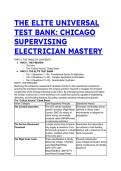
THE ELITE UNIVERSAL
TEST BANK: CHICAGO
SUPERVISING
ELECTRICIAN MASTERY
PART 0: THE TABLE OF CONTENTS
● PART I: THE PREVIEW
○ The Intro
○ The "Critical Axioms" Cheat Sheet
● PART II: THE ELITE TEST BANK
○ Tier 1 (Questions 1–10) - Foundational Syntax & Application
○ Tier 2 (Questions 11–20) - Complex Application & Simulation
○ Tier 3 (Questions 21–30) - Grandmaster Synthesis
PART I: THE PREVIEW
Mastering this exhaustive assessment translates directly to elite operational competence,
ensuring the practitioner possesses the surgical precision required to navigate the stringent
complexities of the Chicago Electrical Code (CEC). By internalizing these advanced principles,
the scholar evolves from a mere technician into a definitive authority capable of engineering,
defending, and executing flawless, life-safety-compliant electrical infrastructure globally.
The "Critical Axioms" Cheat Sheet:
Axiom Category Core Regulatory Principle Operational Impact
The Conduit Imperative The CEC strictly mandates Eliminates combustible wiring
metallic raceways (Rigid Metal methods in dense urban
Conduit, EMT) for nearly all environments to mitigate fire
indoor wiring; non-metallic propagation.
sheathed cable (NM-B/Romex)
is notoriously restricted.
The Service Disconnect A single service drop or lateral Guarantees first responders
Threshold may supply a maximum of six can achieve a total building
disconnects grouped in a single blackout with a maximum of six
location, installed within 5 feet hand movements.
of the entry point.
The Rigid Color Code Phase identification is strictly Prevents catastrophic
defined by voltage: 120/240V cross-voltage termination errors
uses Black/Red/White; during maintenance and facility
208Y/120V uses expansion.
Black/Red/Blue; 480Y/277V
uses Brown/Orange/Yellow.
,Axiom Category Core Regulatory Principle Operational Impact
Emergency System Article 700 emergency systems Ensures localized faults in
Sovereignty must remain physically isolated normal power circuits cannot
in dedicated raceways, with bridge over and compromise
90-minute backup power. life-safety illumination.
Permit Authority Only a licensed electrical Binds the legal liability and
contractor employing a safety of the installation to a
registered City of Chicago vetted, accountable
Supervising Electrician may professional entity.
secure a permit.
PART II: THE ELITE TEST BANK
Tier 1 - Foundational Syntax & Application
Q1: A licensed electrical contractor is installing a new 400A, 120/240V single-phase service
panel in a commercial basement. The spatial environment is constrained by existing HVAC
ductwork. Based on the principles of CEC Article 110, which conclusion regarding the working
space in front of the equipment is the MOST ACCURATE? A) A minimum of 30 inches of clear
working space depth must be maintained, provided the panel doors can open to 90 degrees. B)
A minimum of 36 inches of clear working space depth must be maintained directly in front of the
panel to ensure safe operational access. C) The working space depth may be reduced to 24
inches if the equipment is strictly rated for 240V and guarded by dead-front construction. D)
Working space clearances are highly recommended but not strictly enforced in retrofit
basements if access is restricted to qualified personnel.
● Answer: B (A minimum of 36 inches of clear working space depth must be maintained
directly in front of the panel to ensure safe operational access.)
● Distractor Analysis:
○ A is incorrect: While 30 inches is the standard minimum width of the working space
(or the width of the equipment, whichever is greater), it fails to satisfy the critical
depth requirement for front clearance.
○ C is incorrect: Reducing working space depth to 24 inches is an egregious violation
of CEC 110.26, which mandates a 36-inch minimum depth for systems operating at
600V or less.
○ D is incorrect: Clearances are strictly enforced legal mandates for life safety, not
mere recommendations, regardless of the building's age or restricted access
protocols.
The Mentor's Analysis: The foundational absolute of electrical safety rests on the accessibility
of energized components. When facing spatial constraints during equipment installation, the
immediate priority is preserving the uncompromised 36-inch physical envelope required for
incident response and maintenance. By utilizing rigid spatial planning, the practitioner bypasses
the common trap of compromising life safety for architectural convenience.
Professional/Academic Intuition: Working space depth for systems 600V or less must
never fall below 36 inches; physics and arc flash dynamics do not grant exemptions for
tight basements.
Q2: A supervising electrician is inspecting a newly installed 3-phase, 208Y/120V distribution
panel in a high-rise office building. Based on the principles of Chicago Electrical Code Section
210.5, which phase conductor color-coding scheme is the MOST ACCURATE for this specific
, voltage system? A) Black for A Phase, Red for B Phase, and Blue for C Phase. B) Brown for A
Phase, Orange for B Phase, and Yellow for C Phase. C) Black for A Phase, Red for B Phase,
and White for C Phase. D) Any consistently identifiable color scheme, provided it is documented
at the panelboard.
● Answer: A (Black for A Phase, Red for B Phase, and Blue for C Phase.)
● Distractor Analysis:
○ B is incorrect: Brown, Orange, and Yellow are exclusively mandated for 480Y/277V
systems within the CEC, not 208V systems.
○ C is incorrect: White is universally reserved for the grounded neutral conductor and
cannot be utilized as an ungrounded phase conductor.
○ D is incorrect: While the NEC allows for broader interpretation provided
documentation exists, the CEC specifically mandates rigid color assignments for
branch circuits based on voltage to prevent catastrophic cross-connection.
The Mentor's Analysis: Phase identification eliminates catastrophic cross-voltage termination
errors during maintenance. When facing a multi-voltage building environment, the immediate
priority is standardizing visual indicators of potential difference. By utilizing strict CEC color
mandates, the practitioner bypasses the common trap of relying on localized, non-standardized
documentation.
System Voltage Phase A Phase B Phase C Neutral
120/240V Black Red N/A White
(1-Phase)
208Y/120V Black Red Blue White
(3-Phase)
480Y/277V Brown Orange Yellow Gray/White
(3-Phase)
Professional/Academic Intuition: Never assume National Electrical Code (NEC) flexibility
applies; the CEC demands Black/Red/Blue for 208V and Brown/Orange/Yellow for 480V.
Q3: A residential developer proposes wiring a new 40-story Type I construction condominium
complex utilizing non-metallic sheathed cable (NM-B/Romex) concealed within the drywall
partitions to reduce material costs. Based on the principles of Chicago's structural wiring
amendments, which conclusion is the MOST ACCURATE? A) The installation is fully compliant,
provided the NM-B cable is protected by 1/16-inch steel plates where passing through bored
holes in studs. B) The installation is permissible only if the NM-B cable is strictly limited to
circuits originating and terminating within a single dwelling unit. C) The installation is strictly
prohibited; the CEC demands the use of approved metallic raceways such as Electrical Metallic
Tubing (EMT) or Rigid Metal Conduit (RMC) for this application. D) The installation is compliant,
provided the NM-B cable is inherently rated for Type I non-combustible construction
environments.
● Answer: C (The installation is strictly prohibited; the CEC demands the use of approved
metallic raceways such as Electrical Metallic Tubing (EMT) or Rigid Metal Conduit (RMC)
for this application.)
● Distractor Analysis:
○ A is incorrect: Steel plate protection is an NEC standard for wood-frame residential
wiring, but the CEC outright prohibits the core wiring method (NM-B) in this context
entirely.
○ B is incorrect: While the NEC Article 334.10 permits NM-B in certain structures if
confined to a unit, the Chicago amendments override this, driven by historical fire
TEST BANK: CHICAGO
SUPERVISING
ELECTRICIAN MASTERY
PART 0: THE TABLE OF CONTENTS
● PART I: THE PREVIEW
○ The Intro
○ The "Critical Axioms" Cheat Sheet
● PART II: THE ELITE TEST BANK
○ Tier 1 (Questions 1–10) - Foundational Syntax & Application
○ Tier 2 (Questions 11–20) - Complex Application & Simulation
○ Tier 3 (Questions 21–30) - Grandmaster Synthesis
PART I: THE PREVIEW
Mastering this exhaustive assessment translates directly to elite operational competence,
ensuring the practitioner possesses the surgical precision required to navigate the stringent
complexities of the Chicago Electrical Code (CEC). By internalizing these advanced principles,
the scholar evolves from a mere technician into a definitive authority capable of engineering,
defending, and executing flawless, life-safety-compliant electrical infrastructure globally.
The "Critical Axioms" Cheat Sheet:
Axiom Category Core Regulatory Principle Operational Impact
The Conduit Imperative The CEC strictly mandates Eliminates combustible wiring
metallic raceways (Rigid Metal methods in dense urban
Conduit, EMT) for nearly all environments to mitigate fire
indoor wiring; non-metallic propagation.
sheathed cable (NM-B/Romex)
is notoriously restricted.
The Service Disconnect A single service drop or lateral Guarantees first responders
Threshold may supply a maximum of six can achieve a total building
disconnects grouped in a single blackout with a maximum of six
location, installed within 5 feet hand movements.
of the entry point.
The Rigid Color Code Phase identification is strictly Prevents catastrophic
defined by voltage: 120/240V cross-voltage termination errors
uses Black/Red/White; during maintenance and facility
208Y/120V uses expansion.
Black/Red/Blue; 480Y/277V
uses Brown/Orange/Yellow.
,Axiom Category Core Regulatory Principle Operational Impact
Emergency System Article 700 emergency systems Ensures localized faults in
Sovereignty must remain physically isolated normal power circuits cannot
in dedicated raceways, with bridge over and compromise
90-minute backup power. life-safety illumination.
Permit Authority Only a licensed electrical Binds the legal liability and
contractor employing a safety of the installation to a
registered City of Chicago vetted, accountable
Supervising Electrician may professional entity.
secure a permit.
PART II: THE ELITE TEST BANK
Tier 1 - Foundational Syntax & Application
Q1: A licensed electrical contractor is installing a new 400A, 120/240V single-phase service
panel in a commercial basement. The spatial environment is constrained by existing HVAC
ductwork. Based on the principles of CEC Article 110, which conclusion regarding the working
space in front of the equipment is the MOST ACCURATE? A) A minimum of 30 inches of clear
working space depth must be maintained, provided the panel doors can open to 90 degrees. B)
A minimum of 36 inches of clear working space depth must be maintained directly in front of the
panel to ensure safe operational access. C) The working space depth may be reduced to 24
inches if the equipment is strictly rated for 240V and guarded by dead-front construction. D)
Working space clearances are highly recommended but not strictly enforced in retrofit
basements if access is restricted to qualified personnel.
● Answer: B (A minimum of 36 inches of clear working space depth must be maintained
directly in front of the panel to ensure safe operational access.)
● Distractor Analysis:
○ A is incorrect: While 30 inches is the standard minimum width of the working space
(or the width of the equipment, whichever is greater), it fails to satisfy the critical
depth requirement for front clearance.
○ C is incorrect: Reducing working space depth to 24 inches is an egregious violation
of CEC 110.26, which mandates a 36-inch minimum depth for systems operating at
600V or less.
○ D is incorrect: Clearances are strictly enforced legal mandates for life safety, not
mere recommendations, regardless of the building's age or restricted access
protocols.
The Mentor's Analysis: The foundational absolute of electrical safety rests on the accessibility
of energized components. When facing spatial constraints during equipment installation, the
immediate priority is preserving the uncompromised 36-inch physical envelope required for
incident response and maintenance. By utilizing rigid spatial planning, the practitioner bypasses
the common trap of compromising life safety for architectural convenience.
Professional/Academic Intuition: Working space depth for systems 600V or less must
never fall below 36 inches; physics and arc flash dynamics do not grant exemptions for
tight basements.
Q2: A supervising electrician is inspecting a newly installed 3-phase, 208Y/120V distribution
panel in a high-rise office building. Based on the principles of Chicago Electrical Code Section
210.5, which phase conductor color-coding scheme is the MOST ACCURATE for this specific
, voltage system? A) Black for A Phase, Red for B Phase, and Blue for C Phase. B) Brown for A
Phase, Orange for B Phase, and Yellow for C Phase. C) Black for A Phase, Red for B Phase,
and White for C Phase. D) Any consistently identifiable color scheme, provided it is documented
at the panelboard.
● Answer: A (Black for A Phase, Red for B Phase, and Blue for C Phase.)
● Distractor Analysis:
○ B is incorrect: Brown, Orange, and Yellow are exclusively mandated for 480Y/277V
systems within the CEC, not 208V systems.
○ C is incorrect: White is universally reserved for the grounded neutral conductor and
cannot be utilized as an ungrounded phase conductor.
○ D is incorrect: While the NEC allows for broader interpretation provided
documentation exists, the CEC specifically mandates rigid color assignments for
branch circuits based on voltage to prevent catastrophic cross-connection.
The Mentor's Analysis: Phase identification eliminates catastrophic cross-voltage termination
errors during maintenance. When facing a multi-voltage building environment, the immediate
priority is standardizing visual indicators of potential difference. By utilizing strict CEC color
mandates, the practitioner bypasses the common trap of relying on localized, non-standardized
documentation.
System Voltage Phase A Phase B Phase C Neutral
120/240V Black Red N/A White
(1-Phase)
208Y/120V Black Red Blue White
(3-Phase)
480Y/277V Brown Orange Yellow Gray/White
(3-Phase)
Professional/Academic Intuition: Never assume National Electrical Code (NEC) flexibility
applies; the CEC demands Black/Red/Blue for 208V and Brown/Orange/Yellow for 480V.
Q3: A residential developer proposes wiring a new 40-story Type I construction condominium
complex utilizing non-metallic sheathed cable (NM-B/Romex) concealed within the drywall
partitions to reduce material costs. Based on the principles of Chicago's structural wiring
amendments, which conclusion is the MOST ACCURATE? A) The installation is fully compliant,
provided the NM-B cable is protected by 1/16-inch steel plates where passing through bored
holes in studs. B) The installation is permissible only if the NM-B cable is strictly limited to
circuits originating and terminating within a single dwelling unit. C) The installation is strictly
prohibited; the CEC demands the use of approved metallic raceways such as Electrical Metallic
Tubing (EMT) or Rigid Metal Conduit (RMC) for this application. D) The installation is compliant,
provided the NM-B cable is inherently rated for Type I non-combustible construction
environments.
● Answer: C (The installation is strictly prohibited; the CEC demands the use of approved
metallic raceways such as Electrical Metallic Tubing (EMT) or Rigid Metal Conduit (RMC)
for this application.)
● Distractor Analysis:
○ A is incorrect: Steel plate protection is an NEC standard for wood-frame residential
wiring, but the CEC outright prohibits the core wiring method (NM-B) in this context
entirely.
○ B is incorrect: While the NEC Article 334.10 permits NM-B in certain structures if
confined to a unit, the Chicago amendments override this, driven by historical fire


