

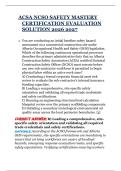
ACSA NCSO SAFETY MASTERY
CERTIFICATION EVALUATION
SOLUTION 2026 2027
1. You are conducting an initial baseline safety hazard
assessment on a commercial construction site under
Alberta Occupational Health and Safety (OHS) legislation.
Which of the following continuous operational processes
describes the primary administrative duty that an Alberta
Construction Safety Association (ACSA) certified National
Construction Safety Officer (NCSO) must execute before
any new sub-contractor workforce is permitted to begin
physical labor within an active work zone?
A) Conducting a formal corporate financial asset risk
review to evaluate the sub-contractor's internal insurance
bonding capacities.
B) Leading a comprehensive, site-specific safety
orientation and validating all required trade credentials
and safety certifications.
C) Running an engineering structural load calculation
blueprint review over the primary scaffolding components.
D) Initiating a secondary toxicological environmental air
quality assay across the local perimeter boundaries. [1]
Correct Answer: B) Leading a comprehensive, site-
specific safety orientation and validating all required
trade credentials and safety certifications.
Rationale: According to the ACSO framework and Alberta
OHS requirements, site-specific orientations are mandatory to
ensure that arriving workforces are aware of localized
hazards, emergency response evacuation routes, and specific
safety expectations. Verifying certifications ensuring workers
,are fully competent before starting high-risk tasks is an
essential administrative duty of an NCSO.
2. While conducting a standard morning walk-through
inspection of an industrial job site, an NCSO observes a
worker operating a portable abrasive grinding wheel
without a proper manufacturer's wheel guard installed.
Under the Alberta OHS Code, what is the immediate field
action required of the safety officer?
A) Wait until the end of the shift to document the missing
guard on the monthly corporate safety compliance ledger.
B) Order the worker to cease operations immediately, tag
the equipment out of service, and verify that a proper
guard is fitted before resuming use.
C) Request that the site superintendent file an official
variance request form directly with the provincial OHS
Director.
D) Instruct the worker to simply slow down the rotational
speed (RPM) of the tool to minimize projectile risks.
Correct Answer: B) Order the worker to cease
operations immediately, tag the equipment out of
service, and verify that a proper guard is fitted before
resuming use.
Rationale: Operating grinding machinery without a guard
exposes the worker to immediate hazards from wheel
explosions, flying sparks, and severe lacerations. Alberta OHS
Code Part 22 mandates that guards must be in place. An NCSO
must intervene immediately to eliminate imminent danger,
enforce a lock-out/tag-out on unsafe tools, and ensure
corrective actions are taken.
3. An employer is undertaking a project that requires
workers to enter a confined space, such as a large
underground utility vault, to perform specialized welding.
According to the Alberta OHS Code Part 5, which of the
following documents must be fully completed and
, explicitly reviewed with the entry team before any worker
crosses the threshold?
A) A standard municipal traffic disruption detour map
blueprint.
B) A comprehensive confined space hazard assessment,
written entry permit, and a formalized emergency rescue
plan.
C) A generic corporate safety policy manual outline from
the previous year.
D) A bill of materials detailing the mechanical specs of the
welding rods.
Correct Answer: B) A comprehensive confined
space hazard assessment, written entry permit, and a
formalized emergency rescue plan.
Rationale: Confined spaces pose fatal atmospheric and
physical entrapment hazards. Alberta OHS Code Part 5
strictly mandates a specific hazard assessment, a signed entry
permit documenting atmospheric testing, and a dedicated,
field-tested rescue plan with a designated tender
(watchperson) before anyone enters.
4. During a formal investigation into a corporate workplace
injury where a worker fell from a flat roof, the NCSO is
evaluating the systemic differences between direct,
indirect, and root causes. How does the ACSA curriculum
define a "root cause" within an accident investigation
framework?
A) The immediate physical event or unsafe act that directly
caused the injury, such as a worker slipping on ice.
B) The underlying systemic, organizational, or
management failures—such as a lack of training or
inadequate safety policies—that allowed the unsafe
condition to exist.
C) The financial and medical cost parameters associated
with post-accident worker compensation claims.
, D) The environmental weather conditions that were active
at the exact hour of the structural incident.
Correct Answer: B) The underlying systemic,
organizational, or management failures—such as a
lack of training or inadequate safety policies—that
allowed the unsafe condition to exist.
Rationale: While direct causes are the immediate actions or
conditions (e.g., missing guardrails), root causes are the
fundamental organizational breakdowns (e.g., poor inspection
protocols, lack of safety leadership) that created or permitted
those conditions. Identifying root causes is the core goal of an
NCSO investigation to prevent future recurrences.
5. A commercial job site is preparing to execute a critical
crane lift involving a heavy, asymmetrical industrial air
handling unit. As the designated field safety coordinator,
what specific documentation must the NCSO verify has
been formally drafted, calculated, and signed before the
rigging lines are tensioned?
A) A standard delivery invoice detailing the retail cost of
the air unit.
B) A specialized engineered critical lift plan that calculates
weight, center of gravity, crane capacity, and rigging safety
factors.
C) A general occupational health brochure concerning
proper posture during manual lifting.
D) An application for a municipal noise variance permit.
Correct Answer: B) A specialized engineered critical
lift plan that calculates weight, center of gravity, crane
capacity, and rigging safety factors.
Rationale: Critical lifts (typically defined as lifts exceeding
75% of crane capacity, or involving multiple cranes, or
complex loads) require a formal critical lift plan under
industry standards and OHS guidelines. This ensures that load
CERTIFICATION EVALUATION
SOLUTION 2026 2027
1. You are conducting an initial baseline safety hazard
assessment on a commercial construction site under
Alberta Occupational Health and Safety (OHS) legislation.
Which of the following continuous operational processes
describes the primary administrative duty that an Alberta
Construction Safety Association (ACSA) certified National
Construction Safety Officer (NCSO) must execute before
any new sub-contractor workforce is permitted to begin
physical labor within an active work zone?
A) Conducting a formal corporate financial asset risk
review to evaluate the sub-contractor's internal insurance
bonding capacities.
B) Leading a comprehensive, site-specific safety
orientation and validating all required trade credentials
and safety certifications.
C) Running an engineering structural load calculation
blueprint review over the primary scaffolding components.
D) Initiating a secondary toxicological environmental air
quality assay across the local perimeter boundaries. [1]
Correct Answer: B) Leading a comprehensive, site-
specific safety orientation and validating all required
trade credentials and safety certifications.
Rationale: According to the ACSO framework and Alberta
OHS requirements, site-specific orientations are mandatory to
ensure that arriving workforces are aware of localized
hazards, emergency response evacuation routes, and specific
safety expectations. Verifying certifications ensuring workers
,are fully competent before starting high-risk tasks is an
essential administrative duty of an NCSO.
2. While conducting a standard morning walk-through
inspection of an industrial job site, an NCSO observes a
worker operating a portable abrasive grinding wheel
without a proper manufacturer's wheel guard installed.
Under the Alberta OHS Code, what is the immediate field
action required of the safety officer?
A) Wait until the end of the shift to document the missing
guard on the monthly corporate safety compliance ledger.
B) Order the worker to cease operations immediately, tag
the equipment out of service, and verify that a proper
guard is fitted before resuming use.
C) Request that the site superintendent file an official
variance request form directly with the provincial OHS
Director.
D) Instruct the worker to simply slow down the rotational
speed (RPM) of the tool to minimize projectile risks.
Correct Answer: B) Order the worker to cease
operations immediately, tag the equipment out of
service, and verify that a proper guard is fitted before
resuming use.
Rationale: Operating grinding machinery without a guard
exposes the worker to immediate hazards from wheel
explosions, flying sparks, and severe lacerations. Alberta OHS
Code Part 22 mandates that guards must be in place. An NCSO
must intervene immediately to eliminate imminent danger,
enforce a lock-out/tag-out on unsafe tools, and ensure
corrective actions are taken.
3. An employer is undertaking a project that requires
workers to enter a confined space, such as a large
underground utility vault, to perform specialized welding.
According to the Alberta OHS Code Part 5, which of the
following documents must be fully completed and
, explicitly reviewed with the entry team before any worker
crosses the threshold?
A) A standard municipal traffic disruption detour map
blueprint.
B) A comprehensive confined space hazard assessment,
written entry permit, and a formalized emergency rescue
plan.
C) A generic corporate safety policy manual outline from
the previous year.
D) A bill of materials detailing the mechanical specs of the
welding rods.
Correct Answer: B) A comprehensive confined
space hazard assessment, written entry permit, and a
formalized emergency rescue plan.
Rationale: Confined spaces pose fatal atmospheric and
physical entrapment hazards. Alberta OHS Code Part 5
strictly mandates a specific hazard assessment, a signed entry
permit documenting atmospheric testing, and a dedicated,
field-tested rescue plan with a designated tender
(watchperson) before anyone enters.
4. During a formal investigation into a corporate workplace
injury where a worker fell from a flat roof, the NCSO is
evaluating the systemic differences between direct,
indirect, and root causes. How does the ACSA curriculum
define a "root cause" within an accident investigation
framework?
A) The immediate physical event or unsafe act that directly
caused the injury, such as a worker slipping on ice.
B) The underlying systemic, organizational, or
management failures—such as a lack of training or
inadequate safety policies—that allowed the unsafe
condition to exist.
C) The financial and medical cost parameters associated
with post-accident worker compensation claims.
, D) The environmental weather conditions that were active
at the exact hour of the structural incident.
Correct Answer: B) The underlying systemic,
organizational, or management failures—such as a
lack of training or inadequate safety policies—that
allowed the unsafe condition to exist.
Rationale: While direct causes are the immediate actions or
conditions (e.g., missing guardrails), root causes are the
fundamental organizational breakdowns (e.g., poor inspection
protocols, lack of safety leadership) that created or permitted
those conditions. Identifying root causes is the core goal of an
NCSO investigation to prevent future recurrences.
5. A commercial job site is preparing to execute a critical
crane lift involving a heavy, asymmetrical industrial air
handling unit. As the designated field safety coordinator,
what specific documentation must the NCSO verify has
been formally drafted, calculated, and signed before the
rigging lines are tensioned?
A) A standard delivery invoice detailing the retail cost of
the air unit.
B) A specialized engineered critical lift plan that calculates
weight, center of gravity, crane capacity, and rigging safety
factors.
C) A general occupational health brochure concerning
proper posture during manual lifting.
D) An application for a municipal noise variance permit.
Correct Answer: B) A specialized engineered critical
lift plan that calculates weight, center of gravity, crane
capacity, and rigging safety factors.
Rationale: Critical lifts (typically defined as lifts exceeding
75% of crane capacity, or involving multiple cranes, or
complex loads) require a formal critical lift plan under
industry standards and OHS guidelines. This ensures that load


