

BIOMOLECULES COMPLETE - 15 Pages Premium
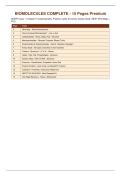
NCERT Class 11 Chapter 9 | Carbohydrates, Proteins, Lipids, Enzymes, Nucleic Acids | NEET Mind Maps +
PYQ
Page Topic
2 Mind Map - Whole Biomolecules
3 How to Analyse Biomolecules? - Live vs Ash
4 Carbohydrates - Mono, Oligo, Poly - Structure
5 Monosaccharides - Glucose, Fructose, Ribose Tricks
6 Disaccharides & Polysaccharides - Starch, Cellulose, Glycogen
7 Amino Acids - 20 Types, Essential vs Non-essential
8 Proteins - Structure 1°,2°,3°,4° - Bonds
9 Lipids - Fats, Oils, Phospholipids - Structure
10 Nucleic Acids - DNA vs RNA - Structure
11 Enzymes - Classification, Properties, Active Site
12 Enzyme Kinetics - Lock & Key vs Induced Fit, Factors
13 Cofactors - Prosthetic, Coenzyme, Metal Ions
14 NEET PYQ 2019-2024 - Most Repeated Q
15 One Page Revision + Tricks + Mnemonics
, Page 2 - Mind Map Biomolecules
Biomolecules = Chemicals of living organisms - 2 types: Micro (small, soluble) - monosaccharides, amino
acids, nucleotides, fatty acids and Macro (large, insoluble) - proteins, polysaccharides, nucleic acids, lipids
Analysis: Grind tissue with CCl3COOH trichloroacetic acid - filtrate = soluble small biomolecules
(micromolecules), retentate = insoluble large (macromolecules)
Live analysis: C H O N present in living, Ash analysis: Inorganic elements - Na K Ca Mg etc remain after
burning
Water = Most abundant 70-90% of cell weight, proteins next 10-15%, lipids 2%, nucleic acids 5-7%, carbs
3%
NCERT Class 11 Chapter 9 | Carbohydrates, Proteins, Lipids, Enzymes, Nucleic Acids | NEET Mind Maps +
PYQ
Page Topic
2 Mind Map - Whole Biomolecules
3 How to Analyse Biomolecules? - Live vs Ash
4 Carbohydrates - Mono, Oligo, Poly - Structure
5 Monosaccharides - Glucose, Fructose, Ribose Tricks
6 Disaccharides & Polysaccharides - Starch, Cellulose, Glycogen
7 Amino Acids - 20 Types, Essential vs Non-essential
8 Proteins - Structure 1°,2°,3°,4° - Bonds
9 Lipids - Fats, Oils, Phospholipids - Structure
10 Nucleic Acids - DNA vs RNA - Structure
11 Enzymes - Classification, Properties, Active Site
12 Enzyme Kinetics - Lock & Key vs Induced Fit, Factors
13 Cofactors - Prosthetic, Coenzyme, Metal Ions
14 NEET PYQ 2019-2024 - Most Repeated Q
15 One Page Revision + Tricks + Mnemonics
, Page 2 - Mind Map Biomolecules
Biomolecules = Chemicals of living organisms - 2 types: Micro (small, soluble) - monosaccharides, amino
acids, nucleotides, fatty acids and Macro (large, insoluble) - proteins, polysaccharides, nucleic acids, lipids
Analysis: Grind tissue with CCl3COOH trichloroacetic acid - filtrate = soluble small biomolecules
(micromolecules), retentate = insoluble large (macromolecules)
Live analysis: C H O N present in living, Ash analysis: Inorganic elements - Na K Ca Mg etc remain after
burning
Water = Most abundant 70-90% of cell weight, proteins next 10-15%, lipids 2%, nucleic acids 5-7%, carbs
3%


