BUSI 1103 Fundamentals of Financial and Management Accounting
Semester 1 - CONCEPTS
1. Primary objective of accounting:
- Provide information that is useful for decision making purposes
- A Means to an End – a tool that can help us to achieve our end
2. It is also known as a language of business
3. Accounting system consists of
- Personnel, procedures, technology, and records
4. Basic functions of accounting system includes:
- Capture, record, interpret the business transactions
- Classify similar transactions into various totals and subtotals so these numbers become
meaningful to users
- Communicate the information to decision makers
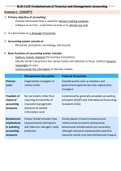
Management Accounting Financial Accounting
Primary Organisation managers at Outside parties such as investors and
users various levels government agencies but also organisation
managers
Freedom of No constraints other than Constrained by generally accepted accounting
choice of requiring the benefits of principles (GAAP) and International Accounting
accounting improved management Standards (IASs)
measures decisions to exceed
information costs
Behavioural Choice should consider how Choice based on how to measure and
implications measurements and reports communicate economic phenomena;
in selecting will influence managers’ daily behavioural considerations are secondary,
accounting behaviour although executive compensation based on
measures reported results may have behavioural impacts
, Time focus Future oriented: formal use Past oriented: historical evaluation
of reports of budgets as well as e.g. 2012 actual performance versus 2011
historical records actual performance
e.g. 2012 budget versus 2012
actual performance
Time span of Flexible, varying from hourly Less flexible: usually one year or one quarter
reports to 10-15 years
Types of Detailed reports: includes Summary reports: primarily report on the
reports details about products, entity as a whole
departments, territories, etc
Influence of Field is less sharply defined; Field is more sharply defined. Lighter use of
other heavier use of economics, related disciplines
functional decision sciences, and
areas behavioural sciences
5. Internal control to strengthen accounting information system:
- Control environment – company committed to integrity and ethical behaviours
- Risk assessment – constantly identify, analyse, and managing risk that might threaten the
accounting system (E.g. username & password made available to all)
- Control activities – policies and procedures in place to target the risks (E.g. manager’s
signature to approve your claims)
- Information and communication – let employees know their roles in improving internal
control; tell them what they can do to help
- Monitoring activities – constant review to evaluate whether the internal control system is
effective (E.g. does the number of fraud reduce?)
6. Integrity of Accounting Information
- Integrity: Complete, unimpaired, honest, sincere
- used by external users to make decisions – investment, loan, supply decisions from
others. If info is inaccurate, company might not have sufficient funds to operate, cannot
get hold of goods to sell
- Internal users use this info to manage and run the company – expansion, new product,
research and development. If info is not accurate, the company will make decisions which
have very serious negative impact on the company and its financial situation.
, 7. Several ways to ensure and improve the integrity of the info:
a. Accounting standards to assist the preparation of accounting information; internal control
structure to strengthen the preparation process; audits of financial statements to ensure
info is complete and free from bias
b. Professional accounting organisations
i. International Accounting Standard Board
ii. Institute of Chartered Accountants in England and Wales (ICAEW)
iii. Association of Chartered Certified Accountants (ACCA)
iv. Institute of Management Accountants (IMA)
c. Personal competence, judgement and ethical behaviour of the accountants
8. Financial Statement :
- Monetary declaration of what is believed to be true about a firm
- Describing in financial terms certain attributes of the firm that accountants believe fairly
represent its financial activities
- To provide information about the entity that is useful to users in making economic
decisions
9. Conceptual Framework
- Produced by the IASB.
- Sets out underlying concepts for financial statements
- According to International Financial Reporting Standards (IFRS)
- Comparability: able to compare with other company within the same industry
- Verifiability: can be concluded with the same answers by different persons
- Understandability: even uneducated can understand
- Timeliness: so info will be useful
- To be useful, financial information ‘must be relevant and faithfully represent what it
purports to represent’
- Relevance:
o Makes a ‘difference in the decisions’ of users.
o Predictive value
o Confirmatory value
- Faithful representation:
o Key concept
o Essentially the same as ‘true and fair’
o Three elements: completeness, neutrality and freedom from error.
Semester 1 - CONCEPTS
1. Primary objective of accounting:
- Provide information that is useful for decision making purposes
- A Means to an End – a tool that can help us to achieve our end
2. It is also known as a language of business
3. Accounting system consists of
- Personnel, procedures, technology, and records
4. Basic functions of accounting system includes:
- Capture, record, interpret the business transactions
- Classify similar transactions into various totals and subtotals so these numbers become
meaningful to users
- Communicate the information to decision makers
Management Accounting Financial Accounting
Primary Organisation managers at Outside parties such as investors and
users various levels government agencies but also organisation
managers
Freedom of No constraints other than Constrained by generally accepted accounting
choice of requiring the benefits of principles (GAAP) and International Accounting
accounting improved management Standards (IASs)
measures decisions to exceed
information costs
Behavioural Choice should consider how Choice based on how to measure and
implications measurements and reports communicate economic phenomena;
in selecting will influence managers’ daily behavioural considerations are secondary,
accounting behaviour although executive compensation based on
measures reported results may have behavioural impacts
, Time focus Future oriented: formal use Past oriented: historical evaluation
of reports of budgets as well as e.g. 2012 actual performance versus 2011
historical records actual performance
e.g. 2012 budget versus 2012
actual performance
Time span of Flexible, varying from hourly Less flexible: usually one year or one quarter
reports to 10-15 years
Types of Detailed reports: includes Summary reports: primarily report on the
reports details about products, entity as a whole
departments, territories, etc
Influence of Field is less sharply defined; Field is more sharply defined. Lighter use of
other heavier use of economics, related disciplines
functional decision sciences, and
areas behavioural sciences
5. Internal control to strengthen accounting information system:
- Control environment – company committed to integrity and ethical behaviours
- Risk assessment – constantly identify, analyse, and managing risk that might threaten the
accounting system (E.g. username & password made available to all)
- Control activities – policies and procedures in place to target the risks (E.g. manager’s
signature to approve your claims)
- Information and communication – let employees know their roles in improving internal
control; tell them what they can do to help
- Monitoring activities – constant review to evaluate whether the internal control system is
effective (E.g. does the number of fraud reduce?)
6. Integrity of Accounting Information
- Integrity: Complete, unimpaired, honest, sincere
- used by external users to make decisions – investment, loan, supply decisions from
others. If info is inaccurate, company might not have sufficient funds to operate, cannot
get hold of goods to sell
- Internal users use this info to manage and run the company – expansion, new product,
research and development. If info is not accurate, the company will make decisions which
have very serious negative impact on the company and its financial situation.
, 7. Several ways to ensure and improve the integrity of the info:
a. Accounting standards to assist the preparation of accounting information; internal control
structure to strengthen the preparation process; audits of financial statements to ensure
info is complete and free from bias
b. Professional accounting organisations
i. International Accounting Standard Board
ii. Institute of Chartered Accountants in England and Wales (ICAEW)
iii. Association of Chartered Certified Accountants (ACCA)
iv. Institute of Management Accountants (IMA)
c. Personal competence, judgement and ethical behaviour of the accountants
8. Financial Statement :
- Monetary declaration of what is believed to be true about a firm
- Describing in financial terms certain attributes of the firm that accountants believe fairly
represent its financial activities
- To provide information about the entity that is useful to users in making economic
decisions
9. Conceptual Framework
- Produced by the IASB.
- Sets out underlying concepts for financial statements
- According to International Financial Reporting Standards (IFRS)
- Comparability: able to compare with other company within the same industry
- Verifiability: can be concluded with the same answers by different persons
- Understandability: even uneducated can understand
- Timeliness: so info will be useful
- To be useful, financial information ‘must be relevant and faithfully represent what it
purports to represent’
- Relevance:
o Makes a ‘difference in the decisions’ of users.
o Predictive value
o Confirmatory value
- Faithful representation:
o Key concept
o Essentially the same as ‘true and fair’
o Three elements: completeness, neutrality and freedom from error.