

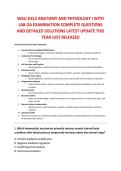
WGU D312 ANATOMY AND PHYSIOLOGY I WITH
LAB OA EXAMINATION COMPLETE QUESTIONS
AND DETAILED SOLUTIONS LATEST UPDATE THIS
YEAR JUST RELEASED
Tested Content Areas (Short Summary)
1. Homeostasis and Feedback Mechanisms
o Understand negative and positive feedback, homeostatic regulation, and body equilibrium.
2. Anatomical Terminology
o Learn anatomical positions, directional terms, body planes, body cavities, and regional
terminology.
3. Cell Structure and Function
o Study organelles, membrane transport, cell cycle, protein synthesis, and cellular metabolism.
4. Chemistry of Life
o Review atoms, molecules, chemical bonds, pH, buffers, enzymes, and biological macromolecules.
5. Histology (Tissue Types)
o Identify epithelial, connective, muscle, and nervous tissues with their functions and locations.
6. Integumentary System
o Understand skin layers, accessory structures, wound healing, thermoregulation, and vitamin D
synthesis.
7. Skeletal System
o Learn bone anatomy, bone remodeling, ossification, joints, fractures, and skeletal organization.
8. Muscular System
o Study muscle physiology, contraction mechanisms, energy production, muscle tissue types, and
major muscles.
9. Nervous System Fundamentals
o Review neurons, action potentials, synapses, neuroglia, spinal cord organization, and brain
anatomy.
10. Laboratory Skills
Practice microscope use, anatomical models, tissue identification, skeletal landmarks, and interpretation
of laboratory observations.
1. Which homeostatic mechanism primarily restores normal internal body
conditions after blood pressure temporarily increases above the normal range?
A. Positive feedback amplification
B. Negative feedback regulation
C. Feedforward stimulation
D. Hormonal escalation
,Answer: B
Rationale: Negative feedback reverses deviations from a normal physiological set
point, making it the body's primary mechanism for maintaining stable internal
conditions.
2. During anatomical study, why is the standard anatomical position important
when describing body structures and their relationships?
A. It changes depending on patient posture
B. It standardizes anatomical descriptions universally
C. It only applies during surgical procedures
D. It identifies disease severity
Answer: B
Rationale: Using the anatomical position ensures healthcare professionals
communicate locations consistently regardless of body orientation.
3. Which body cavity contains the lungs while protecting them from many forms
of external mechanical injury?
A. Pelvic cavity
B. Abdominal cavity
C. Thoracic cavity
D. Cranial cavity
Answer: C
Rationale: The thoracic cavity houses the lungs and heart, with ribs providing
significant protection against external trauma.
,4. Which cellular organelle is primarily responsible for producing ATP through
aerobic cellular respiration in eukaryotic cells?
A. Ribosome
B. Lysosome
C. Mitochondrion
D. Golgi apparatus
Answer: C
Rationale: Mitochondria generate most cellular ATP through oxidative
phosphorylation during aerobic respiration.
5. Which plasma membrane transport process requires cellular energy because
substances move against their concentration gradient?
A. Osmosis
B. Facilitated diffusion
C. Active transport
D. Simple diffusion
Answer: C
Rationale: Active transport uses ATP to move molecules from lower
concentrations to higher concentrations.
6. Why are enzymes considered essential biological catalysts for nearly every
metabolic reaction occurring inside living human cells?
A. They permanently change reaction products
B. They lower activation energy requirements
C. They provide ATP directly
D. They increase body temperature
Answer: B
, Rationale: Enzymes accelerate reactions by lowering activation energy without
being permanently consumed.
7. Which type of chemical bond forms when atoms share pairs of electrons
instead of transferring them completely?
A. Ionic bond
B. Hydrogen bond
C. Covalent bond
D. Metallic bond
Answer: C
Rationale: Covalent bonds involve shared electrons, producing stable molecules
essential for life.
8. What is the primary function of buffer systems in maintaining normal blood
pH within narrow physiological limits?
A. Increase acidity continuously
B. Remove oxygen from blood
C. Resist sudden pH changes
D. Produce digestive enzymes
Answer: C
Rationale: Buffers minimize fluctuations in hydrogen ion concentration,
maintaining stable pH.
9. Which epithelial tissue type is best adapted for rapid diffusion of gases within
the pulmonary alveoli?
LAB OA EXAMINATION COMPLETE QUESTIONS
AND DETAILED SOLUTIONS LATEST UPDATE THIS
YEAR JUST RELEASED
Tested Content Areas (Short Summary)
1. Homeostasis and Feedback Mechanisms
o Understand negative and positive feedback, homeostatic regulation, and body equilibrium.
2. Anatomical Terminology
o Learn anatomical positions, directional terms, body planes, body cavities, and regional
terminology.
3. Cell Structure and Function
o Study organelles, membrane transport, cell cycle, protein synthesis, and cellular metabolism.
4. Chemistry of Life
o Review atoms, molecules, chemical bonds, pH, buffers, enzymes, and biological macromolecules.
5. Histology (Tissue Types)
o Identify epithelial, connective, muscle, and nervous tissues with their functions and locations.
6. Integumentary System
o Understand skin layers, accessory structures, wound healing, thermoregulation, and vitamin D
synthesis.
7. Skeletal System
o Learn bone anatomy, bone remodeling, ossification, joints, fractures, and skeletal organization.
8. Muscular System
o Study muscle physiology, contraction mechanisms, energy production, muscle tissue types, and
major muscles.
9. Nervous System Fundamentals
o Review neurons, action potentials, synapses, neuroglia, spinal cord organization, and brain
anatomy.
10. Laboratory Skills
Practice microscope use, anatomical models, tissue identification, skeletal landmarks, and interpretation
of laboratory observations.
1. Which homeostatic mechanism primarily restores normal internal body
conditions after blood pressure temporarily increases above the normal range?
A. Positive feedback amplification
B. Negative feedback regulation
C. Feedforward stimulation
D. Hormonal escalation
,Answer: B
Rationale: Negative feedback reverses deviations from a normal physiological set
point, making it the body's primary mechanism for maintaining stable internal
conditions.
2. During anatomical study, why is the standard anatomical position important
when describing body structures and their relationships?
A. It changes depending on patient posture
B. It standardizes anatomical descriptions universally
C. It only applies during surgical procedures
D. It identifies disease severity
Answer: B
Rationale: Using the anatomical position ensures healthcare professionals
communicate locations consistently regardless of body orientation.
3. Which body cavity contains the lungs while protecting them from many forms
of external mechanical injury?
A. Pelvic cavity
B. Abdominal cavity
C. Thoracic cavity
D. Cranial cavity
Answer: C
Rationale: The thoracic cavity houses the lungs and heart, with ribs providing
significant protection against external trauma.
,4. Which cellular organelle is primarily responsible for producing ATP through
aerobic cellular respiration in eukaryotic cells?
A. Ribosome
B. Lysosome
C. Mitochondrion
D. Golgi apparatus
Answer: C
Rationale: Mitochondria generate most cellular ATP through oxidative
phosphorylation during aerobic respiration.
5. Which plasma membrane transport process requires cellular energy because
substances move against their concentration gradient?
A. Osmosis
B. Facilitated diffusion
C. Active transport
D. Simple diffusion
Answer: C
Rationale: Active transport uses ATP to move molecules from lower
concentrations to higher concentrations.
6. Why are enzymes considered essential biological catalysts for nearly every
metabolic reaction occurring inside living human cells?
A. They permanently change reaction products
B. They lower activation energy requirements
C. They provide ATP directly
D. They increase body temperature
Answer: B
, Rationale: Enzymes accelerate reactions by lowering activation energy without
being permanently consumed.
7. Which type of chemical bond forms when atoms share pairs of electrons
instead of transferring them completely?
A. Ionic bond
B. Hydrogen bond
C. Covalent bond
D. Metallic bond
Answer: C
Rationale: Covalent bonds involve shared electrons, producing stable molecules
essential for life.
8. What is the primary function of buffer systems in maintaining normal blood
pH within narrow physiological limits?
A. Increase acidity continuously
B. Remove oxygen from blood
C. Resist sudden pH changes
D. Produce digestive enzymes
Answer: C
Rationale: Buffers minimize fluctuations in hydrogen ion concentration,
maintaining stable pH.
9. Which epithelial tissue type is best adapted for rapid diffusion of gases within
the pulmonary alveoli?


